
When a Frigidaire displays Error Code E1, we treat it as a temperature control failure until proven otherwise. That doesn’t automatically mean your refrigerator is done, but it does mean the unit is no longer regulating temperature with the confidence it was engineered to maintain. And when temperature control becomes unreliable, everything downstream suffers: food safety, energy efficiency, compressor workload, and long-term performance.
In Atlanta homes, we see E1 most often on Frigidaire Gallery series and Professional series units, including model families like FGHS2631PF, FFHS2622MS, FRFS2823AS, and FGHB2868TF. These platforms use different control boards and sensor logic depending on configuration, which is why E1 can show up in one home as a simple recoverable condition, and in another home as the early warning sign of a sensor or control problem that won’t resolve without service.
We created this guide to help you respond in the same order our factory-trained technicians do:
- clear and monitor the alert correctly so you don’t chase a false code
- confirm whether the issue is environmental (door sealing, settings, load, recent door-open events) or an active fault
- understand where we focus next: temperature sensor (thermistor) readings, sensor wiring, airflow and evaporator fan performance, and the control board that interprets the data
- know exactly when to stop troubleshooting and schedule repair, before instability turns into food loss or compressor strain
Why E1 Requires Model-Specific Diagnosis
Frigidaire publishes official guidance for refrigerator error codes and alarms, including how alerts behave, what triggers high-temperature warnings, and how to acknowledge them through the control panel.
What Frigidaire does not provide on that general support page is a universal “E1 always means one exact part failed” definition for every refrigeration platform.
That matters, because Frigidaire uses different control boards, sensor logic, and display systems across series and model families.
Here in Atlanta, we see E1-related service calls most often on Frigidaire Gallery series and Professional series units, including model families such as FGHS2631PF, FFHS2622MS, FRFS2823AS, and FGHB2868TF. These are typically refrigerators with freezer compartments, and the alert may originate from either section depending on configuration and how the control board monitors temperature.
So when we get an E1 call, we confirm three things immediately:
- the exact model number and control style
- whether the display also shows any other indicators or alarm behavior alongside E1
- which compartment is struggling (refrigerator vs freezer), because the diagnostic path is different
This approach prevents wasted time and parts swapping that doesn’t solve the root cause.
Step 1: Clear the Alert the Frigidaire-Approved Way
Before we treat E1 as a repair event, we follow the manufacturer’s logic: acknowledge the alert and see whether it returns under normal operation.
Do this first:
- Press CLEAR ALERTS (if your model has it).
- Confirm doors are closed and properly sealed.
- Allow the unit time to stabilize, then watch for recurrence.
If E1 clears and stays cleared, you may have experienced a temporary temperature event. If E1 returns quickly, we treat it as an active fault and move into diagnosis.
Step 2: Correct the Most Common Real-World Causes of Temperature Alarms
A temperature alarm can be triggered when the refrigerator or freezer has been too warm for an extended period. Common causes include a door left open, settings changes, or a poor seal around the doors.
Even when your display shows E1 rather than HI, the most productive early checks are the same: sealing, settings, and temperature recovery.
Quick homeowner checks with no tools
1) Check door sealing and closing
A poor seal lets warm air enter continuously, preventing recovery. We recommend double-checking the gasket around doors for a good seal when high temperature conditions appear.
If your door is not sealing, fix that first. A door issue can mimic sensor failure.
2) Verify temperature settings
Frigidaire’s recommended settings for a product installed in a kitchen are:
- 37°F for the refrigerator
- 0°F for the freezer
If settings were adjusted recently, return them to recommended levels and allow the unit time to stabilize.
3) Consider recent door-open or loading events
If you correct these factors and the unit stabilizes normally, E1 may not return.
Step 3: When E1 Returns — What Our Technicians Check Next
If E1 returns after clearing alerts and sealing/settings are confirmed, the issue is no longer environmental. At that point, we treat it as a temperature control failure that requires component-level diagnosis.
The diagnostic path is consistent across temperature control faults. We focus on the systems responsible for measuring, moving, and interpreting temperature:
1) Temperature sensor / thermistor performance
The temperature sensor (thermistor) is the appliance’s feedback system. If it reads inaccurately or intermittently, the control board can’t regulate cooling correctly. That can trigger recurring alerts and temperature instability.
2) Sensor wiring integrity
Sensor wiring faults are far more common than homeowners expect. A harness can be pinched, loosened, corroded, or partially broken—especially if the unit has been moved, serviced, or leveled recently. Intermittent wiring faults often cause codes that clear temporarily and come back.
3) Airflow and the evaporator fan
Proper cooling depends on cold air circulation. If the evaporator fan isn’t performing correctly, temperatures drift. A failing fan can create warm zones even when the sealed system is healthy.
4) Control board logic
Finally, we evaluate the control board itself. Control boards do fail, but in high-end service we treat them as the last step—not the first. We confirm sensors, wiring, and airflow before we ever recommend board replacement.
Why we use a multimeter test
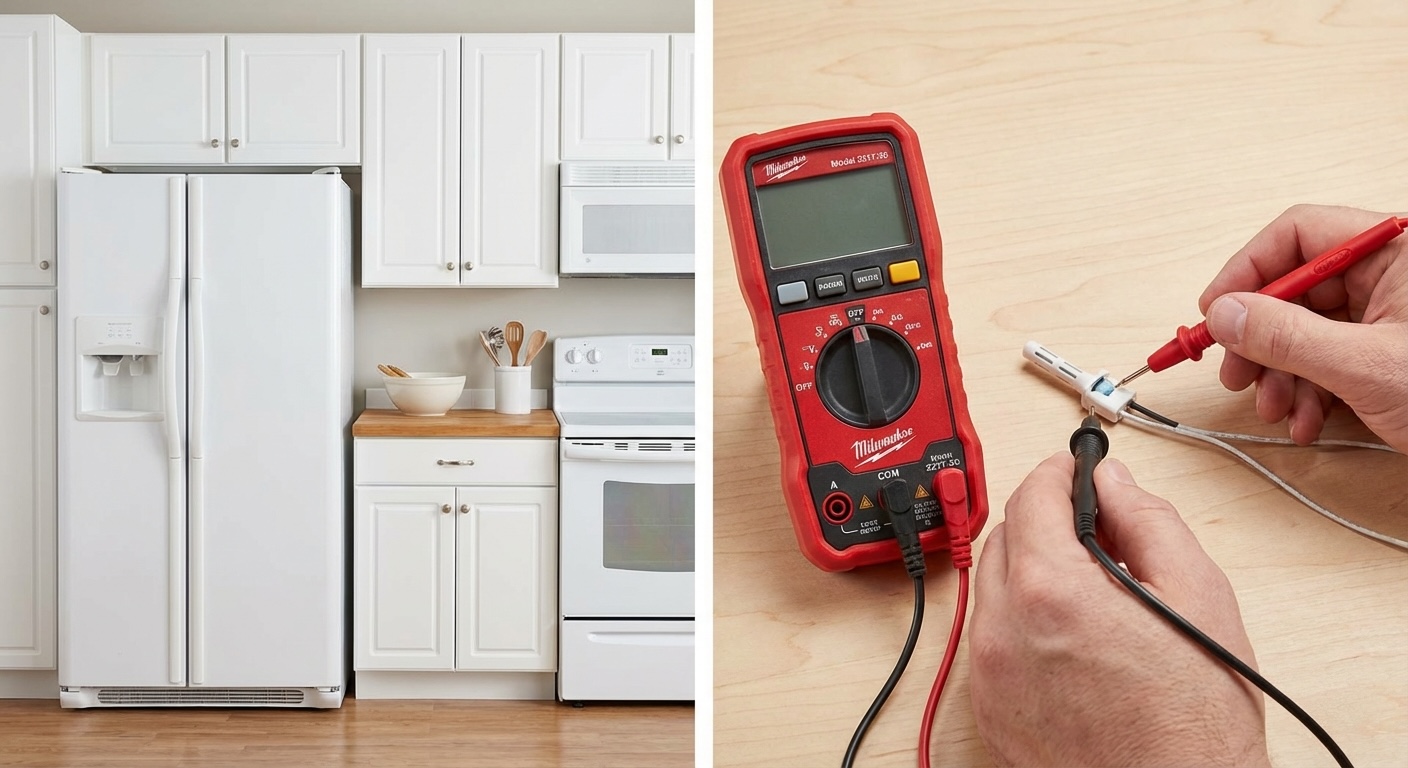
Professional diagnosis depends on measurement. A multimeter test helps us confirm whether a sensor circuit is reading properly and whether wiring continuity is intact. This is where factory-trained work separates clean repairs from trial-and-error replacements.
E1, E2, ER Variants: Why Customers Often See Multiple Codes Mentioned Together
Homeowners frequently face E1 E2 ER error codes because not all Frigidaire platforms display alerts the same way. Some show numeric codes, others show letter codes, and many show alarm states like HI/H or PF. Frigidaire’s official documentation explains several alarm behaviors and acknowledges that power events and temperature excursions can trigger alerts that must be cleared at the control panel.
Our steps are simple: we confirm the model platform, verify temperature behavior, and diagnose the systems that control stability.
Models and Series We Service for E1 Calls
In the Atlanta metro area, we regularly service Frigidaire temperature control and alert issues on:
- FGHS2631PF
- FFHS2622MS
- FRFS2823AS
- FGHB2868TF
- Frigidaire Gallery series
- Frigidaire Professional series
These models are common in high-end kitchens and often feature advanced temperature monitoring. When E1 appears, it deserves prompt, correct diagnosis to protect food and prevent unnecessary wear.
When to Call for Repair
We recommend scheduling service if any of the following are true:
- E1 returns after you clear alerts
- refrigerator or freezer temperatures remain unstable
- the unit runs constantly or struggles to recover after normal door use
- you notice repeat high-temperature conditions
- you’ve confirmed sealing and settings, but the alert continues
Frigidaire’s official guidance emphasizes acknowledging alerts, verifying door sealing, checking temperature settings, and addressing persistent high-temperature conditions. When alerts persist after those steps, professional service is appropriate.
Same-Day Frigidaire Error Code E1 Repair in Atlanta & Georgia
At Appliance Repair Master, we treat E1 the way premium appliances require: fast, clean diagnosis with the correct test sequence.
When we respond to an E1 call, our technicians:
- confirm your exact model platform and display behavior
- clear alerts according to Frigidaire’s recommended process
- verify real temperatures in both compartments (against recommended set points)
- evaluate temperature sensor/thermistor behavior and sensor wiring
- inspect airflow and evaporator fan performance
- test control board logic only after confirming sensors and airflow
The Bottom Line
Frigidaire Error Code E1 is a temperature failure indicator. Your refrigerator or freezer is signaling that temperature regulation or temperature feedback isn’t behaving normally. Frigidaire’s right first response steps are to acknowledge and clear the alert, confirm proper door sealing, verify recommended temperature settings, and monitor whether the condition returns.
If E1 returns, the correct repair is not repeated. It’s a professional diagnosis of the temperature control system—starting with temperature sensor/thermistor, sensor wiring, airflow and the evaporator fan, and finally the control board when needed.
FAQ
1. How do I clear a Frigidaire error alert?
Use CLEAR ALERTS if your model includes it. Frigidaire’s official guidance describes acknowledging and clearing alerts through the control panel.
2. What causes high temperature alarms on Frigidaire refrigerators?
Frigidaire notes that high temperature conditions can be caused by doors left open, sealing issues, or settings changes, and recommends checking the gasket and door seal.
3. What are the recommended Frigidaire temperature settings?
Frigidaire recommends 37°F for the refrigerator and 0°F for the freezer for kitchen installations.
4. What does PF mean on a Frigidaire refrigerator?
PF indicates a power outage or power surge. Frigidaire explains that this code may display after a power event and must be acknowledged.