
When your Whirlpool shows error code E1, the message is short, but the situation can get serious fast. This code usually appears when the appliance cannot rely on a temperature reading it needs to manage cooling and defrost. If the system cannot trust that feedback, it may run too long, not long enough, or cycle temperatures in a way that quietly damages food quality before you notice anything dramatic.
We are Appliance Repair Master in Atlanta, GA, and our technicians are factory-trained with more than 15 years of hands-on experience. We repair Whirlpool units across Georgia, from everyday appliances to higher-end installations where precision matters. In this article we explain what error code E1 typically means, what you can safely do at home, and what a professional diagnosis looks like when the code keeps returning.
One important clarification: we hear our customers saying Whirlpool freezer, but they usually confuse two different setups. Some homes have a standalone freezer. Many others have a refrigerator that includes a freezer section, such as French door, side-by-side, and bottom-freezer designs. Because the airflow and defrost layouts differ, E1 can show different symptom patterns. That is why we split the guide into two natural sections.
What Whirlpool Error Code E1 usually means
On Whirlpool cooling systems, error code E1 most often points to a temperature sensor fault. You may also see it described as a refrigerator sensor malfunction, depending on the model and how the display labels the problem. The control board depends on sensor input to decide when to cool, when to stop, and when to defrost. If the signal is missing, out of range, or unstable, the appliance complains with E1.
Sometimes E1 appears together with frost and airflow trouble. In those cases, the underlying issue may involve a defrost sensor failure, or a defrost process that is no longer behaving correctly. Less commonly, the root cause is a control board issue, where the board misreads a normal sensor signal or fails to interpret it consistently.
Here is the key point. E1 is not the name of a single part. It is the appliance reporting that temperature feedback is not trustworthy.
First priority: protect your food
Start with one proper power cycle reset. Before troubleshooting, check whether you are dealing with an inconvenience or an urgent food-safety issue.
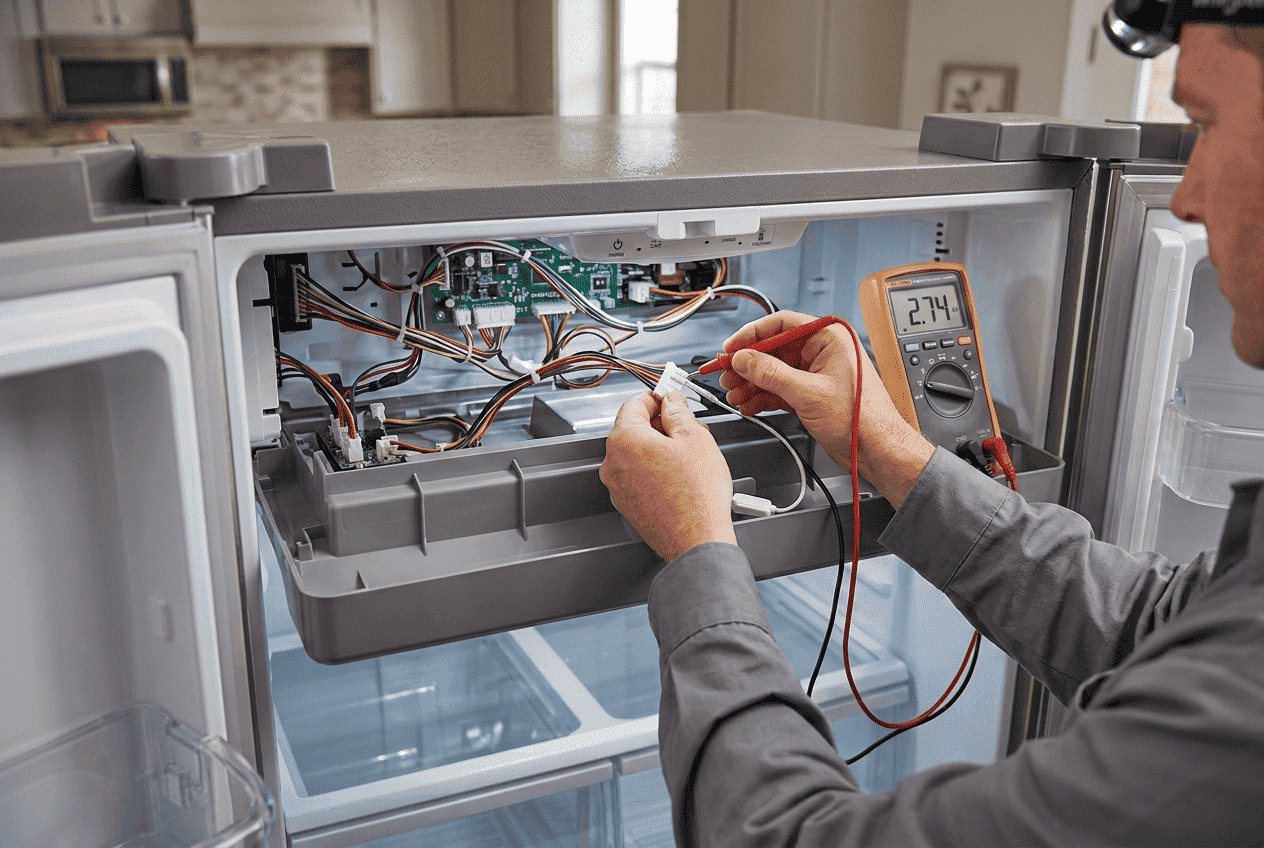
If you have a thermometer, place it in the center of the freezer and check it again in 20 to 30 minutes. If the freezer is above 10 degrees Fahrenheit and rising, move high-risk foods to another freezer or a cooler with ice. If you do not have a thermometer, use ice cream as your early warning sign. If it is softening, the freezer is likely cycling too warm.
Now you can troubleshoot without rushing.
Start with one proper reset
Standalone freezers usually diagnose faster because there is one temperature zone and fewer airflow pathways than in a refrigerator-freezer combination. When error code E1 appears here, the most common causes remain the same: a temperature sensor fault, wiring or connector trouble, a defrost sensor failure in models that use that sensing strategy, or a less common control board issue.
Step 1: check airflow and loading
A standalone freezer still needs circulation. If vents are buried or food is packed tightly against the back wall, the sensor can see temperature pockets that do not reflect the cabinet average. That can aggravate a borderline sensor and make E1 appear more often.
Rearrange only what you need to. Make sure vents are not blocked and that nothing is pressed hard against airflow return areas.
Step 2: look for frost patterns that change the diagnosis
A light, even frost film can be normal. Thick frost buildup that returns quickly is not. Heavy frost can signal a defrost problem, and depending on model it can be consistent with defrost sensor failure or a defrost process that is not completing correctly. Frost also restricts airflow, which creates uneven temperatures and increases the chance that a sensor signal looks wrong to the control.
Do not chip ice with sharp tools. That is how evaporators get punctured. If you need to clear frost safely, do a controlled manual defrost: power off, doors open, towels down, and time.
Step 3: understand what a technician tests, and why it matters
If the code keeps coming back, the real fix requires verification. In our service calls, we confirm actual cabinet temperature, then test the sensor circuit for stability. We inspect wiring and connectors because a loose pin or intermittent contact can look exactly like a sensor failure. If the unit has frost symptoms, we evaluate defrost behavior. Only after sensor and wiring checks do we treat the board as the main suspect for a control board issue.
That sequence prevents unnecessary parts and gets to the real cause faster.
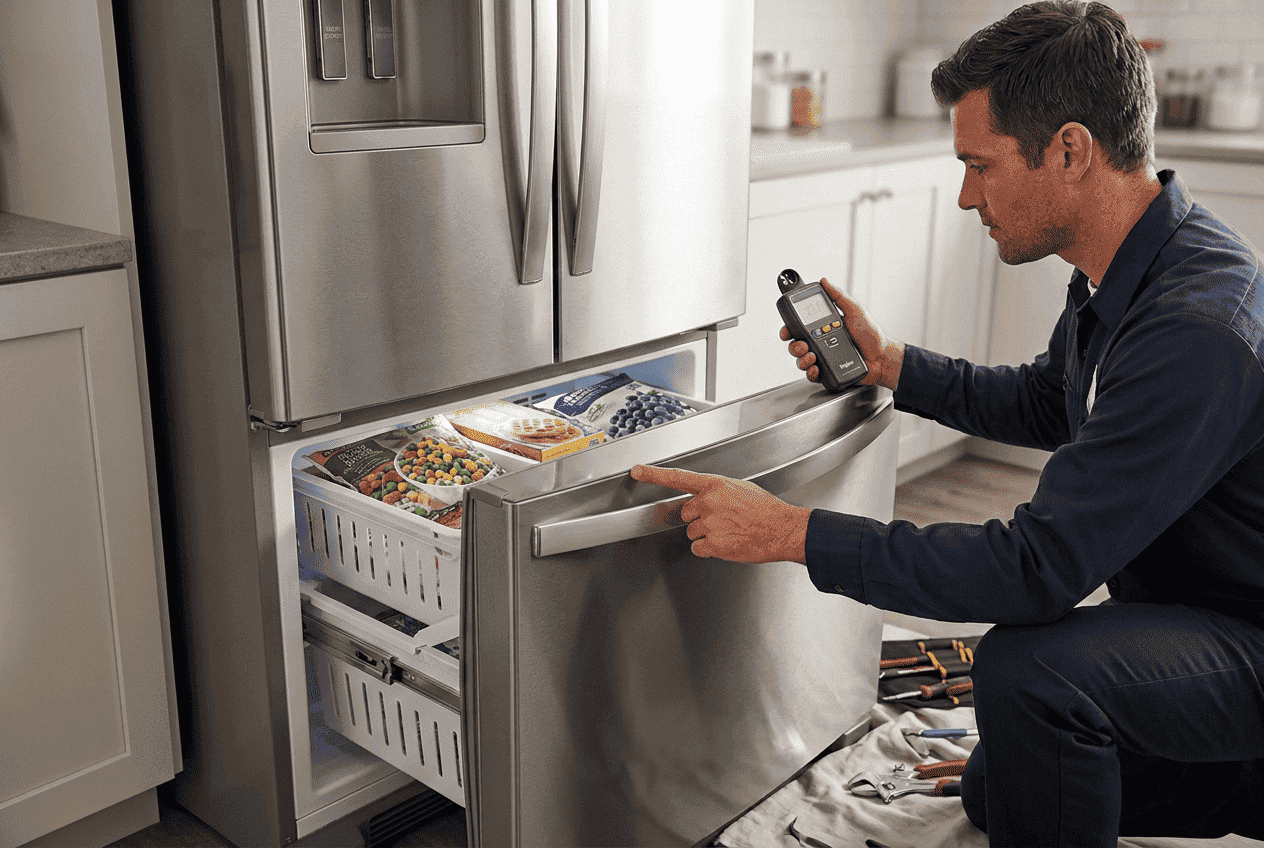
What we test on an E1 standalone freezer service call
At Appliance Repair Master, we focus on verification instead of guesswork.
We confirm actual cabinet temperature, then test the sensor signal for stability. We inspect the harness and connectors, because loose pins, corrosion, and wire damage are common. Only after the sensor circuit is proven good do we evaluate the control board as the primary cause.
If frost patterns indicate a defrost problem, we evaluate defrost operation in context. A defrost issue can distort temperatures enough to trigger sensor-related codes even when the sensor is fine.
What usually fixes E1 on a standalone freezer
Most repairs fall into a few categories. Sensor replacement, harness or connector repair, wiring repair, and in some cases defrost-related service. Control board replacement is less common and should come after sensor and wiring checks.
Whirlpool Refrigerators With Freezer Sections
In a refrigerator with a freezer section, error code E1 can feel more confusing. This design is one cooling system balancing two compartments, and it depends heavily on airflow and defrost timing. When the sensor signal is unstable, you may experience uneven temperatures. The freezer may feel cold while the fresh-food section warms, or frozen food quality may degrade even when the refrigerator seems fine.
On these models, E1 is still commonly a temperature sensor fault or refrigerator sensor malfunction. However, because airflow is shared and defrost performance affects the whole system, E1 may appear with frost buildup that points toward defrost sensor failure or another defrost-related fault. In some cases, the underlying cause becomes a control board issue, but it should be verified rather than guessed.
Step 1: check seals and vents before you assume a part failed
A weak door seal pulls humid air into the cabinet. Humidity becomes frost. Frost changes airflow. Airflow changes temperature behavior. That chain reaction can create unstable readings and trigger E1.
Also check vent blockage. On French door, side-by-side, and bottom-freezer layouts, it is easy for a large item to block a vent without realizing it. A blocked vent can create warm and cold pockets that confuse the control.
Step 2: match the symptoms to likely causes
If you see heavy frost on the freezer back panel and the refrigerator section is warming, airflow restriction is likely. In that case, a defrost problem becomes a strong suspect, including the possibility of defrost sensor failure on models that monitor defrost temperature directly.
If temperatures swing with no obvious frost, a temperature sensor fault or intermittent connection moves up the list. A drifting thermistor can send readings that look believable but wrong, so the system chases the wrong target.
If the unit runs constantly, do not assume that means it is cooling effectively. Constant running can happen when the system is reacting to faulty sensor input, or when it cannot reject heat efficiently due to dirty condenser coils. In Atlanta homes, pet hair and dust buildup are frequent contributors to long run times, which can expose a borderline sensor or connection.
Step 3: how we diagnose E1 on combo units
Professional diagnosis on these models is methodical. We verify temperatures in both compartments, check airflow and fan behavior, test thermistors for stable readings, and inspect wiring at stress points and moisture-prone connectors. If frost patterns support it, we evaluate defrost performance. Only after the sensor circuit is confirmed do we consider a primary control board issue.
That is how you avoid replacing expensive parts that do not solve the actual problem.
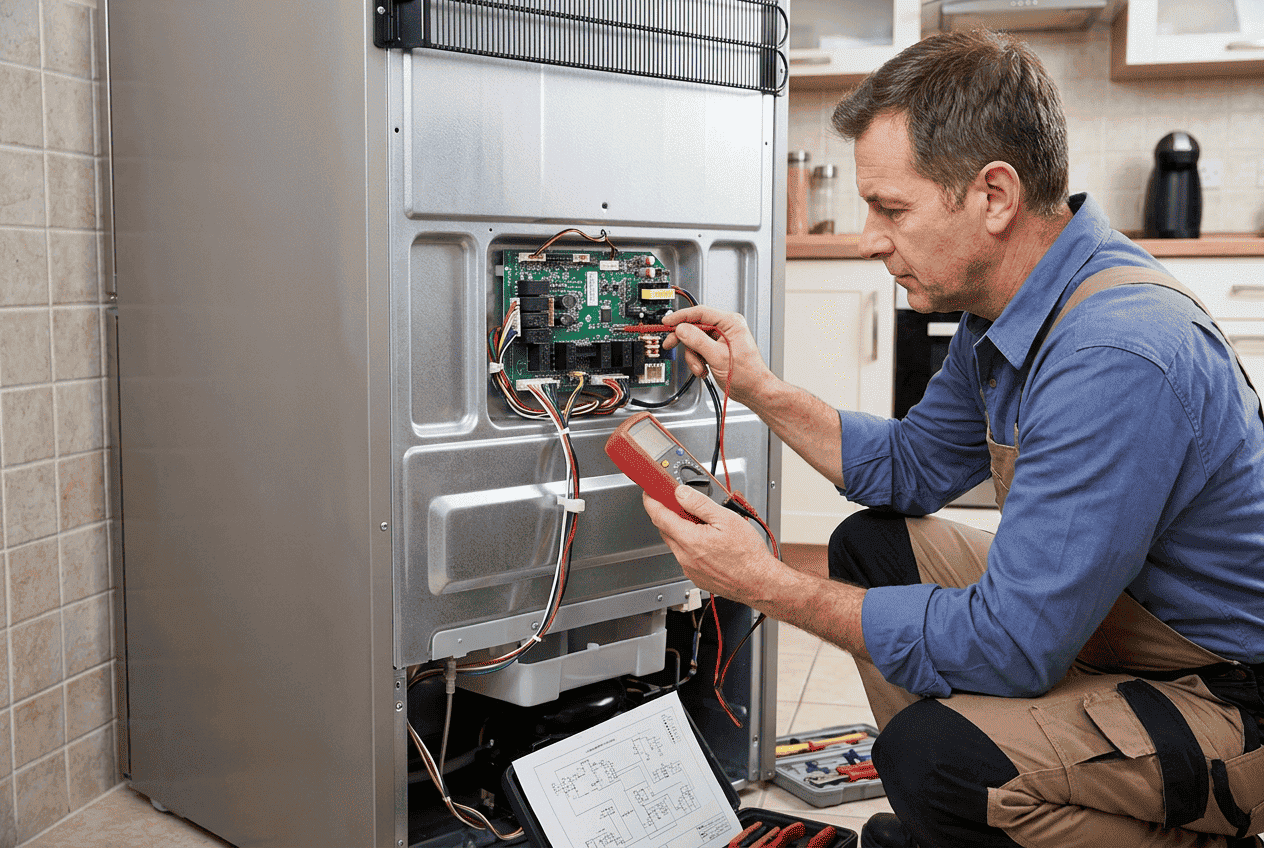
What we test on a refrigerator-freezer E1 service call
We verify temperatures in both compartments. We check airflow and fan behavior. We test thermistors for stable readings across expected ranges. We inspect wiring at stress points and moisture-prone connectors. If frost patterns support it, we evaluate defrost behavior.
Only after sensor and wiring checks do we consider the control board as the primary culprit.
This matters because replacing a board without verifying the sensor circuit is one of the most expensive ways to guess wrong.
What to do right now
If you want a practical plan you can follow today, use this sequence:
- Do one proper reset with a full 60-second power-down
- Check that doors seal and vents are not blocked
- Look for heavy frost that suggests airflow restriction
- Measure temperature with a thermometer if possible
- If E1 returns, schedule service to test the sensor circuit and wiring properly
That is the approach that prevents food loss and prevents you from buying parts you do not need.
When to call professional service
Call for service if:
- E1 returns after a proper reset,
- temperatures are rising,
- you see repeated frost buildup,
- or if the refrigerator section is warming while the freezer seems only partly effective.
We offer same-day service in Atlanta and across Georgia. Our technicians are factory-trained and experienced with both standard Whirlpool appliances and higher-end installations.
The Bottom Line
Whirlpool Error Code E1 is usually a warning that the appliance cannot rely on temperature feedback. In standalone freezers, the cause is often a sensor, connector, or wiring issue, sometimes paired with defrost trouble when heavy frost is present. In refrigerator-freezer combinations, E1 can show up with uneven compartment symptoms because airflow and defrost performance affect both zones.
Start with one proper reset, then check seals, vents, frost patterns, and real temperature. If E1 returns, do not gamble on random parts. Get a correct diagnosis so your freezer stays stable and your food stays protected.
FAQ
1. What does Whirlpool Error Code E1 mean?
It usually means the control board is not receiving a reliable temperature sensor signal. The cause can be a failing sensor or thermistor, wiring or connector issues, defrost-related sensing problems, or less commonly a control board fault.
2. Can a power cycle clear E1?
Yes, if the code was triggered by a temporary power or control glitch. If the code returns after a proper reset, the underlying problem is likely still present.
3. Why is my refrigerator warm but my freezer seems okay with E1?
In a refrigerator-freezer combination, airflow restrictions or frost buildup in the freezer can reduce cooled-air delivery to the refrigerator section. Sensor issues can also cause uneven temperature control.
4. Is E1 always a defrost problem?
No. It is commonly a sensor signal problem. Defrost becomes a stronger suspect when heavy frost buildup is present and airflow is restricted.
5. Should I replace the control board first?
We do not recommend that. Sensor and wiring checks should come first. A control board is expensive and often not the initial failure.
6. Do French door, side-by-side, and bottom-freezer models behave the same with E1?
Not always. Layout and platform differences change symptom patterns. Diagnosis should be based on model information and observed behavior, not the code alone.