
At Appliance Repair Master, all the time we see the same pattern with the LG LFXS Series: the refrigerator still has power, the panel still responds, and the doors still seal, yet the machine starts sending a different message through temperature, sound, ice production, or a code on the display.
That is where most LG LFXS series problems begin in homes. Homeowners do call because something has gone out of order, and the change is clear enough to feel but not yet clear enough to name.
Our guide gives that change a name. We explain the issues we diagnose most often in Atlanta homes, including linear compressor failure, sealed system refrigerant leak, clogged capillary tube, error code 22 33, evaporator fan motor, 10-year compressor warranty, and CH E E CH codes. Read on and you will see what these signs usually mean, what deserves fast action, and where professional LG LFXS series repair makes the most sense.
Quick symptom snapshot
What you notice | What we check first |
|---|---|
Fresh food section feels warmer | Cooling performance and airflow |
Freezer items soften | Compressor-side cooling or sealed-system loss |
Ice production drops | Cooling efficiency, airflow, or fan issues |
New clicking, buzzing, or scraping sound | Relay, fan, or compressor strain |
Display shows a code | Code-specific diagnosis |
Refrigerator runs longer than usual | System is struggling to recover temperature |
That snapshot is where we start. From there, the next step is to sort the broad symptom from the likely fault.
Where these problems first show themselves
In our field work across Atlanta, homeowners usually notice four changes first:
- the refrigerator section loses its usual steady cold
- the freezer softens food that should stay firm
- the ice bin slows down
- the display starts speaking in codes
These early signs line up with how LG and third-party troubleshooting references describe cooling faults: blocked vents, failed fan motors, relay trouble, capacitor issues, compressor problems, and leaking sealed-system faults can all reduce cooling performance.
What we ask homeowners to check before the visit
Check | Why it matters |
|---|---|
Are both sections warming, or only one? | Helps separate airflow trouble from broader cooling loss |
Did ice production drop before the food warmed up? | Often an early cooling clue |
Has the refrigerator started running longer? | Points to recovery trouble |
Did a code appear, even once? | Can narrow the diagnosis fast |
Is there a new rear noise or fan sound? | Helps identify relay, fan, or compressor-side strain |
Homeowner checklist
- fresh food side is warmer than usual
- freezer performance is less steady
- ice production has slowed
- the refrigerator sounds busier than it used to
- a code has appeared on the display
If two or three of those signs are showing up together, the refrigerator is giving you usable information. That is where the trail usually leads next: toward the compressor side of the system.
When the problem points to linear compressor failure
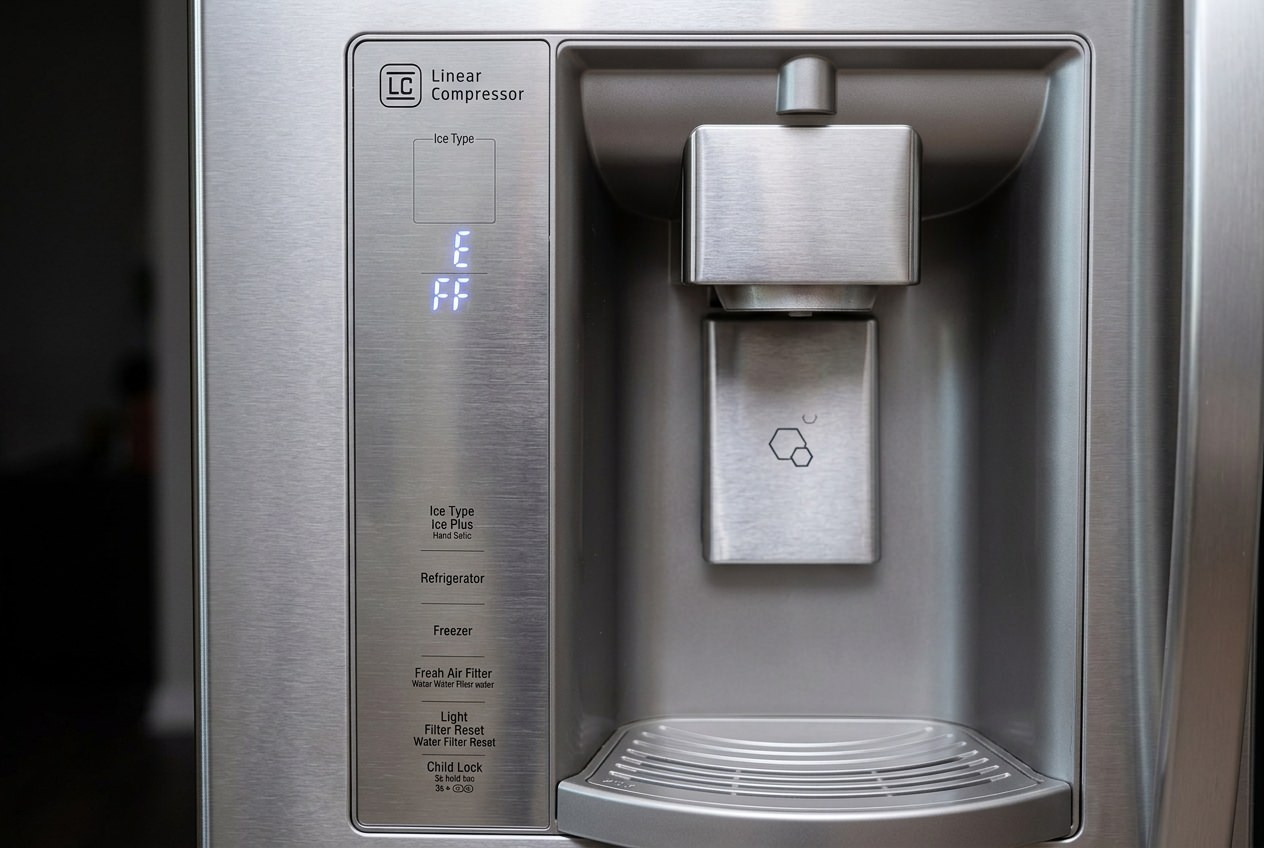
Among the more serious LG LFXS series problems, linear compressor failure is the concern homeowners mention first. We understand why. It sits at the center of cooling performance, and when it weakens, the refrigerator can still look alive while the result on the shelves says otherwise.
LG manufacturers’ error-code guide states that 22 indicates a compressor-relay problem and 33 also indicates a compressor-relay problem, with repair service required for both. As for LG’s model LFXS28968S, the warranty has extended coverage for the sealed system and the compressor, which is why many owners start asking about the 10-year compressor warranty as soon as cooling starts slipping.
What we see on compressor-side calls
Symptom in the home | What it suggests |
|---|---|
Fridge and freezer both trending warm | Cooling loss is broader than one airflow path |
Unit runs but temperatures do not recover | The system is active without enough cooling output |
Ice production slows with overall warming | Cooling capacity is fading |
Clicking or harsh startup noise from the rear | Start components or compressor health need attention |
Error code 22 33 appears | Compressor-relay diagnosis moves up the list |
What we verify before calling it compressor trouble
We do not jump straight to compressor replacement. That is how homeowners wind up paying for the wrong repair.
You should know that many different sources showcase several look-alikes that can produce similar symptoms: start relay failure, faulty capacitor, failed fan motors, main control board trouble, a faulty compressor, and leaking refrigerant sealed system faults.
Our technician’s note
A refrigerator that is powered on is not the same thing as a refrigerator that is cooling correctly. That distinction matters. It keeps the diagnosis honest and keeps the homeowner from throwing parts at the machine.
Once cooling drops across both sections, the conversation usually shifts from compressor suspicion to the sealed system itself. That is where we look next.
Sealed system refrigerant leak
A sealed system refrigerant leak changes the whole repair picture. The refrigerator may still run. It may still move air. It may still make enough noise to sound busy. What it will not do is hold temperature with confidence.
CH E or E CH indicates a high-side refrigerant leak, with a high possibility of leakage from the condenser. As for, CL E or E CL indicates a low-side refrigerant leak, with a high possibility of leakage from the evaporator. So you have to address repair service for both conditions.
That is why CH E E CH codes belong in the serious category. When homeowners search this issue, the refrigerator is often pointing to a refrigeration-loop problem, not a minor electronic glitch.
Signs that put a leak on our radar
What we see | Why we take it seriously |
|---|---|
Refrigerator runs longer and longer | It is trying to recover temperature without enough cooling strength |
Freezer weakens first | Common sign of overall cooling loss |
Cabinet temperatures turn uneven | Cooling loop is no longer behaving normally |
CH E E CH codes appear | LG links them to a high-side refrigerant leak |
Oily residue near refrigerant components | Can indicate leak points in the sealed system |
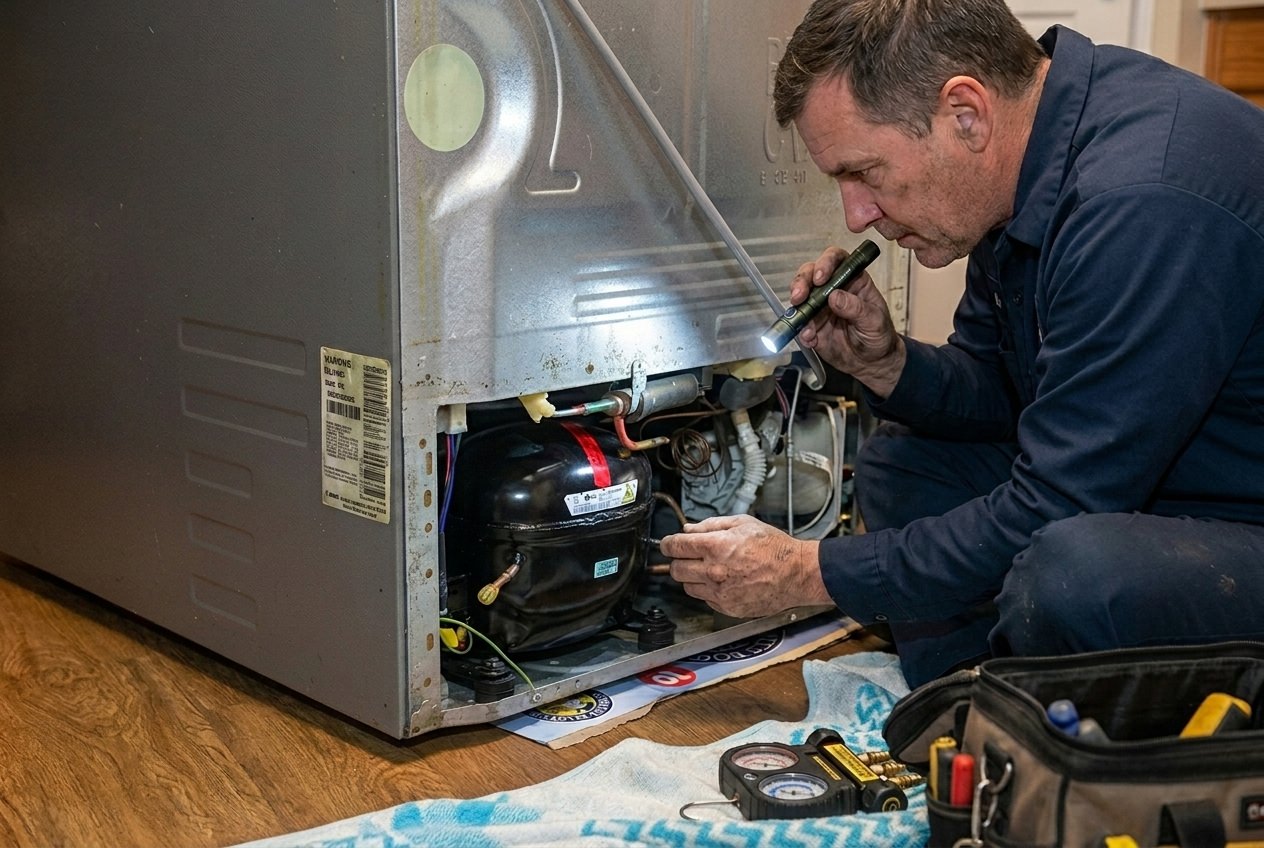
A refrigerant leak can cause a freezer to run too warm, can leave the evaporator coils without full frost coverage, and may show oily residue because refrigerant is mixed with oil in the system.
What we tell homeowners here:
A leak is not a wait-it-out problem. Once refrigerant leaves the loop, performance does not usually recover on its own. The useful question is no longer “Will it bounce back?” It is “Where is the failure, and is the repair economically sound?”
That narrows the field, but it still does not finish the job. A leak is not the only sealed-system issue that can make a refrigerator act underpowered. The next one is harder to spot and just as easy to misread.
Clogged capillary tube
A clogged capillary tube can imitate compressor trouble and imitate a leak. From the homeowner’s side, the symptom is simple: the refrigerator is running, yet the cooling is off. From the service side, the real issue is refrigerant flow.
A blockage in the system can cause ice buildup on the other side of the restriction in the refrigerant flow path, and that system pressures can indicate whether there are restrictions in the sealed system.
When we start thinking about a restriction
- cooling improves briefly, then fades again
- one section seems closer to normal than the other
- the compressor area is active, but cabinet temperatures stay unstable
- frost pattern on the evaporator does not look complete
- leak symptoms do not fully line up with the way the refrigerator is behaving
Why this matters
This is where diagnosis earns its keep. A clogged capillary tube can waste time if the repair path starts with guesswork. If the refrigerant is not moving correctly, the refrigerator can act as though the compressor is weak even when the real issue is farther down the line.
Pro tip from our technicians
On a sealed-system complaint, the right first move is diagnosis, not parts ordering.
Once the sealed system is on the table, we also have to look at the air side of the machine. Cooling can be present and still fail to reach the right places. That takes us to the evaporator fan motor.
Evaporator Fan Motor
Not every cooling complaint belongs to the compressor or the sealed system. Many service calls come down to airflow.
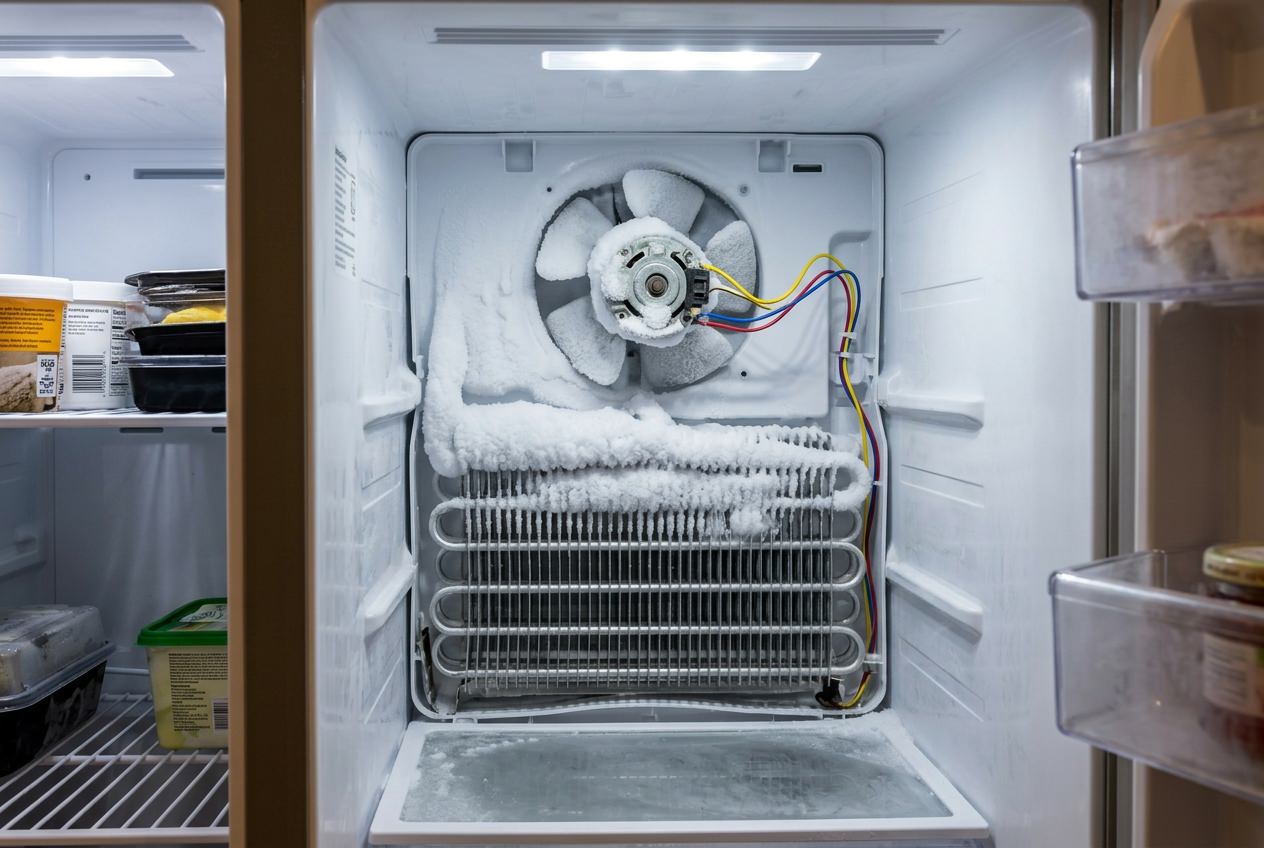
The evaporator fan draws air over the cooling coils and circulates it through the refrigerator and freezer compartments. If the fan fails, the freezer may still get cold while the refrigerator stays warm. It also notes that an unusually noisy evaporator fan motor should be replaced.
LG manufacturers say a FF error indicates the freezer fan is not operating normally and may be affected by frost buildup. LG’s rF error indicates an abnormality in the refrigerator compartment fan motor, and repeated symptoms after reset should be checked by a service technician.
What airflow trouble looks like
Symptom | What it points to |
|---|---|
Freezer colder than fresh-food section | Air may not be moving correctly |
Fresh-food section warms first | Classic airflow complaint |
Scraping or rubbing sound from freezer area | Frost or fan interference |
Cooling comes and goes | Fan operation may be intermittent |
FF or rF code appears | Fan diagnosis moves front and center |
Safe checks for homeowners
- make sure interior vents are not blocked by containers or food
- look for heavy frost or ice buildup inside the freezer area
- write down any FF or rF code exactly as shown
- note whether the sound changes when doors open or close
Blocked vents and overloaded storage can disrupt airflow, and LG recommends defrosting and checking vent blockage when frost is involved with fan errors.
Airflow complaints often overlap with code complaints, which is why the next section pulls those display messages into one clean reference point.
What Error Code 22 33 And CH E E CH Codes Mean
Homeowners often search for error code 22 33 as one phrase. LG manufacturers separate the codes, but the meaning lands in the same place: 22 is a compressor-relay problem and 33 is a compressor-relay problem. Repair service is required.
Homeowners also search CH E E CH codes when the display shows CH E or E CH. That code points to a high-side refrigerant leak.
Quick code map
Code or keyword | Meaning according to LG |
|---|---|
error code 22 33 | Compressor-relay problem |
CH E E CH codes | High-side refrigerant leak |
FF | Freezer fan issue, sometimes tied to frost |
rF | Refrigerator fan-motor abnormality, possibly frost-related |
The value of a code is simple: it narrows the field. Once the field is narrower, the next question is practical. Does the owner have warranty coverage that changes the repair decision?
10-year Compressor Warranty
The phrase 10-year compressor warranty matters, but it has to be read with care.
What LG manufacturers say about model LFXS28968S in the warranty section lists:
Component | Coverage listed by LG |
|---|---|
Sealed System (Condenser, Dryer, Connecting Tube and Evaporator) | 5 years parts and 5 years labor |
Compressor (Linear/Inverter) | 10 years parts and 5 years labor |
The warranty period starts from the original date of delivery or purchase and points owners to the detailed warranty information that came with the product.
What we ask customers to have ready
- full model number
- serial number
- purchase or delivery date
- a photo of the display if a code is showing
That saves time and keeps the conversation grounded. Coverage varies by model and by the exact part involved, so we do not promise warranty outcomes before the model is verified.
Our Diagnostic Checklist Before We Order Parts
This is where the rubber meets the road. Before parts are replaced, we want the symptom pattern to hold up under basic checks.
What to check first
- confirm the unit has stable power
- make sure both doors close fully
- check that interior vents are clear
- note whether both sections are warm or only one
- listen for new clicking, buzzing, scraping, or fan noise
- write down every code exactly as shown
What not to do
- do not keep resetting the refrigerator and assume the issue is solved
- do not judge the unit by lights and panel response alone
- do not order a compressor because someone online guessed
- do not ignore repeating error code 22 33 or CH E E CH codes
Issue | Symptom pattern | Typical repair direction |
|---|---|---|
linear compressor failure | Both sections warming, unit runs, poor recovery | Compressor-side diagnosis and relay/start circuit check |
sealed system refrigerant leak | Long run times, broad cooling loss, leak-related code | Sealed-system diagnosis |
clogged capillary tube | Unstable cooling, incomplete frost pattern, restriction signs | Pressure testing and sealed-system diagnosis |
evaporator fan motor | Freezer colder than fresh-food section, noisy fan, FF/rF code | Fan inspection, frost check, airflow repair |
error code 22 33 | Compressor-relay fault on display | Relay/compressor circuit diagnosis |
CH E E CH codes | High-side refrigerant leak code | Sealed-system diagnosis |
That checklist usually answers the first homeowner’s question: “Can I keep watching it?” At this stage, the better question is whether waiting helps the machine or only delays the inevitable call.
Repair or replace? Our technical verdict
We keep this simple.
Repair usually makes sense when
- the refrigerator is still in otherwise solid condition
- the fault is isolated and diagnosable
- airflow or fan issues are the main cause
- warranty coverage may offset compressor or sealed-system cost
- the cabinet, doors, and electronics are still worth preserving
Replacement deserves discussion when
- the refrigerator has repeated major cooling failures
- deep sealed-system work is needed on an older unit
- the repair cost is high relative to the refrigerator’s age and condition
- several major components are starting to stack up at once
Our Rule Of Thumb
We diagnose first, then talk about money. That keeps the decision sane. LG LFXS series repair can make perfect sense when the fault is clear and the rest of the machine still has value. It makes less sense when the refrigerator has moved into repeat-failure territory and the sealed-system cost no longer pencils out.
That is why we sell clarity.
Conclusion
Most LG LFXS series problems start with a refrigerator that still looks normal from across the kitchen. The real clues show up in cooling, airflow, noise, ice production, and display codes.
In our Atlanta service work, the most important step is narrowing the issue before anyone replaces parts. Linear compressor failure, sealed system refrigerant leak, clogged capillary tube, error code 22 33, evaporator fan motor, 10-year compressor warranty, and CH E E CH codes all point the conversation in a useful direction, but they do not replace diagnosis.
If your LG LFXS Series refrigerator is running but no longer cooling with consistency, call Appliance Repair Master. We provide experienced refrigerator service in Atlanta, clear fault identification, and same-day scheduling when available.
FAQ
1. What are the most common lg lfxs series problems?
In our practice, the most common complaints are weak cooling, uneven temperatures, reduced ice production, fan-related airflow issues, compressor-relay codes, and sealed-system faults.
2. What does error code 22 33 mean on an LG refrigerator?
22 indicates a compressor-relay problem and 33 indicates a compressor-relay problem. Repair service is required for both.
3. What do CH E E CH codes mean?
Homeowners often search CH E E CH codes when they see CH E or E CH on the display. That code indicates a high-side refrigerant leak.
4. Can an evaporator fan motor make the refrigerator warm while the freezer still seems cold?
Yes. The evaporator fan circulates cold air through the compartments, and if it fails, the freezer may still get cold while the refrigerator stays warm.
5. Is a clogged capillary tube the same as a refrigerant leak?
No. A clogged capillary tube is a refrigerant-flow restriction. A leak means refrigerant has escaped the sealed system. Both can reduce cooling and mimic compressor trouble.
6. Does the 10-year compressor warranty cover the whole repair?
Not always. LG lists 10 years parts and 5 years labor for the compressor and 5 years parts and 5 years labor for the sealed system. Exact coverage depends on model and warranty terms.
7. Should I keep using the refrigerator if it is still running?
If cooling is slipping, do not assume the problem is minor. A refrigerator can stay powered on while losing its ability to hold safe temperatures.