
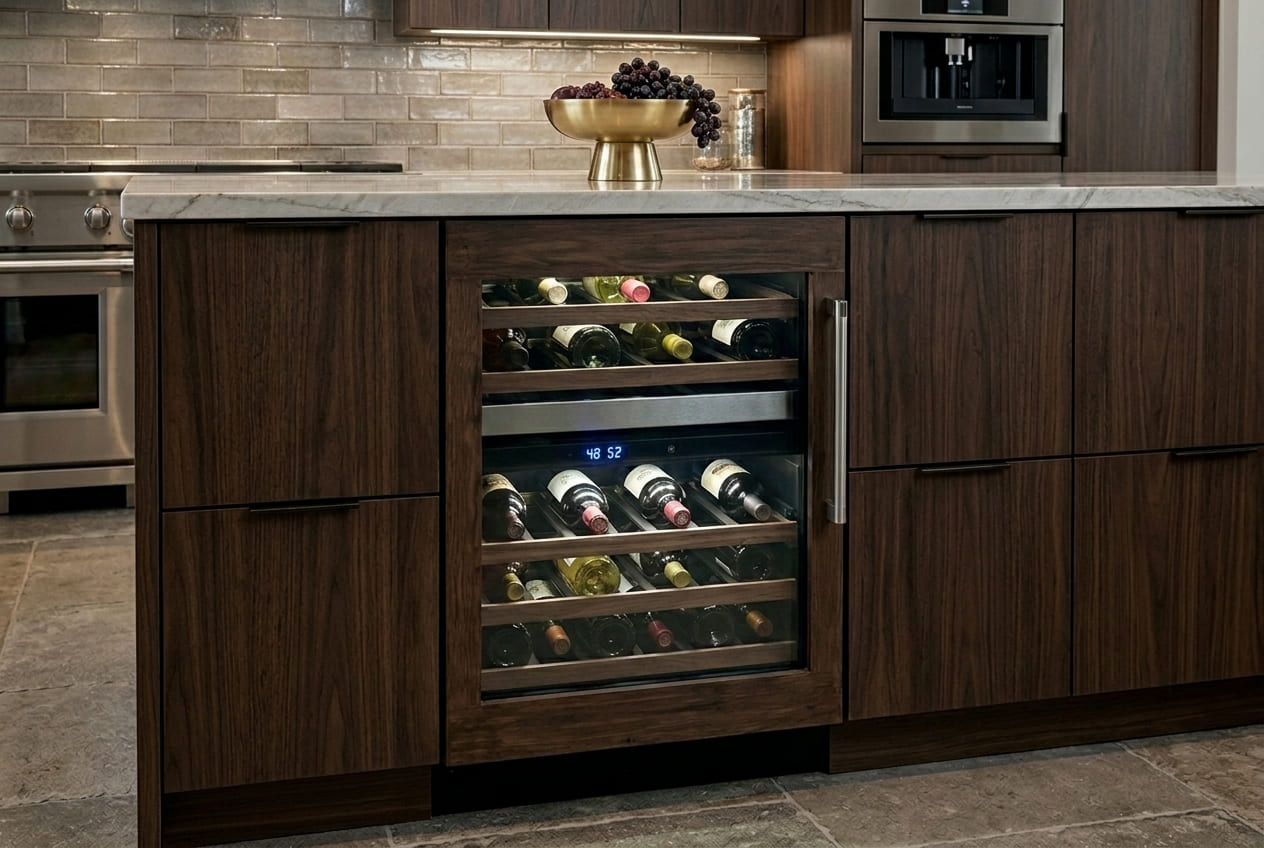
Thermador wine coolers are built to a standard that most kitchen appliance brands simply don’t match. Whether it’s a fully integrated column or an undercounter unit, these machines are engineered for stable, precise temperature management — and for running quietly enough that you barely notice them. That’s part of the appeal. When a Thermador wine cooler starts making noise that feels out of place, owners tend to notice right away, because the baseline is so low.
The Freedom series, the T-Series undercounter units, and the integrated column models all share a common design philosophy: consistent cooling, minimal vibration, and a refined finish that fits seamlessly into high-end kitchens. Thermador’s Free Flow cooling system, used across several wine storage models, is specifically designed to circulate air evenly without creating the kind of turbulence that leads to temperature swings or mechanical strain. So when something starts sounding off, it’s worth paying attention.
This guide walks through what’s normal, what isn’t, what causes noise problems in Thermador wine coolers, and what you can actually do about it — whether that’s a quick self-check or a call to a technician.
How Quiet Are Thermador Wine Coolers Supposed to Be?
Short answer: very quiet. Most Thermador wine storage units operate in the range of 38–44 dB — roughly the ambient noise level of a quiet library. In practice, that means you might hear a soft hum when the cooling cycle is active, a faint click when the thermostat engages or disengages, and occasional airflow sounds as the fans circulate air through the cabinet.
A few things worth knowing:
- Compressor noise in Thermador units is typically low-frequency and brief. You’ll hear it start up, run for a cycle, and stop — that’s normal.
- The evaporator fan (inside the cabinet) and the condenser fan (near the compressor, usually at the bottom rear) both run during cooling cycles. A soft, steady airflow sound from either is expected.
- Built-in and integrated models are designed to be installed flush with cabinetry, which can sometimes amplify vibration if the unit isn’t perfectly level or if there’s contact with surrounding panels.
- In open-plan kitchens, even normal operating sounds can seem more noticeable simply because there’s less ambient noise to mask them.
The key distinction: consistent, low-level sound is normal. Sudden changes in sound — new rattles, louder hums, intermittent beeping, or metallic knocking — are not.
Which Thermador Wine Cooler Models Come Up Most Often in Noise Complaints?
Based on service calls we handle in the Atlanta area, a handful of models come up repeatedly when owners report noise issues. These are all legitimate, currently produced or recently discontinued Thermador wine storage units:
Model | Type | Common Noise Complaint |
T24UW900LP | Undercounter, built-in | Vibration, fan noise |
T24UW905LP | Undercounter, built-in | Rattling, compressor hum |
T24IW905SP | Integrated column | Fan noise, beeping |
T24UW800LP | Undercounter | Condenser fan noise |
T24UW820LS | Undercounter | Rattling, door-related sounds |
The T24UW-US designation refers to the broader undercounter wine storage category in Thermador’s lineup — models in this group share similar cooling architecture, which means similar noise patterns when something goes wrong.
Why do fully built-in models generate more noise complaints? Primarily because they’re enclosed on multiple sides. Any vibration that would normally dissipate into open air instead transfers into the surrounding cabinetry — and that amplifies the sound considerably. The Freedom series integrated columns have more installation clearance requirements for this exact reason.
Normal Sounds vs. Warning Sounds: A Practical Guide
Sound | What It Usually Means | Normal? | When to Call a Tech |
Soft, steady hum | Compressor running | Yes | Only if it never stops |
Brief click | Thermostat cycling on/off | Yes | If clicking becomes rapid or constant |
Gentle airflow sound | Evaporator or condenser fan | Yes | If it becomes a whine or grinding |
Occasional drip or gurgle | Refrigerant moving through lines | Yes | If accompanied by temperature issues |
Rattling or buzzing | Loose component, vibration against cabinet | Maybe | If it persists or worsens |
Metal clunking noise | Fan blade obstruction, loose hardware | No | Promptly |
Persistent beeping | Door ajar, temperature alert, sensor fault | No | If it doesn’t stop after door check |
Beeping alarm with display warning | High-temperature event or system fault | No | Same or next day |
“H” on the temperature screen | High-temperature alert — cabinet too warm | No | Immediately |
The H temperature screen display is Thermador’s way of flagging that the internal temperature has risen above the safe threshold. This is not a sound issue alone — it’s a system warning that something is actively wrong with the cooling.
Why a Thermador Wine Cooler Starts Making Unusual Noise

Most noise problems have a root cause. Here are the most common ones we see in the field:
- Poor leveling or surface contact
If the unit isn’t perfectly level, the compressor and fans vibrate unevenly. In built-in installations, even slight contact between the unit’s frame and surrounding cabinetry can turn a minor vibration into a noticeable rattle. - Blocked vents
Thermador wine coolers need clear airflow at the front grille (undercounter models) or rear (column models). When vents are blocked — by a rug, a cabinet door that doesn’t fully open, or debris — the cooling system works harder, and the fans run louder and longer. - Overstocked cabinet
Loading too many bottles into the unit can impede airflow between shelves. This forces the fans to compensate, increases the load on the compressor, and can cause the unit to run louder than usual. It’s one of the most overlooked causes. - Overheating compressor
When the compressor runs under sustained stress — due to poor ventilation, a dirty condenser, or a refrigerant issue — it generates more heat and more noise. A compressor that’s working too hard sounds noticeably different from one running normally: louder, more labored, sometimes with a low knocking undertone. - Damaged or dirty door seal
A door seal gasket that’s damaged or has become dirty allows warm air to enter the cabinet. The unit then has to work continuously to compensate, which means the fans and compressor run more often and at higher load — and the temperature inside starts to rise. Over time, this also stresses the cooling system. - Faulty temperature sensor
A faulty temperature sensor can send incorrect readings to the control board, causing the system to overcool or undercool — and to run the compressor and fans in irregular cycles. This often presents as inconsistent noise: quiet for a while, then suddenly loud, then quiet again. - Fan obstruction or wear
Ice buildup, a loose wire, or a worn bearing in the evaporator or condenser fan can cause anything from a soft whine to a hard rattling sound. Fan issues tend to get worse over time if left unaddressed. - Rubber mounts and padding wear
The compressor sits on rubber isolation mounts designed to absorb vibration. When these mounts age and harden, vibration transfers directly to the frame — and you hear it. This is especially common in units that are 5+ years old.
Real-Life Noise Scenarios and What They Usually Point To

Scenario 1: It runs loudly all the time, never seems to stop
This usually means the unit is struggling to maintain temperature. Common culprits: blocked vents, a dirty condenser coil, or a door seal that’s letting warm air in. The system never reaches its target temp, so it never cycles off.
Scenario 2: It starts beeping and the display shows a temperature warning
A high-temperature alert combined with a beeping alarm is the unit telling you something has failed — or is close to failing. Check the door first. If it’s closed properly and the beeping continues, the issue is likely internal: a sensor fault, a failing fan, or a refrigerant problem.
Scenario 3: It vibrates noticeably when the compressor kicks on
This is almost always a mechanical issue — either the rubber isolation padding under the compressor has worn out, or the unit has shifted slightly and is now making contact with the surrounding cabinetry. Sometimes re-leveling fixes it. Sometimes the mounts need replacement.
Scenario 4: It gets louder in summer
Georgia summers are no joke. When ambient temperatures climb, the condenser has to work harder to reject heat. The fans run longer, the compressor cycles more frequently, and the unit is simply louder. If the noise is proportional to outdoor temperature and the unit still cools properly, this may be within normal range — but if it’s dramatically louder or struggling to hold temperature, it’s worth a service call.
Scenario 5: The noise started after loading more bottles
Overloading the cabinet is a surprisingly common trigger. Too many bottles packed tightly together can impede airflow through the shelves, forcing the fans to compensate. Rearranging the load — leaving space between bottles and not blocking the internal vents — often reduces the noise noticeably.
Scenario 6: It hums normally, then suddenly starts rattling
Intermittent rattling that comes and goes is often a loose component — a shelf bracket, a drip tray, or a panel that’s vibrating in resonance with the compressor. It can also be a fan blade that’s slightly out of balance. These are usually straightforward fixes, but they don’t resolve on their own.
Scenario 7: Noise appeared right after installation or after flooring work
New installations sometimes need fine-tuning. If the unit isn’t perfectly level, or if the flooring surface changed (new tile, hardwood, etc.), vibration patterns shift. A metal clunking noise right after installation almost always points to contact between the unit and the surrounding cabinet — check clearances first.
What You Can Safely Check Yourself Before Calling a Tech
There are a few things any homeowner can do without risk:
- Check the leveling. Use a level on top of the unit. Adjust the front feet until the unit is stable and doesn’t rock. This alone resolves a surprising number of vibration complaints.
- Inspect the door seal. Run your hand around the closed door — you shouldn’t feel any air escaping. Look for cracks, tears, or areas where the gasket has pulled away from the frame. A damaged seal is visible and easy to spot.
- Clear the vents. Make sure nothing is blocking the front grille or the rear exhaust area. Even a dish towel draped nearby can restrict airflow enough to cause problems.
- Rearrange the bottles. If the unit is packed full, try removing a few bottles and leaving space between them. Don’t block the internal air circulation channels.
- Clean the exterior grille. Dust and lint accumulate on the condenser grille over time. A soft brush or vacuum attachment can clear it without any disassembly.
- Check that the door is fully closed. Sometimes a bottle neck or a shelf that’s slightly out of position prevents the door from sealing completely.
What not to attempt yourself: anything involving the refrigerant system, the compressor, internal wiring, or the control board. These require specialized tools and, in the case of refrigerant, EPA certification to handle legally and safely.
When It's Still Safe to Use — and When to Stop
Not every noise means you need to unplug the unit immediately. Here’s a practical guide:
Generally safe to continue using (with monitoring):
- Mild vibration that doesn’t affect temperature
- Occasional rattling from a loose shelf or drip tray
- Slightly louder fan noise during hot weather, if temperature holds steady
Stop using and call a tech:
- The beeping alarm won’t stop, even after checking the door
- The display shows an “H” or high-temperature warning
- The internal temperature is rising and wine is no longer being kept at the right temperature
- The compressor is making a hard knocking or grinding sound
- The unit smells like burning or hot plastic
The risk of continued use when the unit is genuinely overheating isn’t just about the wine — it’s about the compressor. Running a compressor under sustained thermal stress shortens its life significantly, and compressor replacement is one of the more expensive repairs on any wine cooler.
Why DIY Repair Can End Up Costing More
It’s tempting to look up a part number, order it online, and try to fix it yourself. We understand the impulse. But with Thermador wine coolers specifically, there are a few ways this can go sideways:
- Misdiagnosis is the most common problem. A faulty temperature sensor and a failing thermostat can produce nearly identical symptoms — but they’re different parts, different costs, and different repair procedures. Replacing the wrong one first means paying twice.
- Panel and trim damage. Thermador’s built-in units have integrated trim kits and custom panel options that are expensive to replace. Disassembly without the right approach can crack trim, strip screws, or damage the door alignment — turning a $150 repair into a $600 one.
- Refrigerant system risk. If the noise is coming from the compressor or refrigerant lines, any attempt to open or modify those components without proper equipment is both dangerous and illegal without EPA certification. Our technicians hold EPA certification for refrigerant handling — this isn’t something to improvise.
- Voiding any remaining warranty. Unauthorized disassembly can void coverage on parts that might otherwise be covered.
The bottom line: a professional diagnosis costs less than two rounds of guessing.
Why Atlanta Homeowners Call Appliance Repair Master

When a Thermador wine cooler starts making noise, the diagnosis matters as much as the repair. These aren’t generic appliances — they have model-specific cooling architectures, proprietary control boards, and installation configurations that affect how problems present.
Here’s what we bring to the job:
- Model-specific troubleshooting — we work with Thermador wine storage units regularly and know the common failure patterns by model
- Same or next day scheduling — most calls in the Atlanta metro and surrounding GA areas are handled within 24 hours
- Warranty on all labor — if the repair doesn’t hold, we come back
- EPA-certified technicians for any work involving refrigerant systems
- Honest diagnosis — if the issue is something you can fix yourself, we’ll tell you
We’re not here to upsell. We’re here to fix it right and make sure it doesn’t come back.
How to Prevent Future Noise Problems
A little routine attention goes a long way with Thermador wine coolers:
Airflow and placement
- Keep the front grille clear at all times — don’t push the unit flush against a rug or mat that blocks the lower vent.
- For column models, verify rear clearance matches Thermador’s installation specs.
- The Free Flow cooling system works best when internal air circulation isn’t obstructed — don’t pack bottles so tightly that air can’t move between them.
Loading habits
- Avoid consistently overstocking the unit — leave room for air to circulate.
- Don’t place bottles directly against the back wall or the internal fan housing.
- Heavier bottles on lower shelves reduce vibration from top-heavy loading.
Cleaning
- Clean the condenser grille every 3–6 months, more often if you have pets.
- Wipe down the door gasket with a damp cloth periodically — a dirty seal loses its flexibility and starts to let air in.
- Check for dust buildup around the base of the unit.
Leveling checks
- Re-check leveling after any flooring work, moving, or if the unit has been bumped.
- Built-in models should be checked annually — cabinetry can shift slightly over time.
Seasonal awareness
- In Georgia, summer heat puts extra load on the cooling system. During peak summer months, avoid opening the door more than necessary and make sure the room where the unit is installed has adequate ventilation.
FAQ
1. Why is my Thermador wine cooler beeping in the middle of the night?
Nighttime beeping is almost always a temperature alert — the cabinet warmed up enough to trigger the alarm. This can happen if the door wasn’t fully closed, if the room temperature spiked (e.g., after cooking), or if a cooling component is starting to fail. Check the door seal and the display for any error code. If the beeping returns after the door is confirmed closed, it’s time to call a tech.
2. What does the "H" on the temperature display mean?
The “H” indicator is Thermador’s high-temperature alert — it means the internal temperature has exceeded the safe range for wine storage. It’s not just a warning light; it means the unit is actively failing to cool. Don’t ignore it, especially in summer when temperatures can climb quickly.
3. The noise started after I added more bottles — is that related?
Very likely, yes. Adding a significant number of bottles changes the thermal load and can restrict internal airflow if the unit is now packed tightly. Try spacing the bottles out and leaving the internal air channels clear. If the noise persists after adjusting the load, there may be an underlying issue that the added load simply made more apparent.
4. Is it normal for my Thermador wine cooler to be louder in summer?
Somewhat. In Georgia’s summer heat, the condenser works harder to reject heat, and the fans run more frequently. A modest increase in operating noise during peak summer months is within normal range — provided the unit is still maintaining temperature. If it’s struggling to cool or running constantly, that’s beyond seasonal variation.
5. Can I keep using the wine cooler if it's louder than usual but still cooling?
It depends on the type of noise. A mild rattle from a loose shelf? Probably fine short-term. A hard knocking from the compressor area, or a beeping alarm that keeps returning? Those warrant stopping use and getting a diagnosis. Running a stressed compressor to failure is a much more expensive outcome than a service call.
6. How do I tell if the noise is coming from the fan or the compressor?
Fan noise tends to be higher-pitched — a whine, a hum, or a rhythmic ticking — and it’s usually consistent while the cooling cycle runs. Compressor noise is lower-frequency: a deep hum, a knock, or a vibration you can sometimes feel through the floor. If the noise stops when the cooling cycle ends, it’s likely fan-related. If it persists or pulses with the compressor startup, that’s where to look.
Conclusion
Thermador wine coolers are genuinely quiet machines — that’s part of what you’re paying for. When one starts making noise that feels new or out of place, it’s usually the unit’s way of flagging something that deserves attention, even if it’s not urgent yet.
Some sounds are completely normal: the soft hum of the compressor, the click of the thermostat, the gentle movement of air through the cabinet. Others — persistent beeping, a metal clunking noise, vibration that gets worse over time, or a temperature warning on the display — are signals worth acting on before a minor issue becomes a major repair.
If you’re in Atlanta or anywhere in the GA area and your Thermador wine cooler has started sounding different, Appliance Repair Master is ready to take a look. Same or next day service, honest diagnosis, and work we stand behind.