
A Frigidaire freezer or refrigerator is built to run quietly, efficiently, and with precision, especially in premium kitchens where temperature stability matters. So when the display suddenly flashes “ER”, it’s more than a minor inconvenience. It’s the appliance alerting you to a disruption in one of its most important systems: communication between controls or temperature sensing.
Any good news? In many cases, Frigidaire Error Code ER is fixable, and you can often narrow down the cause quickly with the right approach.
In this article, we’ll show you:
- What Error Code ER means on Frigidaire refrigerators and freezers
- The two most common variations (ER CE and ER T1)
- What typically causes the error
- What you can safely try at home (without risking board damage)
- When professional diagnosis is the smarter investment—especially for Gallery and Professional Series models
Our guide applies to common models and families including: FGHS2631PF, FFHS2622MS, FRFS2823AS, FGHB2868TF, plus Gallery Series and Professional Series units.
What Is Frigidaire Error Code ER?
Frigidaire uses “ER” as a general error prefix, meaning the refrigerator or freezer has detected a fault in a monitored system. In most cases, the code you see will include a second part that identifies the exact category.
The most common versions include:
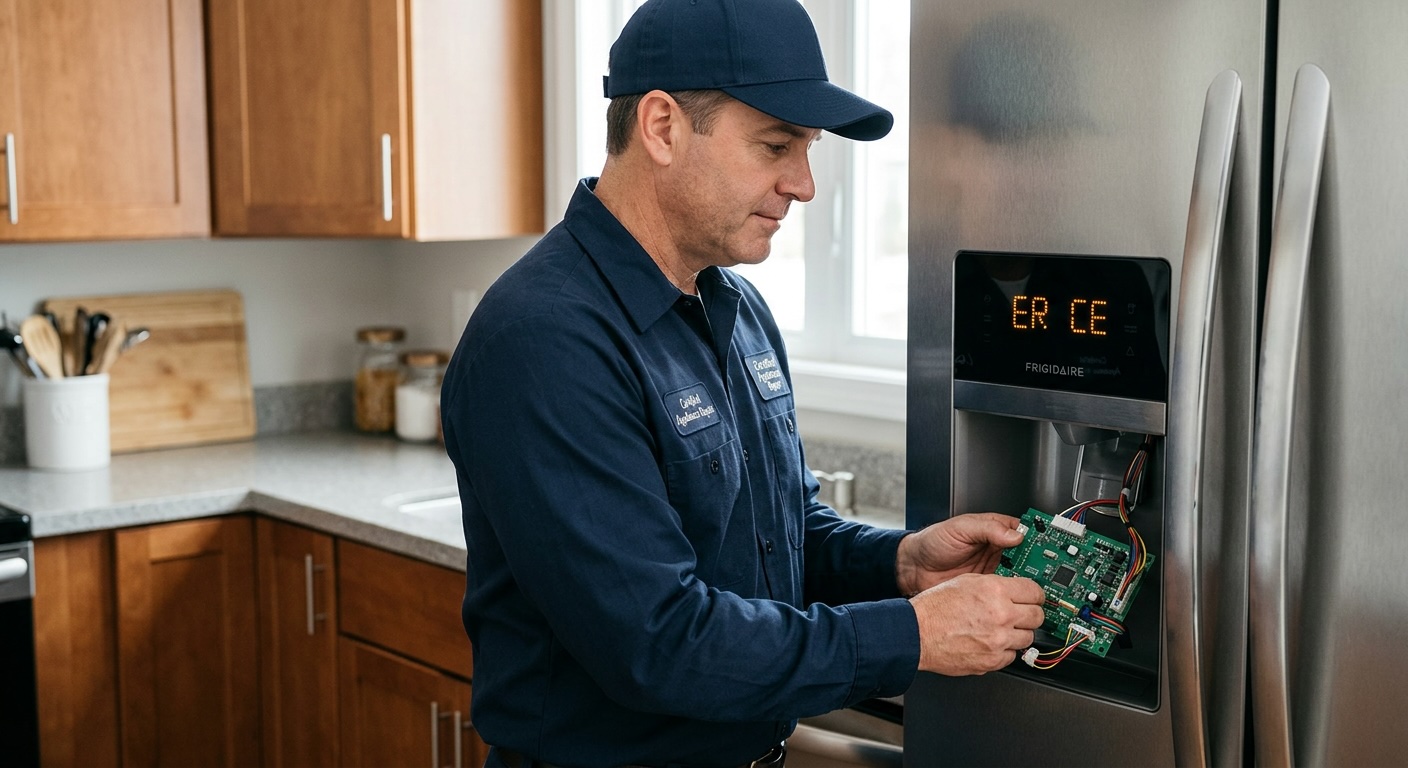
ER CE — Communication Error
This indicates a problem with communication between the main control board (the appliance’s brain) and the user interface board (the display/controls). This can be caused by a wiring harness issue, a loose connection, or a failed control component.
ER T1 — Freezer Sensor / Temperature Sensor Error
This suggests the freezer temperature sensor (thermistor) is sending an abnormal reading—or the control board cannot correctly interpret that sensor input. This can be caused by a failed sensor, wiring damage, or control board faults.
Why These Errors Matter in High-End Refrigeration
Modern Frigidaire units, especially in Gallery and Professional Series, rely on precise data flow. When communication or sensor feedback is interrupted, performance can degrade in ways that aren’t immediately obvious.
A refrigerator might still run, but behind the scenes you may see:
- inconsistent cooling
- temperature swings (especially in the freezer)
- compressor cycling issues
- alarms returning repeatedly
- frost buildup due to improper defrost logic
For homeowners with premium food storage, entertaining demands, or luxury kitchen design, ER errors should be treated as early warnings—not cosmetic display glitches.
ER CE Communication Error: What Causes It
When you see ER CE, the refrigerator is essentially telling you:
“My control board and my display aren’t talking correctly.”
This communication travels through a wiring harness connecting the display board and the main board. If that pathway is disrupted, even briefly, the system triggers ER CE.
Most common causes of ER CE
- Power surge or interruption
Even a split-second outage can freeze or desync board communication. - Loose or oxidized harness connection
Vibration and compressor cycling can loosen connectors over time. - User interface board failure
Often paired with flickering displays or unresponsive buttons. - Main control board failure
Usually accompanied by cooling instability or recurring error codes after reset.
How to Fix ER CE
Because control boards are expensive and misdiagnosis is common, luxury service strategy is:
reset first → inspect connections second → test professionally before replacing boards
Step 1: Perform a Correct Power Cycle Reset
A real reset is not simply pressing buttons.
- Unplug the unit (or shut off the breaker) for 5 full minutes
- Restore power and allow 10–15 minutes for full system reboot
- Monitor whether ER CE returns
This clears transient communication freezes caused by power instability.
Step 2: If ER CE Returns, Don’t Replace a Board Yet
If the error reappears quickly, the next step is not “order a control board.”
A skilled technician will check:
- harness continuity
- connector seating
- pin condition and oxidation
- stable power supply to boards
- communication signal integrity
A wiring harness repair is far less costly than board replacement—and often the real fix.
ER T1 Freezer Sensor Error: Why It Happens
When ER T1 appears, Frigidaire is warning that the freezer temperature sensor is:
- open (broken circuit)
- shorted
- out of expected range
- unable to be read due to wiring damage
Most common causes of ER T1
- Failed freezer thermistor (temperature sensor)
- Damaged sensor wiring harness
- Ice/frost interference in airflow and sensor accuracy
- Control board misreading sensor input
How to Fix ER T1
Step 1: Power Cycle Reset
Always start here (same 5-minute reset as above).
If ER T1 clears and doesn’t return, it may have been a temporary read error.
Step 2: Check for Freezer Frost or Airflow Blockage
If your freezer has:
- heavy frost buildup
- blocked vents
- a fan obstruction
It can distort sensor readings and lead to recurring temperature errors.
Step 3: Professional Sensor Testing
At this point, diagnosis is the smart move. A technician will test:
- sensor resistance values
- harness continuity
- connection integrity at the control board
- whether the control board is properly interpreting input
This prevents replacing parts blindly, especially if the issue is wiring rather than the sensor.
What About Other Error Codes Like E1, E2, or ER Alone?
Frigidaire models sometimes show E1, E2, or just ER without the suffix.
While these can vary by model, they often relate to:
- sensor errors
- temperature circuit faults
- communication issues
If your display does not show a full code (such as ER CE or ER T1), the next step is to check your model’s technical sheet or request professional diagnostic readout.
When to Call a Professional
If you care about protecting performance and preventing repeat failures, call a professional when:
- Error returns immediately after reset
- Cooling performance is unstable
- Freezer temperature rises or swings
- Display becomes unresponsive or flickers
- Error appears in a premium model (Gallery / Professional)
In high-end appliance care, the goal isn’t just “make it stop showing the code.”
It’s ensuring the system operates at precision again, without unnecessary board replacement.
The Final Thoughts
A correct reset may resolve it, but recurring ER errors typically signal a deeper issue involving:
- control board communication
- wiring harness integrity
- temperature sensor failure
- or control board interpretation
If you own a Frigidaire Gallery or Professional Series unit, diagnosing the root cause early is the best way to protect long-term performance and prevent expensive component failure.
FAQ
1. Can I keep using my freezer with the ER showing?
You can, but it’s not recommended. If the sensor or communication is compromised, temperature stability may suffer, especially in the freezer, leading to food safety risks.
2. Will resetting fix Frigidaire ER CE permanently?
Sometimes, especially after a surge or power interruption. But if ER CE returns quickly, it usually indicates a wiring harness issue or board failure that needs diagnostic confirmation.
3. Is ER T1 always a faulty temperature sensor?
Not always. It may also be wiring damage or a control board issue. That’s why resistance and continuity testing is the gold standard before replacing parts.
4. Which is more expensive: ER CE or ER T1?
ER CE can become expensive if boards are replaced unnecessarily. ER T1 is often a sensor replacement, but diagnosis matters because wiring issues can mimic sensor failure.