

If your LG French Door refrigerator (LFXS or LMXS series) isn’t cooling properly, isn’t making ice like it should, or running nonstop, you’re probably asking two questions: What’s failing? and Is it worth fixing?
That’s a reasonable reaction, because these refrigerators don’t always fail in an obvious, old-school way. With older fridges, you’d hear a clicking noise… and then nothing. With many modern LG French door units, the failure can be more like a slow leak in a tire. The fridge still runs, even the lights still come on. The display looks fine. But the food starts getting warmer.
And then you start seeing the usual phrases online: linear compressor failure, class action lawsuit, not cooling, control board failure, ice maker problems, warranty issues.
Some of that is real. Some of it is misunderstood. And some of it is “internet diagnosis” that sends homeowners in the wrong direction.
Our article is for people who want the straight version: what typically goes wrong in LG’s LFXS series and LMXS series French door refrigerators, what symptoms mean, what you can safely check yourself, and when it’s time to call a pro (especially if you’re in Atlanta and want it solved fast).
We’ll cover:
- The linear / inverter linear compressor and what failure looks like in the real world
- The cooling problems that mimic compressor failure (and how to spot them)
- LG French door ice maker problems that start small and get annoying fast
- Control board failure signs and why a board issue can look like anything
- A practical way to think through repair vs replace on LFXS/LMXS models
- What to expect from a professional diagnosis and why sealed-system work isn’t DIY territory
- Smart maintenance habits that help
If your LG French door refrigerator is already warming up, skip the panic-scroll and keep reading here.
Our guide will help you understand what’s happening inside your fridge before you schedule service.
Why LG LFXS and LMXS Models Develop Cooling Problems
On paper, these refrigerators are solid machines. The LFXS and LMXS series were designed around energy efficiency and tighter temperature control. The inverter linear compressor adjusts speed instead of simply switching on and off. Multiple temperature sensors feed data to the main control board. Airflow is carefully directed between compartments.
That’s the good news, isn’t it?
The flip side? When one component drifts out of spec, the whole system reacts. And the symptoms don’t always point clearly to the root cause.
Here are the problems we see most often in Atlanta homes.
Linear Compressor Failure
Let’s address it directly. We have to warn that while assuming every cooling issue doesn’t mean automatically speaking about compressor failure. The compressor is a common culprit in some cases, yes—but it’s not the only reason an LFXS/LMXS unit warms up.
LG’s inverter linear compressor was engineered to reduce friction and improve efficiency. Fewer moving parts compared to conventional compressors means quieter operation and better energy performance.
But in certain production years, premature compressor failure became widely reported. Litigation followed, and many units received extended compressor part coverage. That history is why homeowners immediately suspect the compressor when cooling drops.
Weak vs Dead Compressor: Why It Matters
A dead compressor is easy: it won’t start, it trips protections, it draws wrong amps, or it’s electrically open/shorted. But many service calls aren’t that clean.
A compressor can be running and still not doing its job well. It can show up as:
- Refrigerator section warming first
- Freezer struggling but not fully thawed
- Unit running for long stretches
- Temperatures slowly climbing over days
- Sometimes, unusual clicking/buzzing (not always)
That slow failure is what makes homeowners second-guess themselves. They’ll say: “It’s not cooling, but it’s running.” That’s a classic scenario where testing matters.
A proper diagnosis typically includes:
- Checking how the compressor is being commanded (is the board calling for cooling?)
- Measuring electrical performance (amperage, windings, inverter operation if applicable)
- Inspecting frost pattern and airflow
- Evaluating sealed-system performance (pressure readings and behavior)
Bottom line: A compressor issue is possible. But it’s a conclusion you earn with tests, not a guess you start with.
Cooling Problems That Imitate Compressor Failure
If you only remember one thing from our article, make it this:
The most expensive part isn’t always the problem.
A surprising number of not cooling calls on LFXS/LMXS units trace back to airflow and defrost issues.

1) Frost Buildup That Chokes Airflow
When the evaporator area ices up, airflow drops. The refrigerator compartment warms, because most of the cold air distribution depends on proper airflow.
What you might notice:
- Refrigerator section warm, freezer “sort of cold”
- A fan noise that changes or gets louder (fan hitting ice)
- Temperature swings that feel random
- Ice cream soft on top shelf, still hard in the back corner.
This is where people get misled. They feel warm air in the fridge and assume “compressor.” Meanwhile, the compressor may be working overtime because the coil is encased in frost and can’t exchange heat properly.
2) Evaporator Fan Problems
If the evaporator fan slows down or stops, the coil may still get cold, but the cold air doesn’t circulate. The compressor keeps running, but the refrigerator never recovers.
Symptoms often include:
- Freezer colder than fridge
- Weak airflow at vents
- Warmer temps on door shelves
- Intermittent cooling (fan works sometimes, not others)
Fan motors are far cheaper than sealed-system repairs—but they can create the same “not cooling” complaint.
3) Dirty Condenser / Poor Ventilation (The Boring One That Matters)
Some models have condensers that are easier to clog than people realize. Add pet hair, dust, and a tight installation space and the refrigerator can run hot and lose efficiency.
Symptoms:
- Longer run times
- Cabinet feels warm at sides
- Poor recovery after door openings
- Ice production slows (because stable temps are harder to maintain)
This isn’t glamorous, but it’s real. And it’s often fixable with cleaning and proper clearance.
4) Door Seals
A torn gasket or a door that doesn’t close fully turns the refrigerator into a humid-air vacuum. Moisture enters, frost increases, and the unit runs longer.
Quick homeowner clue:
- Condensation on gaskets
- Frost in odd places
- You can slip a dollar bill out too easily when the door is closed.

The Ice Maker: Why Ice Maker Problems Are So Common on French Door LGs
If your refrigerator is mostly cooling but the ice maker is acting up, you’re in a crowded club.
LG French door ice systems are convenient, but they’re sensitive. Door-mounted ice makers especially have less thermal margin than a traditional deep-freezer ice bin.
Common complaints:
- Not making ice
- Small cubes / hollow cubes
- Ice clumping in the bin
- Slow production
- Water leaking or freezing in the fill area
Here’s the important concept:
Ice makers don’t fail in isolation as often as you’d think.
They’re dependent on:
- Stable freezing temps
- Good airflow
- Correct fill volume
- Proper water pressure
- A valve that closes completely
- Control signals that cycle consistently
Sometimes the ice maker assembly itself is bad. Other times, the ice maker is the first thing to show you that temperatures are drifting.
So if your ice maker problems arrive alongside “fridge not cooling quite right,” treat the ice complaint as a symptom, not automatically the root cause.
The Refrigerator’s Brain Failure
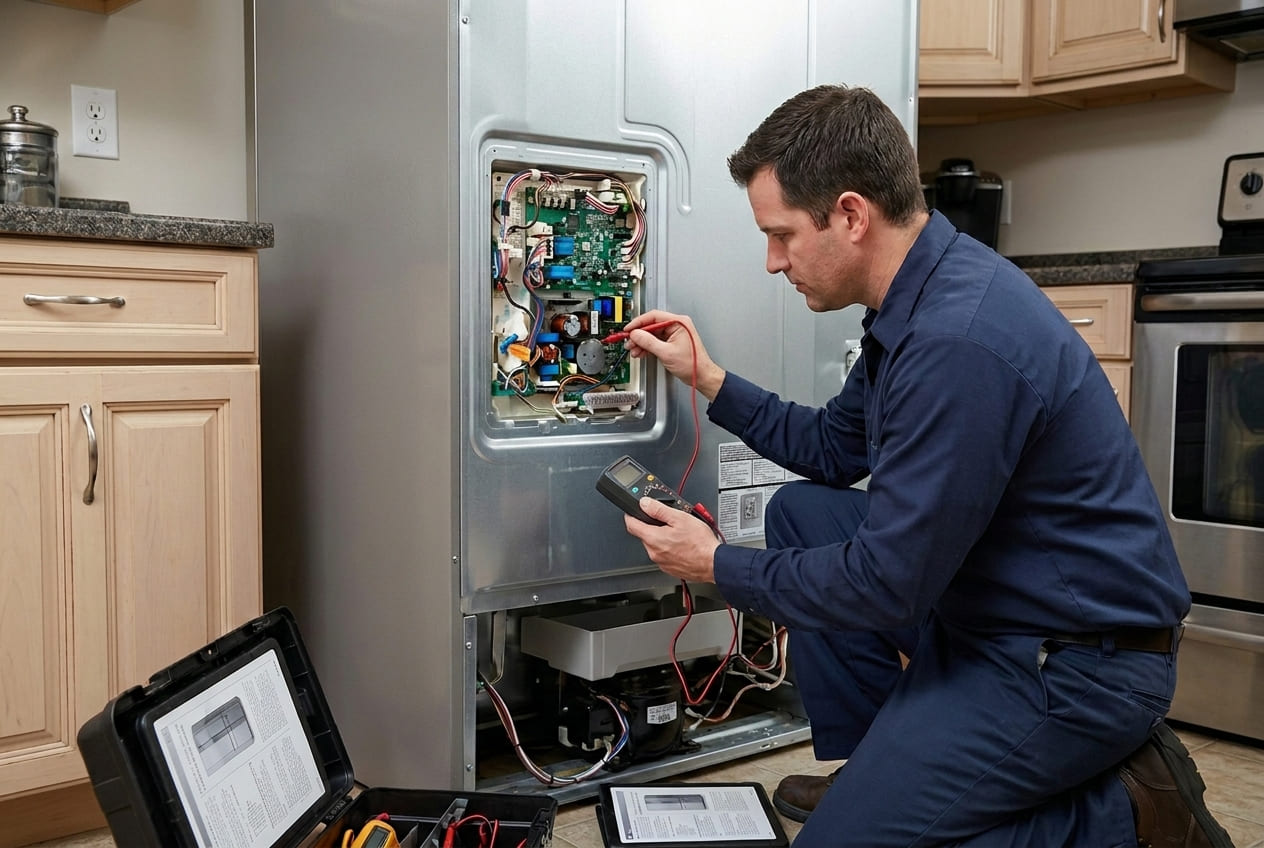
Of course, here we’ll talk about control boards. Modern LG French door refrigerators are controlled by boards that coordinate compressor operation, fans, defrost cycles, and sensor inputs. When a control board starts failing, you can get almost any symptom:
- Intermittent cooling
- Fans not running consistently
- Defrost not initiating
- Display acting weird
- Compressor not engaging when it should
- Random temperature swings
This is where a lot of parts darts get thrown: swap a board, swap a sensor, swap an ice maker, hope it sticks.
Our technicians’ approach is to verify:
- Is the board receiving correct sensor readings?
- Is it sending proper voltage/commands to fans and compressors?
- Is there a repeatable fault pattern?
Boards can be expensive, and on inverter-driven systems, the relationship between board and compressor matters.
Warranty Questions
Many LFXS and LMXS owners assume a compressor issue means a free repair.
That’s where homeowners get stuck. They hear “10-year compressor warranty” and assume the whole repair is covered. In practice:
- The part might be covered
- Labor may not be fully covered past a certain period
- Eligibility depends on model/serial and documentation
- You still need correct diagnosis and proper repair procedure
For example, LG’s U.S. support documentation for certain LFXS models lists compressor warranty coverage including extended parts coverage. Warranty terms can vary by model and purchase date.
As a good service company, we will verify what applies before anyone commits to major work.
This parts only detail matters. Labor costs can still apply after the first year. Coverage also depends on model and serial number.
Before making repair decisions, verifying warranty status is step one.
Repair or Replace? Quick Decision Snapshot
Scenario | Smarter Move | Why |
First compressor failure on unit under 8–9 years | Repair | Cabinet and insulation still strong; part coverage may apply |
Ice maker or control board issue only | Repair | Localized failure, not sealed system |
Multiple sealed system repairs already done | Replace | High chance of repeat failure |
Internal refrigerant leak in cabinet wall | Replace | Not economically repairable |
Unit over 10 years old with major failure | Replace | Repair cost often exceeds remaining lifespan |
Why Sealed-System Repairs Aren’t DIY
Sealed-system work involves regulated refrigerant handling and proper procedures: recovery, leak checks, evacuation, and correct charging.
A sloppy sealed-system job often leads to repeat failures, contamination in the system, or a refrigerator that cools “kind of” for a few weeks and then collapses again.
Accuracy determines longevity.
Atlanta Homes: The Local Factors That Matter
Across Atlanta and surrounding Georgia communities, we commonly see:
- Power fluctuations stressing electronics
- Garage installations exposed to high heat
- Tight cabinetry limiting airflow
- Pet hair clogging condenser areas
These factors don’t automatically cause failure, but they increase stress on the system.
What You Can Check Before Calling
Before scheduling service, homeowners can:
- Confirm temperature settings
- Ensure doors seal tightly
- Replace overdue water filters
- Clean accessible condenser areas
- Listen for airflow at interior vents
If cooling continues to decline, professional diagnosis is the next step.
LG French Door Repair in Atlanta & Georgia
If your LG LFXS or LMXS refrigerator is:
- Not cooling
- Running constantly
- Experiencing ice maker problems
- Showing signs associated with linear compressor failure
- Having control board issues
The Bottom Line
An LG French door refrigerator isn’t a simple appliance. It’s a sophisticated system with compressor, sensors, fans, control board—all of it working in balance. When one part drifts, the whole machine starts compensating. That’s why these units don’t always fail loudly.
The mistake isn’t owning an LFXS or LMXS model. And it’s not even having a problem. The mistake is assuming every symptom means the same thing—or waiting until the refrigerator fully gives up before acting.
Most major breakdowns start as small warnings: longer run times, softer ice cream, slower ice production, uneven cooling from shelf to shelf. Those early signs are opportunities. Catch the issue early, and you’re usually talking about a repair. Ignore it long enough, and you’re talking about replacement.
If your LG French door refrigerator is acting differently than it used to, trust that instinct. These machines are designed to run quietly in the background.
At Appliance Repair Master, we specialize in LG French Door refrigerator repair as well as being fluent with luxury appliances. We verify warranty status, diagnose correctly, and recommend repair or replacement based on condition, not assumption.
And with the right diagnosis, most of the time, they can be brought back to doing exactly what they were meant to do—keeping your kitchen routine uninterrupted.
FAQ
1. Why is my LG French Door refrigerator not cooling but still running?
If your LG LFXS or LMXS refrigerator is running but not cooling properly, the issue is not always the compressor. While linear compressor failure is possible, similar symptoms can be caused by airflow restrictions, evaporator fan problems, defrost system failure, or sealed system leaks. These refrigerators often continue running while cooling performance gradually declines, which is why proper diagnosis is critical before replacing major components.
2. How do I know if my LG linear compressor has failed?
A failed linear compressor typically results in both the refrigerator and freezer sections warming up, extended run times, and little to no temperature recovery. However, a compressor can also weaken before fully failing. The only reliable way to confirm compressor failure is through electrical testing and sealed system pressure readings. Noise alone is not a reliable indicator.
3. Is LG’s 10-year compressor warranty fully covered?
Many LG French door refrigerator models include extended compressor part coverage, often up to 10 years. However, labor coverage is usually shorter than the parts coverage. Warranty terms depend on the specific model and purchase date. It’s important to verify your unit’s eligibility before assuming the repair will be fully covered.
4. Why is my LG French Door ice maker not making ice?
Ice maker problems in LFXS and LMXS models can be caused by unstable temperatures, low water pressure, a faulty inlet valve, airflow issues, or a failed ice maker assembly. In many cases, ice production issues are linked to cooling inconsistencies rather than the ice maker itself.
5. Should I repair or replace my LG French Door refrigerator?
Repair is often worthwhile if the refrigerator is under 8–9 years old and hasn’t had repeated sealed system repairs. Replacement may make more sense if the unit is over 10 years old, has experienced multiple compressor failures, or has an internal refrigerant leak that cannot be economically repaired. A professional diagnosis helps determine the most cost-effective decision.