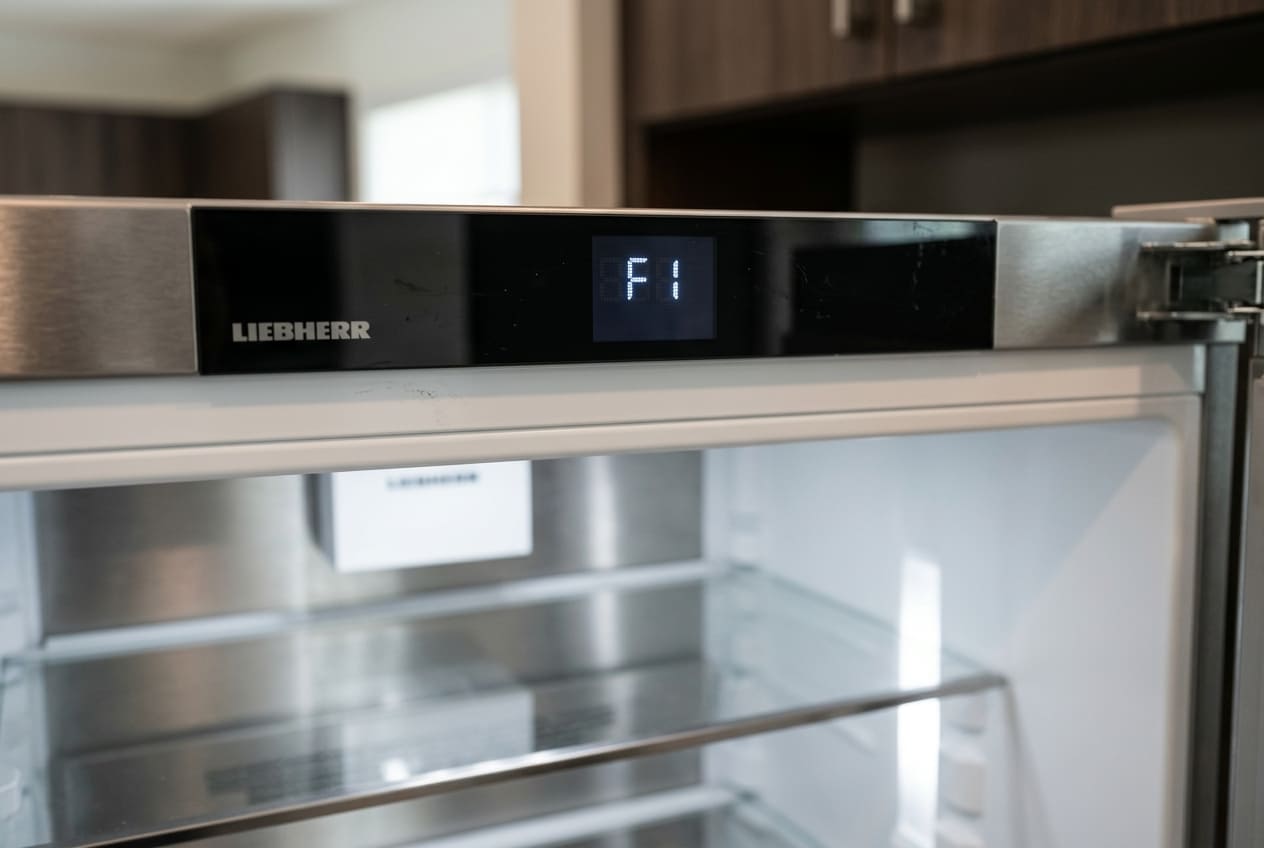
When a Liebherr freezer posts an F error, the appliance requires a measured diagnosis. The freezer may continue running, but one part of the temperature-control system has lost reliable communication with the board.
For freezer complaints, the strongest public service path centers on F3 and F4: freezer air sensing and freezer evaporator sensing. F5 raises board-side concern. Other F numbers need model-specific service information before anyone should attach a part name to the code.
That matters in Atlanta homes. Humid air, frequent door openings, heavy grocery loads, and built-in kitchen layouts all demand clean recovery from a premium freezer. Appliance Repair Master services Liebherr freezer and refrigerator-freezer problems across Atlanta and nearby Georgia communities. Our diagnostic work starts with the appliance designation, service number, serial number, affected compartment, exact display message, temperature behavior, and alarm history.
What this page covers
This page focuses on Liebherr freezer F errors only. It doesn’t fold unrelated appliance families or model-series marketing labels into the freezer diagnosis.
F3 and F4 are handled as the main freezer-facing faults. F5 is handled as a control-board response concern. F0-F2 and F6-F9 are discussed only as model-specific displays that need the exact service number before diagnosis.
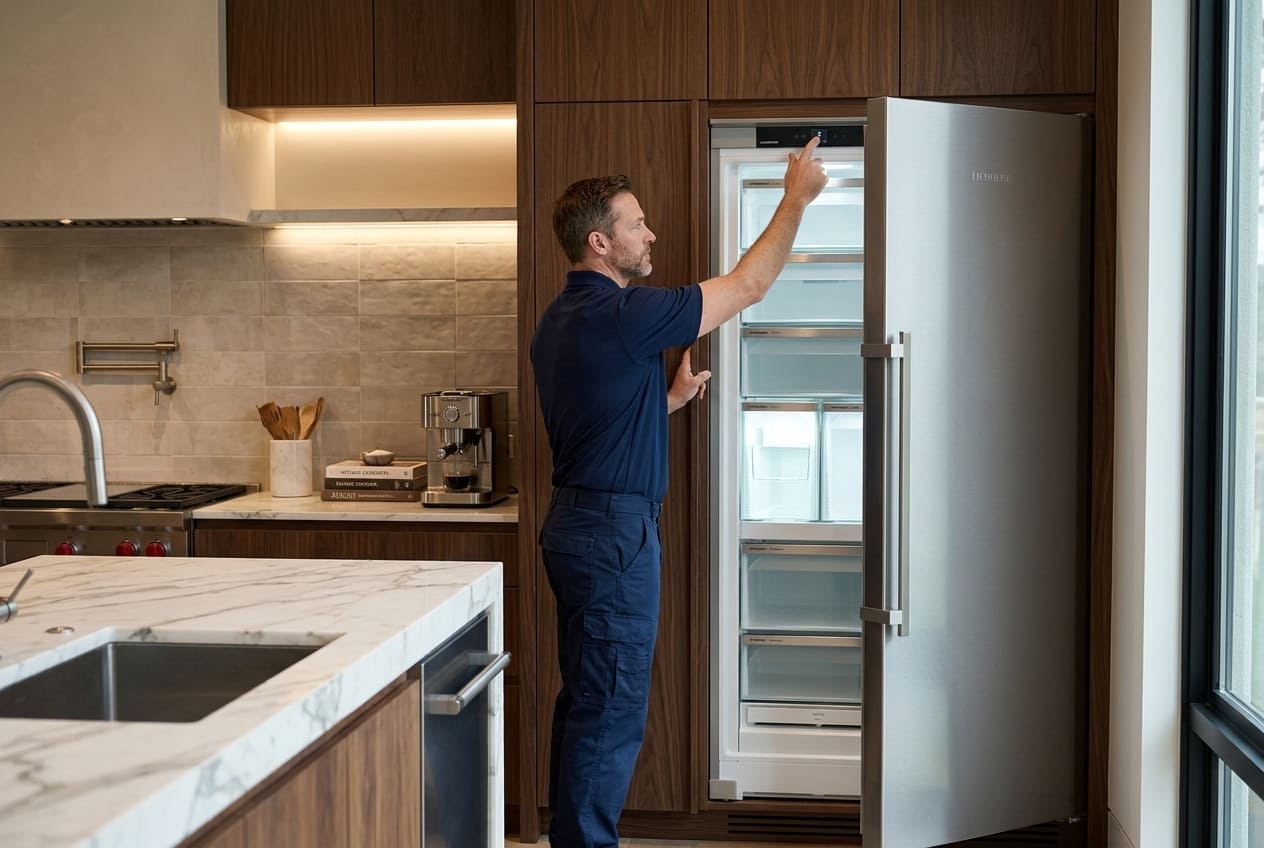
What a Liebherr Freezer F Error Means
F error is a service-level fault signal. It can involve the freezer air sensor, freezer evaporator sensor, wiring path, connector condition, or the board that interprets the incoming signal.
The service number matters because Liebherr appliance electronics changed across generations. A responsible repair starts with the exact appliance data, then confirms the code against measured freezer temperature and operating behavior.
F3 Freezer air sensor path. Common clues: freezer temperature drift, softening food, slow recovery after door openings. | F4 Freezer evaporator sensor path. Common clues: frost changes, uneven cooling, fault returning after cooling cycles. |
F5 Control-board response path. Common clues: inconsistent fault behavior, signal problems that do not resolve after sensor checks. | F0-F2 / F6-F9 Model-specific service path. Do not attach a freezer part claim without the service number and appliance-specific data. |
Quick decision panel
If the freezer is warming: protect food first, reduce door openings, and schedule service.
If the freezer still holds temperature: save the code photo, note recent events, and avoid repeated resets before diagnosis.
If the code is F6-F9: treat it as model-specific and preserve the display before clearing it.

F3: Freezer Air Sensor Fault
F3 is the core freezer-side code to take seriously. It commonly points toward the freezer air sensor path: the part of the control system that helps the board understand freezer compartment temperature.
A freezer air sensor fault can look like a cooling problem from the kitchen side. The appliance may run, the display may still respond, and the compressor may sound normal. The issue is the data feeding the cooling decision.
- Freezer temperature drifts outside its normal range
- Ice cream softens near the front of the drawer or shelf
- Food near the door loses firmness first
- The temperature alarm returns after normal use
- Recovery after door openings becomes slower
- The display temperature conflicts with food condition
F3 homeowner checkpoint
SAVE: Take a clear photo of the F3 display before clearing it.
MEASURE: Use a separate freezer thermometer if food condition is uncertain.
LIMIT: Reduce door openings while the fault is active.
CHECK: Note whether food near the front is softening first.
RECORD: Write down recent power loss, loading, door-left-open events, or cleaning.
REQUEST: Ask for freezer air sensor, connector, and board-input testing.

Repair path for F3
A technician verifies freezer temperature, compares it with display behavior, inspects the sensor circuit, checks connector seating, and confirms whether the board receives a stable freezer-temperature signal.
Part replacement comes after the failed path is identified. Replacing a sensor without testing the circuit can miss a loose connector or board-side fault.

F4: Freezer Evaporator Sensor Fault
F4 commonly belongs to the freezer evaporator sensor path. That sensor helps the appliance manage cooling cycles and interpret conditions around the evaporator area.
When evaporator feedback becomes unreliable, the freezer may cool unevenly, recover poorly, or build frost patterns that return after clearing the display.
- Frost behavior changes around the freezer section
- The freezer cools unevenly from front to back
- Temperature alarm returns after cooling cycles
- Food near the front softens first
- The fault returns after a reset or restart
- Freezer recovery becomes sluggish after door openings
F4 evaporator-side clues
LOOK: Check whether frost has changed since the fault appeared.
NOTE: Track recovery time after the door has been opened.
COMPARE: Check food condition near front and rear zones.
AVOID: Don’t scrape ice near the evaporator area.
PHOTO: Capture frost patterns before wiping or defrosting.
REQUEST: Ask for evaporator sensor, harness, and board-response testing.

Repair path for F4
A proper F4 visit checks freezer temperature, frost pattern, evaporator sensor behavior, connector condition, harness integrity, and control-board response.
Sharp tools, forced panel removal, or rushed ice clearing can turn a sensor fault into a damaged evaporator job. Preserve the symptom pattern and let the technician test the circuit cleanly.

F5: Control-Board Response Fault
F5 raises concern around the control electronics. The board receives sensor data, interprets that input, and directs freezer operation. If board response becomes unstable, the appliance can act inconsistent even when individual sensors appear reasonable at first pass.
This is not a homeowner reset issue. Board-side diagnosis requires electrical checks, stable power review, connector inspection, and a clear comparison between sensor input and appliance response.
- Fault behavior changes across use cycles
- The display clears, then the fault returns without a simple temperature pattern
- Sensor readings don’t explain appliance behavior
- The freezer runs unpredictably after basic checks
- Multiple alarms or display behaviors appear close together
- The appliance fails to respond normally after service-level testing
Sensor fault The sensor sends the wrong value or loses a stable reading. | Wiring fault The signal breaks before it reaches the board. |
Connector fault Poor contact creates intermittent behavior. | Board fault The board mishandles incoming data or fails response checks. |
Repair path for F5
The technician compares sensor input with board response, inspects connectors, checks communication stability, and verifies whether the board can interpret the circuit correctly.
What If the Display Shows F0-F2 or F6-F9?
Don’t use generic internet tables to force every F number into a freezer repair.
If the display shows F0, F1, F2, F6, F7, F8, or F9, preserve the code and match the appliance by service number. The technician should verify the exact fault path against the model before recommending a sensor, harness, or board repair.
Model-specific F-code handling
CAPTURE: Take a photo of the display and alarm status.
CONFIRM: Find the service number inside the appliance.
MEASURE: Check whether the freezer is holding temperature.
DOCUMENT: Note recent power loss, heavy loading, or door-left-open events.
AVOID: Don’t order parts from a universal code chart.
SCHEDULE: Request model-specific Liebherr freezer diagnosis.

Food Safety Comes First
F error becomes urgent when freezer temperature rises or food begins to soften. The display matters, but food condition drives the next move.
Keep the door closed as much as practical. Move high-value or highly perishable items if the freezer is warming. Take a photo of the code before any reset. A preserved timeline helps the technician diagnose faster.
Homeowner action list
SAVE: Photo of the F error display.
CHECK: Door fully closed and gasket making contact.
MEASURE: Separate thermometer reading if available.
LIMIT: Door openings while the fault is active.
MOVE Sensitive food if freezer temperature is rising.
RECORD: Recent loading, power outage, cleaning, or alarm events.
Don’ts Before Service
- Don’t repeatedly unplug the freezer to make the display disappear.
- Don’t scrape ice near the evaporator or sensor area.
- Don’t pull panels to inspect wiring.
- Don’t use liquid cleaners around electronic contact areas.
- Don’t load warm food into the freezer while troubleshooting.
- Don’t order a sensor before the service number and circuit test confirm the path.
- Don’t assume every F error means the same part across Liebherr generations.
Why this matters
Repeated resets can erase useful timing. Forced access can damage panels, wiring, insulation, or evaporator components. The safest homeowner role is to preserve the display, protect the food, and give the technician a clean fault history.

How Appliance Repair Master Diagnoses a Liebherr Freezer F Error
- Code and appliance confirmation: We record the display behavior, service number, freezer type, and alarm history.
- Temperature verification: We compare measured freezer temperature with the display and food condition.
- Freezer sensor-path inspection: For F3, we check the freezer air sensor circuit and connector path.
- Evaporator-side inspection: For F4, we check evaporator sensor behavior, frost pattern, harness condition, and board input.
- Board-response testing: For F5, we verify whether the board receives and interprets the sensor path correctly.
- Wiring and connector review: We inspect visible wear, loose seating, moisture, corrosion, and continuity where accessible.
- Repair recommendation: We explain whether the evidence points to a sensor, wiring correction, connector service, evaporator-side repair, or board diagnosis.
- Final system test: We confirm display behavior, freezer temperature response, and alarm status after the repair path is completed.
Why Atlanta homeowners choose Appliance Repair Master
- Liebherr-focused freezer diagnostics,
- same-day service availability,
- sensor and evaporator testing,
- control-board troubleshooting,
- model-specific repair planning,
- and 15+ years of appliance repair experience.
When to Get the F Error Checked
- F3 or F4 appears on a Liebherr freezer display
- The freezer temperature is rising
- Food softens or refreezes with poor texture
- The temperature alarm returns after normal use
- The error comes back after clearing the display
- F5 appears or the display behavior becomes inconsistent
- The fault appears after panel work, cleaning, or a power event
- F6-F9 appears and the manual does not clearly identify the fault

Bottom Line
For a Liebherr freezer, F3 and F4 deserve the most attention because they align with freezer-side sensor and evaporator-feedback faults in public service references. F5 raises control-board concern. F0-F2 and F6-F9 should stay model-specific until the appliance service number confirms the correct diagnostic path.
The repair starts with the display code, measured freezer temperature, alarm timing, food condition, wiring path, and board response. Appliance Repair Master checks those points in one focused visit so the recommendation follows the test results instead of a generic code chart.
FAQ
1. Is every F number a freezer fault?
No. Some F numbers can belong to product-specific paths outside the freezer-side diagnosis. This page keeps the repair focus on freezer-facing F errors and model-specific verification.
2. Which Liebherr F errors matter most for a freezer?
F3 and F4 are the key freezer-side codes in public service references. F3 points toward freezer air sensing. F4 points toward freezer evaporator sensing.
3. What does F3 mean on a Liebherr freezer?
F3 commonly points toward the freezer air sensor path. A technician checks measured freezer temperature, food condition, connector seating, wiring continuity, and board input.
4. What does F4 mean on a Liebherr freezer?
F4 commonly points toward the freezer evaporator sensor path. Frost behavior, freezer recovery, evaporator feedback, harness condition, and board response matter during diagnosis.
5. What does F5 mean?
F5 raises control-board or control-electronics concern. It should be diagnosed after sensor input, wiring, and connector stability have been checked.