
Samsung refrigerators can leak for several very different reasons, and the puddle itself usually shows you very little. What matters is:
- where the water shows up,
- when it shows up,
- and whether it returns in the same place.
Water under a drawer is not the same problem as a dispenser drip. Moisture along the gasket is not the same problem as a water filter leak. And a recurring pool under the cabinet can come from a defrost drain clogged line, a frozen drain tube, or an ice maker water line that is no longer sealing the way it should.
Our article is written to sort that out fast. It follows the most common samsung water leaking patterns back to their likely source, including:
- autofill water pitcher leak complaints,
- internal drain failures,
- and door seal condensation that keeps showing up in the same spot.
Our goal is simple: give homeowners a clearer read on the leak, help them rule out the obvious, and make it easier to decide when repair is the next step.
Leak pattern map
This quick table is designed to shorten the first stage of diagnosis. Start with where the water shows up, then read the likely system behind it.
Where you see water | Most likely cause | What to inspect first | Typical next step |
Under crisper drawers | defrost drain clogged or frozen drain tube | Rear evaporator cover and drain trough | Clear the drain path and confirm the heater clip or drain probe is working |
At the dispenser recess | dispenser drip or valve seepage | Nozzle, dispenser paddle, and post-dispense drip pattern | Check whether the drip is brief and normal or continuous and service-worthy |
Around the filter area | water filter leak | Filter seating, O-rings, and filter head housing | Re-seat the filter, purge air, and inspect the housing for cracks |
Behind or under the cabinet | ice maker water line or inlet connection | Supply line, couplers, and valve area | Inspect for abrasion, loose compression fittings, and seepage under pressure |
Along the door frame | door seal condensation | Gasket condition, leveling, and room humidity | Confirm the seal, alignment, and heater settings before deeper repair |

Pitcher, dispenser, and gasket zone
Front-of-cabinet leaks are easy to misread. Water near the dispenser does not always mean a dispenser fault. Moisture near the gasket does not automatically mean the door seal is bad. On Samsung models with a Beverage Center, the same front zone includes the dispenser nozzle, the pitcher dock, the gasket edge, and several surfaces where warm room air meets cold interior parts.
Start with one question: when does the water appear?
After dispensing? After the pitcher refills? After the door has been opened several times? That timing usually tells you more than the puddle itself.
Autofill water pitcher leak
An autofill water pitcher leak usually shows up inside the Beverage Center or along the shelf edge below it. Common causes are simple: the pitcher is not fully seated, the lid seal is out of position, the sensor area is wet, or leftover water has not drained correctly after the pitcher was removed and reinstalled. The key detail is the repeat pattern. If the water appears during fill or right after the pitcher is handled, start there.
Dispenser drip
A light dispenser drip right after dispensing can be normal. A drip that keeps returning, leaves standing water, or shows up long after use is a different issue. That usually points to a valve that is not closing cleanly, a nozzle assembly problem, or pressure changes after a recent filter change. Immediate after-drip and delayed seepage are not the same symptoms.
Door seal condensation
Door seal condensation is often reported as a leak because it leaves water along the gasket line or at the lower edge of the door. In most cases, the cause is humid air reaching a cold surface through a weak seal, frequent door openings, or slight door misalignment. That repair path is different from a drain problem or a water line fault, so it helps to separate condensation from an active water feed leak early.
Quick checks for the front zone
- Remove and reinstall the pitcher slowly; confirm it sits flat and the lid closes evenly.
- Check for moisture in the pitcher compartment before assuming the pitcher itself is defective.
- Dispense water, wait two to five seconds, and observe whether the dispenser drip stops or continues.
- Run a paper test on the gasket at several points; one weak section can create recurring door seal condensation.
Water under the drawers: usually a drain problem
Water under the crisper drawers or on the refrigerator floor usually comes from the defrost side of the system, not the drinking-water side.
During a normal defrost cycle, meltwater should move out of the cabinet through the drain path and down to the evaporation pan. When that path is restricted, water stays inside the refrigerator instead of draining away. Once enough collects, it runs forward and shows up under the drawers.
Defrost drain clogged
A defrost drain clogged condition is one of the most common causes of this leak pattern. The drain opening can narrow from debris, residue, or buildup, which slows the flow during defrost. Early on, the leak may appear only once in a while. As the restriction gets worse, the water comes back more often. That is why this problem is easy to underestimate: one cleanup can make it look solved when it is not.
Frozen drain tube
A frozen drain tube causes a similar leak, but the failure is different. In this case, the drain path is blocked by ice. Water cannot move through the tube, so it backs up inside the cabinet and often turns into sheet ice beneath the drawers. Owners may thaw it, see the leak disappear, and assume the fix worked. If the leak returns, the issue was not the ice alone — it was the reason the drain froze in the first place.
What this leak pattern usually means
If water keeps returning under the crispers, the job is to find out which of these is happening:
- water is draining too slowly
- water is not draining at all
- the drain path is freezing again after thawing
That difference decides the repair. A basic cleanup may help in a minor case. A recurring water leak usually means the drain system needs to be opened up, inspected, and corrected properly.
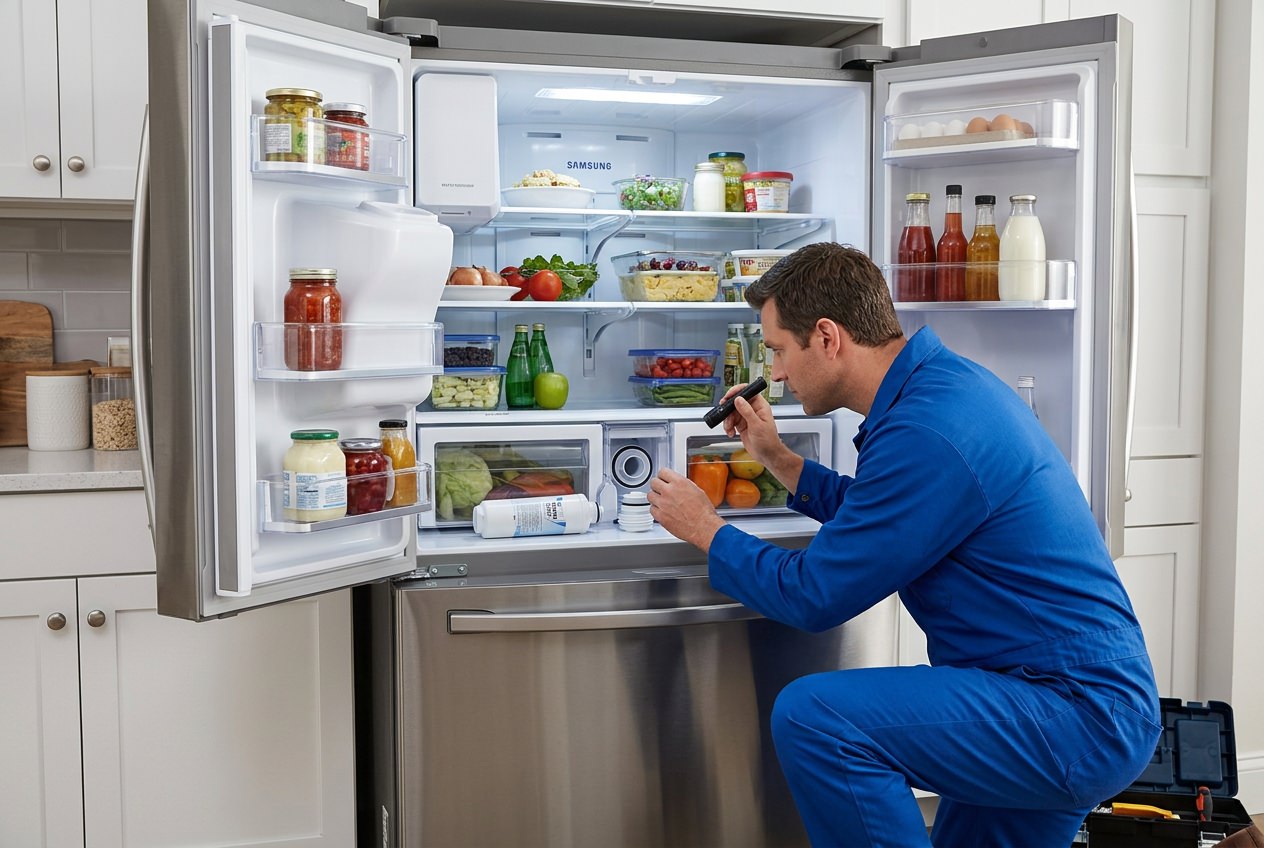
Water around the filter area or under the machine: pressurized water path faults
Leaks from the pressurized water path do not behave like defrost leaks. They are usually cleaner, more direct, and more likely to show up near the filter area, at the back of the refrigerator, or under the cabinet.
Two causes are often mixed together: water filter leak and ice maker water line problems. They both involve the water supply, but they fail differently.
Water filter leak
A water filter leak often starts right after the filter is replaced. The filter may not be locked in place, the seal may be damaged, or the housing may be cracked. In some cases, the leak shows up only when water is dispensed. That usually shifts attention to the filter head or its seals.
Ice maker water line
An ice maker water line leak usually starts lower and farther back. A loose fitting, worn section of line, or slow valve seep can leave water under the refrigerator. Some leaks appear only when the ice maker fills. Others keep forming because the valve does not close fully.
Quick way to separate the two
A pressurized-path leak changes when the household water supply to the refrigerator is turned off. A defrost leak does not. That is one of the fastest ways to tell whether the problem is coming from the supply line or from water trapped inside the cabinet.
The RF question homeowners ask online
Many owners search Samsung RF Series (lawsuit) when they see repeat icing, water under the deli area, or moisture around the ice room. That search term matters because it reflects a known pattern of owner concern around some RF-platform refrigerators.
For diagnosis, though, it does not answer the question: where is this refrigerator leaking from? A repeat water problem on an RF model can still come from very different faults — ice-room icing, drain restriction, valve seepage, filter-head leakage, or moisture caused by poor sealing.
That is why the repair has to stay specific. On these models, the technician needs to check the ice room, drain path, surrounding seals, and the control behavior affecting defrost and moisture management. The search term may point to a broader history. It does not replace a hands-on diagnosis of the unit in the kitchen.
Homeowner checks vs. service triggers
These checks are reasonable before booking service. The right-hand column marks the point where repeated moisture is no longer a setup issue.
What to check | What a normal result looks like | When to book repair |
Pitcher seating | Pitcher docks squarely, no standing water in the compartment | Moisture returns after correct seating or the pitcher area never fully dries |
Filter installation | Filter locks firmly, no drip after purge | Leak starts after every filter install or appears from the filter head body |
Drain behavior | No water under drawers after a full day of normal use | Water or ice returns under drawers after thawing or cleaning |
Dispenser after-drip | A brief, light drip stops quickly | Drip continues, pools, or reappears long after dispensing |
Rear supply line | No dampness under the cabinet with the water line on | Any persistent dampness at the rear line, coupler, or valve area |
Why location matters in Atlanta, Georgia
Leak diagnosis is never only about the refrigerator. Room conditions matter too. In Atlanta and across much of Georgia, humidity can make borderline sealing and moisture-management issues show up sooner. A weak gasket that might produce a small moisture trace in a dry season can become visible door seal condensation in a humid kitchen. A dispenser recess that already has minor after-drip can stay wet longer because evaporation is slower. A drain system that is beginning to struggle can be exposed faster when the refrigerator works harder to manage repeated warm, moist air entry.
That does not mean humidity is the root cause of every water leak. It means local conditions can amplify the symptom and make timing more noticeable. For service, this helps explain why some homeowners describe a leak as seasonal or say the refrigerator behaves worse after heavy kitchen traffic, long cooking sessions, or repeated openings during weekends and family gatherings. Those details are useful. They help tell the difference between an isolated spill event and a leak pattern tied to system performance.
Conclusion
Samsung refrigerator leak complaints usually become easier to solve once the symptom is sorted by system. Water under the drawers points toward drainage. Moisture at the dispenser calls for a different reading. A leak near the filter housing or behind the cabinet shifts attention to the pressurized water path. That is the value of a technical approach: it turns one vague complaint, samsung water leaking, into a smaller set of testable causes.
For homeowners, the best next step is not to keep resetting or monitoring indefinitely. It is to identify the pattern, perform the safe checks that fit that pattern, and act quickly when a water leak repeats. That is especially important when the refrigerator shows internal pooling, recurring ice under the drawers, persistent dispenser moisture, or any sign that the ice maker water line or filter head is leaking under pressure. The earlier the fault is isolated, the easier it is to prevent cabinet damage, floor damage, and repeat food-storage disruption.
FAQ
1. Why is my Samsung refrigerator leaking clear water under the crisper drawers?
The most common causes are a defrost drain clogged condition or a frozen drain tube. Both faults prevent defrost water from leaving the evaporator area correctly, so water moves forward and collects under the drawers.
2. Can a new filter cause a leak right away?
Yes. A water filter leak often starts immediately after replacement if the filter is not fully seated, an O-ring is damaged, the wrong filter is installed, or the housing has a crack. If the leak continues after correct installation and purging, the filter head assembly should be inspected.
3. How much dispenser drip is normal?
A brief dispenser drip right after dispensing can be normal. It becomes a service issue when the drip continues, pools in the recess, or returns long after the last use. At that point, the nozzle path, valve behavior, or pressure balance may need repair.
4. Could the pitcher area leak even if the pitcher itself is not cracked?
Yes. An autofill water pitcher leak can be caused by poor seating, a wet sensor area, an uneven lid seal, or residual water remaining in the compartment. The pitcher is only one part of the system.
5. Does shutting off the home water supply help with diagnosis?
It can. If the leak stops when the household supply to the refrigerator is shut off, the problem is more likely in the water filter leak path, inlet valve, or ice maker water line. If water still collects inside the cabinet, the drain system remains the stronger suspect.
6. Should I be concerned if I found the term Samsung RF Series (lawsuit) while researching my model?
It is useful as background because it reflects public discussion around recurring symptoms on some RF-platform refrigerators. It should not replace diagnosis. The same search term can be associated with different real faults, including ice-room moisture issues, drain problems, or dispenser-area leak behavior.