
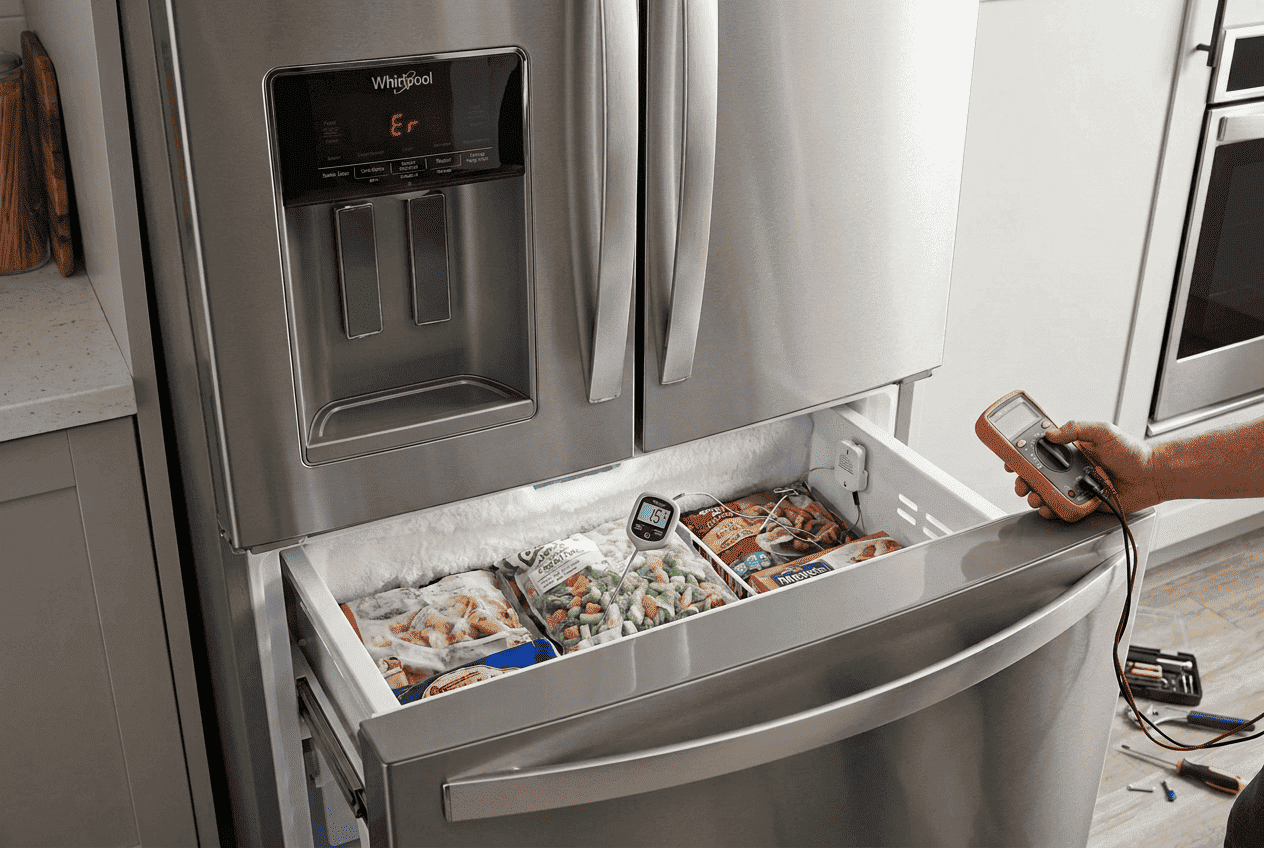
When a Whirlpool freezer displays Error Code ER, it means the appliance has detected a problem that affects how it monitors and controls freezer temperature. This issue often appears while the freezer is still running, which makes it difficult for homeowners to judge how serious the situation really is.
This article explains what Whirlpool Error Code ER means, why it appears in both standalone freezers and refrigerators with freezer compartments, and what typically causes it. You’ll learn how sensor failures, defrost problems, power interruptions, and communication errors can trigger the ER code, and how those issues affect freezer performance over time.
In many homes, the first signs are subtle. Freezer temperatures become less stable, frozen food does not stay fully solid, or an alarm begins sounding to indicate a temperature warning. When the ER code appears on the display, it confirms that the freezer can no longer regulate cooling accurately without intervention.
Error Code ER is common in Whirlpool French door, side-by-side, and bottom-freezer models. While the designs differ, the underlying causes are often the same. A temperature sensor may be failing, a defrost component may not be working correctly, or the control system may be receiving unreliable data.
Understanding what this code means and how it relates to your specific Whirlpool model can help you decide what steps to take next. Below you’ll learn the most common causes of Error Code ER, what symptoms usually accompany each one, and when professional repair is the most effective solution.
What Error Code ER Means on Whirlpool Freezers
In our day-to-day work across Atlanta and surrounding Georgia areas, we see Error Code ER more often than almost any other Whirlpool freezer alert. What makes it confusing for homeowners is that the freezer often still appears to be running when the code shows up. Lights are on, the compressor hums, and the display works. Yet something is clearly not right.
From a technical standpoint, Error Code ER means the freezer’s control board is no longer receiving trustworthy information from one of the systems it relies on to manage temperature. Whirlpool freezers depend on sensors and electronic communication to decide when to cool, when to stop, and when to defrost. When that information becomes unreliable, the appliance flags the problem instead of continuing to operate blindly.
In practical terms, ER is not a single failure. It is a family of errors that points to one of several underlying problems. In our experience, those problems usually fall into a few categories:
- A failing freezer temperature sensor (also called a thermistor)
- A defrost sensor or defrost system issue
- A power interruption that affected electronic components
- A communication error between control boards
Each of these problems affects freezer performance in a different way, and that distinction matters when deciding what to do next.
Why Whirlpool Uses ER Codes This Way
Whirlpool designs its appliances to warn homeowners early, before food safety is fully compromised or major components are damaged. Rather than waiting for temperatures to climb dramatically, the system displays ER when it detects abnormal readings, missing signals, or communication failures.
That is why many homeowners call us saying, “The freezer is still cold, but I’m getting this code.” In those cases, the appliance is telling the truth. It is still cooling, but it can no longer guarantee that temperatures will stay stable without intervention.
This is also why simply resetting the freezer often clears the display temporarily. A reset does not fix a sensor that is drifting out of range or a defrost component that is starting to fail. Once the freezer resumes normal operation and detects the same abnormal data, the ER code returns.
Standalone Freezers vs. Refrigerators With Freezers
We service both standalone Whirlpool freezers and Whirlpool refrigerators that include freezer compartments, and the ER code appears on both. However, how the problem shows up can differ depending on the design.
In standalone freezers, ER codes are more directly tied to:
- Freezer temperature sensor failure
- Defrost system problems
- Power-related electronic damage
In refrigerators with freezer compartments, especially French door, side-by-side, and bottom-freezer models, the system is more complex. These units rely on multiple sensors and control boards that communicate with one another. As a result, an error in one area, such as a pantry drawer sensor or user interface board, can indirectly affect freezer performance and trigger ER.
Understanding which type of appliance you have helps narrow down the likely cause and prevents unnecessary part replacement.
What You Can Safely Check at Home
There are a few basic observations homeowners can make without risking damage to the appliance:
- Confirm that freezer vents are not blocked by food packages
- Make sure the door is sealing properly and not left slightly open
- Note whether the freezer temperature is rising, falling, or fluctuating
- Pay attention to new sounds, such as fans running louder or longer
These checks help provide useful information, but they do not replace proper diagnosis. Testing sensors, defrost components, or control boards requires specific tools and Whirlpool specifications. Attempting deeper repairs without training often turns a manageable repair into a costly one.
This is why we encourage homeowners only to observe, not to experiment, when ER codes appear.
Freezer Temperature Sensor and Thermistor Failure
One of the most common reasons we are called out for Whirlpool Error Code ER is a failure related to the freezer temperature sensor, also known as the freezer thermistor. In Whirlpool diagnostics, this problem often appears as ER E2 or ER F2, and it affects both standalone freezers and refrigerators with freezer compartments.
From our experience servicing Whirlpool appliances throughout Atlanta, this issue rarely starts as a sudden breakdown. It usually develops gradually, which is why many homeowners do not connect early symptoms to a sensor problem until the error code appears.
What the Freezer Temperature Sensor Actually Does
The freezer temperature sensor is responsible for continuously measuring the internal temperature of the freezer compartment. That information is sent to the control board, which then decides:
- When to run the compressor
- How long cooling cycles should last
- When to stop cooling
- Whether temperatures are within safe limits
If the sensor provides accurate readings, the freezer maintains steady temperatures with minimal fluctuation. When the sensor begins to fail, the control board loses its reference point.
In simple terms, the freezer no longer knows how cold it really is.
How Freezer Thermistor Failure Triggers ER Codes
A freezer thermistor failure does not always mean the sensor stops working completely. In many cases, it starts sending incorrect resistance values. The control board compares those values to expected ranges. When the readings fall outside those ranges, the system recognizes that it can no longer trust the data.
At that point, Whirlpool’s software logic triggers Error Code ER, often accompanied by E2 or F2 codes, to indicate a temperature sensor problem.
This is why homeowners often tell us, “The freezer is still cold, but it doesn’t seem right.” The appliance may still cool, but without reliable feedback, it cannot maintain consistency.
Symptoms We Commonly See in Atlanta Homes
When we diagnose ER E2 or ER F2 calls, homeowners usually report one or more of the following issues:
- Frozen food becoming soft and then refreezing
- Ice cream that never fully hardens
- Frost buildup on food packaging
- The freezer running longer than usual
- Temperature readings that change unexpectedly
These symptoms are not random. They are direct results of the control board reacting to bad sensor data. Sometimes it overcompensates by running too long. Other times it shuts down cooling too early.
Why This Happens So Often in Whirlpool Freezers
Whirlpool freezer temperature sensors are exposed to extreme conditions over many years. In our experience, the most common causes include:
- Moisture intrusion from condensation or ice buildup
- Age-related sensor drift
- Wiring degradation from repeated freeze-thaw cycles
- Ice contacting the sensor directly after defrost issues
In French door and bottom-freezer models, sensor placement can make them more vulnerable to moisture and ice. In side-by-side units, longer wiring runs increase the chance of connection problems.
Can This Be Safely Checked at Home?
There are limited, non-invasive checks homeowners can make:
- Make sure airflow inside the freezer is not blocked
- Avoid packing items tightly against the rear wall where sensors are often located
- Note whether the freezer temperature changes after restocking or door openings
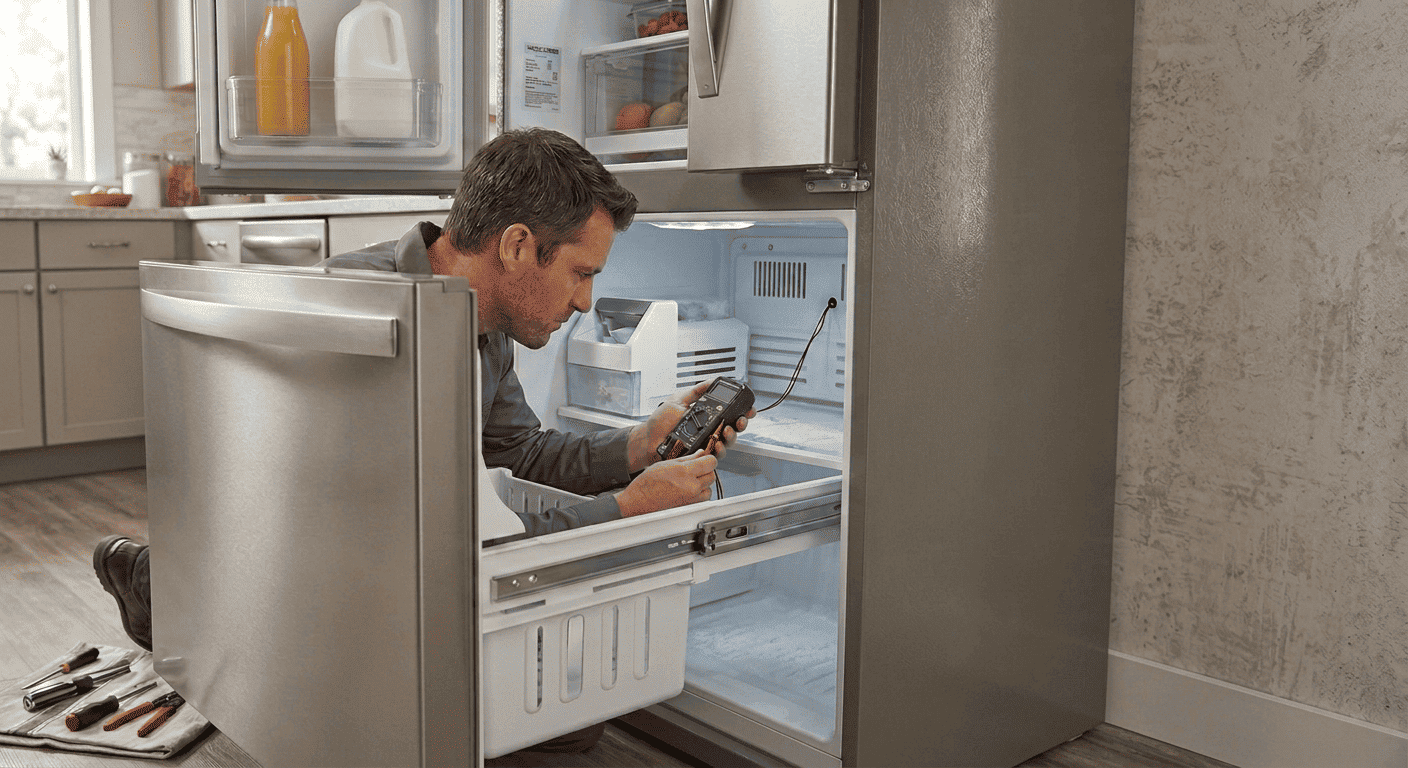
What we do not recommend is attempting to test or replace a sensor without proper tools. Thermistors must be tested with a multimeter and compared against Whirlpool’s resistance charts at specific temperatures. Installing the wrong sensor or misreading values can lead to additional error codes, control board confusion, or permanent damage.
From a cost perspective, a correctly diagnosed sensor replacement is usually straightforward. A misdiagnosed repair can quickly become expensive.
Why ER E2 / ER F2 Should Not Be Ignored
When a freezer temperature sensor fails, the appliance is operating without accurate guidance. Over time, this can cause:
- Inconsistent freezing and food spoilage
- Excessive compressor run time
- Increased energy consumption
- Stress on sealed system components
We often see cases where homeowners waited weeks after the first ER code, only to end up with secondary problems that could have been avoided with early repair. To learn more about error code E2, you can visit this page.
Defrost Sensor and Defrost System Problems
Another major cause behind Whirlpool Error Code ER involves the freezer’s defrost system. In Whirlpool diagnostics, these problems commonly appear as E5 or F5 defrost sensor errors, or as a DF defrost failure. We see these issues frequently in Atlanta homes, especially in refrigerators that have been in service for several years.
Unlike temperature sensor problems, defrost failures often develop quietly. The freezer may appear to be cooling, but behind the panels, ice is slowly building where it should not.
How the Defrost System Is Supposed to Work
Whirlpool freezers are designed to remove frost automatically. During normal operation, moisture in the air settles on the evaporator coils and freezes. To prevent ice from blocking airflow, the appliance periodically enters a defrost cycle.
During that cycle:
- The defrost heater warms the evaporator just enough to melt frost
- The defrost sensor monitors temperature to prevent overheating
- Melted ice drains away from the coils
When everything works as designed, this process happens without the homeowner ever noticing.
What Happens When the Defrost Sensor Fails
When the E5 F5 defrost sensor begins to fail, the freezer loses its ability to monitor defrost temperatures accurately. In some cases, the defrost cycle never completes. In others, it never starts at all.
As a result, frost remains on the evaporator coils and continues to accumulate. Because this happens behind the freezer’s interior panels, the problem is often invisible until performance is affected.
In our service calls, homeowners usually report issues such as:
- Freezer temperatures that slowly rise
- Uneven cooling inside the freezer
- Frost or snow forming on food packages
- Fan noise changing or becoming louder
When airflow becomes restricted, the freezer struggles to circulate cold air. The control board detects abnormal conditions and responds by triggering Error Code ER, often alongside DF defrost failure.
Why Defrost Failures Are Common in Whirlpool Units
From our experience, defrost-related ER codes occur most often due to:
- Defrost sensor failure from age or moisture
- Ice damage to sensor wiring
- A stressed defrost heater affecting sensor readings
- Previous temperature sensor problems that caused excessive icing
In French door and bottom-freezer models, the defrost system works harder because of frequent door openings and larger freezer compartments. This makes these models more susceptible to defrost sensor issues over time.
Why Defrost Problems Should Not Be Delayed
Defrost issues are rarely harmless. When ice buildup is left unaddressed, it can lead to:
- Complete airflow blockage
- Rapid temperature rise in the freezer
- Fan motor damage
- Increased compressor workload
We often see situations where a simple defrost sensor repair turns into a more involved job because the freezer was allowed to run in a restricted state for too long.
What Homeowners Can Safely Do
There are a few safe observations homeowners can make when defrost problems are suspected:
- Check for visible frost buildup inside the freezer
- Listen for changes in fan operation
- Note whether cooling improves temporarily after unplugging the unit
What we strongly advise against is manually chipping ice or using heat tools inside the freezer. This often damages panels, sensors, or wiring and can turn a repairable issue into a costly replacement.
Proper defrost diagnostics require access to internal components, electrical testing, and Whirlpool-specific specifications. This is where professional service becomes important.
High Temperature Alarms and Freezer Overheating
When a Whirlpool freezer shows E9 or F9, it means the internal temperature stayed too warm for too long. This code often appears together with Error Code ER and is usually a consequence of another unresolved issue rather than a standalone failure.
In our experience, high temperature alarms are most commonly triggered by:
- A failing freezer temperature sensor
- Ice buildup caused by defrost failure
- Restricted airflow inside the freezer
- A recent power outage
Even if the freezer cools again afterward, the alarm indicates that temperature control was lost at some point. Repeated E9 or F9 alerts suggest the underlying cause has not been resolved and should be addressed to prevent food loss and added strain on the system.
Power Interruption Issues
The PO power outage code appears when the freezer detects a loss of power long enough to affect internal temperature. In Georgia, this is common after storms or brief grid interruptions.
A single PO event is not usually a problem. However, when ER codes or cooling issues appear shortly after a power outage, it often means that a sensor or control component was affected by the voltage change. In those cases, the freezer may run but struggle to regulate temperature accurately.
Control Board Communication Errors
The SY CE communication error indicates that internal control boards are no longer communicating correctly. This issue is most common in French door and side-by-side refrigerators, which rely on multiple boards working together.
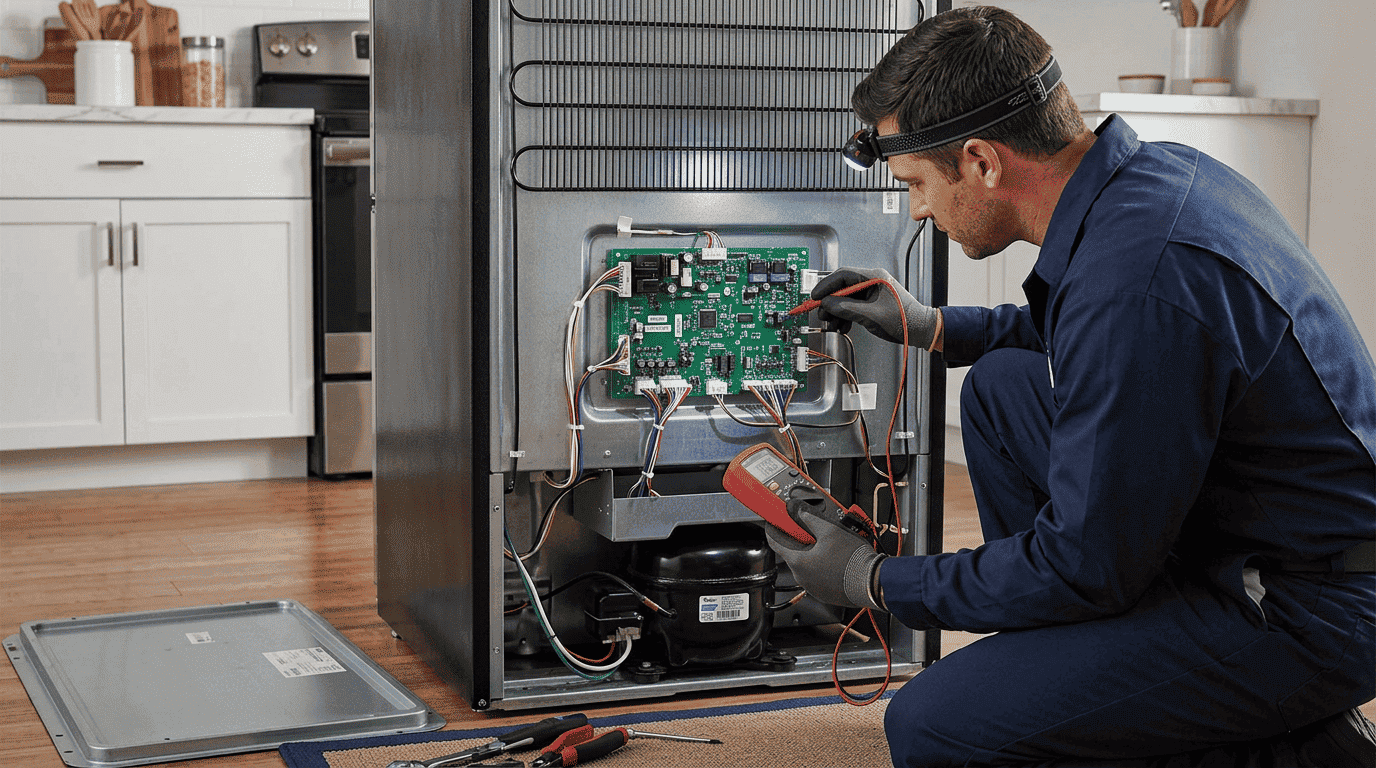
Communication errors can be caused by:
- Voltage damage after a power surge
- Loose or damaged wiring
- A failing user interface or main control board
When communication breaks down, the freezer may display ER codes even if cooling hardware is still functional. Proper diagnosis is essential, as replacing the wrong board often leads to repeat failures.
Pantry Sensor Problems in French Door Models
In Whirlpool French door refrigerators, a PC pantry sensor error may also contribute to ER codes. Although the pantry drawer is separate from the freezer, its sensor affects airflow and temperature balance across the appliance.
When the pantry sensor fails, the control system may mismanage cooling distribution. This can indirectly affect freezer performance and trigger ER warnings. These issues are not user-adjustable and typically require sensor testing and replacement.
Why Resetting Rarely Solves Error Code ER
Resetting the freezer may clear the display temporarily, but it does not correct sensor failures, defrost problems, or communication errors. Once the appliance resumes operation and detects the same abnormal data, the ER code usually returns.
If ER reappears after a reset, it is a strong indication that a component needs to be tested and repaired rather than reset again.
Whirlpool Models Commonly Affected by Error Code ER
We see Error Code ER most often in:
- French door refrigerators with multiple sensors and control boards
- Side-by-side models with long wiring harnesses
- Bottom-freezer units where sensors are exposed to moisture and ice
These are refrigerators with freezer compartments, not standalone freezers only, and each design has its own weak points that influence how ER codes appear.
What to Do When Whirlpool Error Code ER Appears
When Error Code ER shows up on a Whirlpool freezer, it is not a random glitch and not something to ignore. It means the appliance has lost reliable control over temperature monitoring, most often due to a sensor issue, defrost failure, power-related damage, or internal communication problem.
From our experience at Appliance Repair Master, ER codes rarely resolve on their own. In some cases, the freezer may continue to cool for a while, but performance becomes unpredictable. Food quality suffers first. Component stress follows next.
The key is timing. Addressing the problem early usually means a targeted repair, such as replacing a freezer temperature sensor, correcting a defrost sensor failure, or resolving a communication error. Waiting too long often leads to repeated alarms, food loss, and more expensive repairs.
If you are unsure whether the issue is minor or serious, professional diagnosis provides clarity before the problem escalates.
FAQ
1. What does Whirlpool Error Code ER mean?
Error Code ER indicates that the freezer is no longer receiving accurate information from a sensor or control system. As a result, it cannot regulate temperature reliably.
2. Is it safe to keep food in the freezer with an ER code?
If temperatures remain stable, food may be safe temporarily. However, ER codes often signal instability. Repeated temperature changes can compromise food quality even if items refreeze.
3. Can a power outage cause Error Code ER?
Yes. A PO power outage can trigger ER if electronic components or sensors are affected by voltage changes, especially after storms or repeated outages.
4. Will unplugging the freezer fix the problem?
Resetting may clear the display briefly, but it does not fix sensor failures, defrost issues, or SY CE communication errors. If ER returns, repair is usually required.
5. Which Whirlpool models are most affected by ER codes?
We most often see ER codes in French door, side-by-side, and bottom-freezer refrigerators, as well as some standalone freezers. These models rely heavily on multiple sensors and control boards.
6. Is this a repair or replacement situation?
In most cases, Error Code ER points to a repairable issue. Replacement is rarely necessary unless multiple major components are damaged.