
When a Whirlpool freezer displays Error Code E2, the appliance is not reporting a random malfunction or a minor electronic hiccup. It is issuing a warning that the freezer system can no longer rely on the temperature information it is receiving. From a professional repair standpoint, this is one of the most serious alerts Whirlpool equipment can generate, because it almost always points to a system-level imbalance rather than a single failed component.
At Appliance Repair Master, we have spent more than fifteen years repairing residential appliances across the full spectrum: from common mass-market models found in everyday homes to advanced luxury refrigeration systems installed in high-end properties. Over those years, we have diagnosed thousands of complex freezer-related failures. Error Code E2 consistently ranks among the most misunderstood, especially by homeowners attempting DIY repairs. The reason is simple: E2 looks like a sensor problem on the surface, but in practice it is usually a logic problem created by abnormal freezer behavior.
This article is written to depict the primary focus in Whirlpool freezer systems, including standalone upright and chest freezers. Within the same master article, we will also clearly explain how the same freezer logic operates inside refrigerators that contain freezer compartments, including French door, side-by-side, and bottom-freezer designs. These appliances are not standalone freezers, but the freezer system inside them follows the same rules, with added complexity.
How Whirlpool Freezer Systems Are Designed to Work
Modern Whirlpool freezers are electronically managed systems. Gone are the days of simple thermostats turning compressors on and off. Today’s freezers rely on constant feedback from multiple sensors and components, all interpreted by a control board that makes real-time decisions.
A properly functioning Whirlpool freezer depends on several critical elements working together:
- Accurate temperature feedback from thermistors
- Stable airflow provided by the evaporator fan
- A defrost system that prevents frost accumulation
- Reliable communication between sensors and the control board
When all of these elements operate within expected parameters, freezer temperatures remain stable and predictable. When even one element begins to drift, the control board detects behavior that no longer aligns with its programmed logic and records error codes. Error Code E2 specifically indicates that freezer temperature feedback has become unreliable.
What Error Code E2 Means
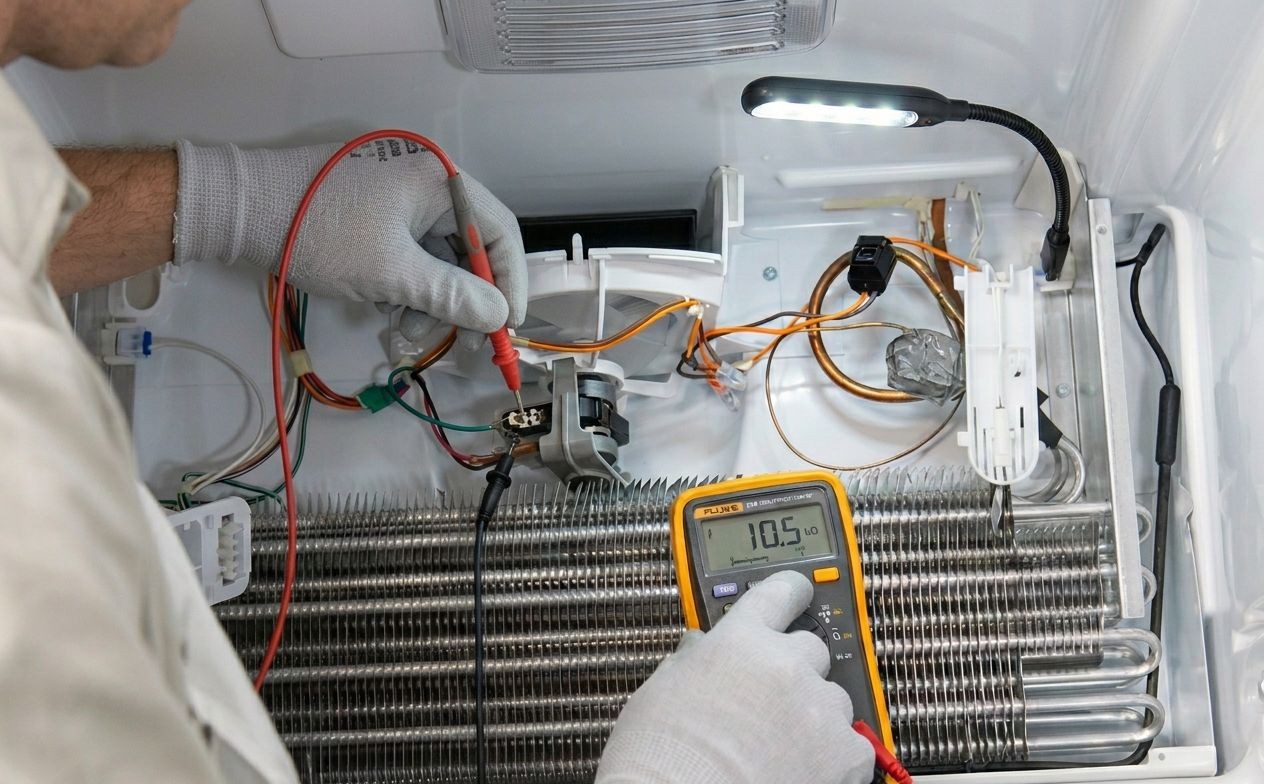
In technical documentation, Error Code E2 is most often described as a freezer sensor fault. While that description is technically correct, it is incomplete and frequently misleading for homeowners. From a practical diagnostic perspective, E2 means that the control board is receiving freezer temperature data that does not match physical reality or conflicts with other system inputs.
In our field experience, E2 almost always falls into one of three diagnostic categories:
- A sensor is providing incorrect, unstable, or drifting readings
- The freezer environment itself is abnormal due to airflow or frost issues
- Electrical communication between components is inconsistent
The critical takeaway is this: E2 is rarely solved by replacing parts blindly. Effective problem solving requires identifying which category applies and why.
Freezer Sensor Faults and Thermistor Behavior
Thermistors are temperature-sensitive resistors. As the freezer temperature changes, their electrical resistance changes along a predictable curve. The control board reads this resistance and interprets it as temperature. Over time, however, thermistors can degrade.
Common causes of thermistor failure include moisture exposure, insulation breakdown, internal element fatigue, and wiring strain. When a thermistor begins to drift, it may still function intermittently, producing readings that appear reasonable at times and invalid at others. The control board detects these inconsistencies and triggers Error Code E2.
However, in many cases we diagnose, the thermistor is not lying. It is accurately reporting an abnormal freezer condition created by another failure. This is why replacing a thermistor without understanding the freezer environment often leads to repeat E2 errors.
Defrost Sensor Faults and the Path Toward DF Defrost Failure
A defrost sensor fault is one of the most common contributors to Error Code E2. The defrost system is responsible for removing frost from the evaporator coil so that airflow can remain unrestricted. When defrost performance begins to decline, frost accumulates gradually and often goes unnoticed.
As frost builds on the evaporator:
- Airflow becomes restricted
- Cold air distribution becomes uneven
- Temperature varies significantly across the freezer
These conditions produce conflicting sensor readings. The control board interprets these conflicts as a freezer sensor fault and records E2. If the defrost problem continues, the system may later log DF defrost failure, which confirms that defrost cycles are not completing properly.
Evaporator Fan Error and Airflow-Driven Temperature Conflicts
An evaporator fan error does not always mean the fan has stopped spinning. In many Whirlpool freezers, fans weaken gradually. Bearings wear out, motors lose torque, or ice buildup interferes with rotation. The fan may still run, but not at the speed required to move air evenly throughout the freezer.
When airflow drops, temperature pockets form:
- Sensors near the evaporator read extremely cold
- Sensors farther away read warmer than expected
The control board cannot reconcile these readings and flags the situation as unreliable freezer temperature feedback, resulting in Error Code E2. In these cases, replacing sensors alone will not solve the problem because airflow imbalance is the true cause.
Condenser Thermistor and Its Indirect Role in E2
The condenser thermistor monitors how effectively the system is shedding heat. When condenser temperatures rise due to dirt buildup, restricted ventilation, or failing condenser fans, overall system behavior changes. Compressors run longer, cooling recovery slows, and temperature stabilization becomes erratic.
These system-wide changes affect freezer temperature behavior. The control board may interpret the resulting fluctuations as a freezer sensor fault, even though the issue originates outside the freezer compartment itself.
Ice Maker Thermistor and Freezer Feedback Loops
In Whirlpool freezers and refrigerators equipped with ice makers, the ice maker thermistor becomes part of the freezer temperature feedback loop. This sensor determines when ice harvest cycles occur. If it reports incorrect temperatures, the control board may disable ice production to prevent mechanical damage.
Homeowners often report that ice production stops first, followed by Error Code E2. Replacing the ice maker assembly without testing the thermistor and freezer environment frequently fails to resolve the underlying issue.
Power Events and PO Power Outage Warnings
A PO power outage warning indicates that freezer temperature rose during a loss of power. When power is restored, the control board reassesses sensor data under conditions that differ from normal operation. While power outages do not usually cause E2 directly, they often expose marginal components, weakened wiring connections, or sensors already drifting out of specification.
This is why many E2 service calls occur shortly after storms or electrical interruptions.
Reset Procedure: What It Can and Cannot Tell You
A reset procedure, performed by disconnecting power long enough for the control board to fully reboot, is a safe first step for homeowners. It can clear temporary logic faults caused by voltage irregularities or communication glitches.
A reset can help determine whether E2 was transient or persistent. If the error returns after normal operation resumes, the freezer system is confirming an active fault. A reset does not repair sensor drift, airflow problems, defrost failures, or communication instability.
Advanced Diagnostics, Model Differences, and Professional Problem Solving
We have already mentioned that Error Code E2 is not a simple failure message but a system-level warning indicating unreliable freezer temperature feedback. So let’s move deeper into how Whirlpool appliances detect and interpret this problem, why certain related error codes matter, how freezer design changes diagnostics, and where DIY efforts typically fall short.
We have also decided to clearly separate standalone Whirlpool freezers from refrigerators that contain freezer compartments, because while the freezer system logic is shared, the architecture and failure patterns are not identical.
Service Diagnostic Mode: Why It Exists and Why It Is Often Misused
Whirlpool appliances include a built-in service diagnostic mode designed for trained technicians. This mode allows access to stored error codes, live sensor readings, fan tests, and component activation sequences. In professional hands, it is a powerful diagnostic tool. In untrained hands, it is one of the fastest ways to complicate an already existing problem.
From a homeowner perspective, service diagnostic mode often creates a false sense of clarity. Seeing numbers on a display does not automatically mean those numbers are being interpreted correctly. Thermistor readings, for example, must be evaluated in context. A resistance value that appears “within range” at one temperature may be completely invalid at another.
Common problems we see after DIY diagnostic attempts include:
- Clearing stored error history that would have revealed a pattern
- Triggering additional error codes unrelated to the original failure
- Disabling normal cooling cycles or ice maker logic
- Misinterpreting time-based tests as component failures
For homeowners, service diagnostic mode is best used only to confirm the presence of Error Code E2. Anything beyond that requires experience, proper test equipment, and an understanding of how Whirlpool control boards prioritize inputs.
SY CE Communication Error and Why It Changes the Diagnosis
When Error Code E2 appears together with SY CE communication error, the entire diagnostic direction shifts. SY CE indicates a communication failure between key electronic components, such as the main control board and the user interface or secondary boards.
In these cases, the freezer system may actually be functioning mechanically as designed. Sensors may be accurate, airflow may be normal, and defrost may be working. However, if the control board cannot reliably receive or process data, it treats that data as untrustworthy and flags E2.
Communication failures are often caused by:
- Wiring harness damage or poor pin tension
- Oxidation at connectors
- Voltage instability
- Aging control board components
Replacing sensors in these situations almost never resolves the problem. Communication integrity must be restored before any sensor data can be trusted again.
PC Pantry Sensor and Cross-Zone Interference
In Whirlpool refrigerators equipped with pantry drawers, the PC pantry sensor introduces an additional layer of complexity. While this sensor does not belong directly to the freezer compartment, it influences airflow and temperature prioritization across the entire appliance.
When a pantry sensor reports incorrect temperatures, the control board may adjust dampers or fan operation in a way that indirectly destabilizes freezer conditions. This can lead to freezer temperature fluctuations that trigger Error Code E2, even though the freezer components themselves appear functional.
This is one of the reasons freezer diagnostics inside multi-zone refrigerators must consider the entire appliance, not just the freezer section.
Standalone Whirlpool Freezers: Upright and Chest Models
Standalone Whirlpool freezers operate with fewer zones and fewer sensors than refrigerators, but that simplicity does not make them immune to Error Code E2. In fact, because there are fewer variables, failures tend to show up more clearly.
In standalone freezers, E2 most often relates to:
- Freezer sensor fault caused by thermistor drift
- Defrost sensor fault leading to frost accumulation
- Evaporator fan error resulting in poor air circulation
Because airflow paths are simpler, diagnosing these units is often more direct. However, replacing parts without testing is still a common mistake. Even in standalone freezers, airflow restriction or wiring issues can mimic sensor failure.
Refrigerators With Freezer Compartments
The following appliance types are not standalone freezers, but refrigerators that contain freezer sections. While the freezer system logic is the same, the presence of additional compartments, dampers, and sensors changes how failures present themselves.
French Door Refrigerators
French door models are among the most complex Whirlpool designs. They often include multiple thermistors, adjustable dampers, pantry drawers, and independent temperature targets. In these systems, a failure in one zone can easily affect another.
A malfunctioning PC pantry sensor, for example, can alter airflow in a way that destabilizes freezer temperature. The control board sees conflicting data and logs Error Code E2, even though no single freezer component has failed outright.
Side-by-Side Refrigerators
Side-by-side designs rely heavily on balanced vertical airflow. Frost buildup on the evaporator, evaporator fan error conditions, or defrost sensor fault issues commonly disrupt this balance. Because freezer and fresh food compartments share airflow paths, problems escalate quickly and are often misdiagnosed as simple sensor failures.
Bottom-Freezer Refrigerators
Bottom-freezer designs are particularly sensitive to airflow restriction. Gravity, longer air paths, and ice accumulation all play a role. A small defrost problem or fan performance issue can create large temperature differences that trigger E2 even before food quality is visibly affected.
Why DIY Repairs Rarely Solve Error Code E2
Error Code E2 invites DIY attempts because it appears to point directly at a replaceable part. Unfortunately, this is where many homeowners lose time and money. Without proper testing, part replacement becomes guesswork.
The most common DIY mistakes we see include:
- Replacing thermistors without verifying airflow
- Ignoring defrost performance and frost patterns
- Clearing codes without understanding why they appeared
- Misinterpreting service diagnostic mode data
- Overlooking communication and wiring issues
These actions often suppress the symptom temporarily while allowing the underlying problem to continue.
How We Solve E2 Correctly
Professional freezer diagnostics focus on system behavior, not just component presence. At Appliance Repair Master, our technicians approach E2 methodically.
We evaluate:
- Sensor resistance under real operating temperatures
- Airflow volume and evaporator fan stability
- Defrost cycle initiation and completion
- Wiring integrity and connector condition
- Control board response to changing inputs
This approach allows us to identify the root cause rather than treating the symptom. It also prevents unnecessary part replacement and repeat service calls.
Reset Procedure Revisited: When It Is Helpful and When It Is Not
A reset procedure can be useful as an observation tool. If Error Code E2 clears and does not return under normal operation, the issue may have been transient. If it returns consistently, the freezer system is confirming a real failure.
Resets should never be used as a repair strategy. They do not correct sensor drift, airflow restriction, defrost failure, or communication errors. Treating resets as fixes only delays proper diagnosis.
Error Code E2 as an Early Warning Sign
One of the most important things homeowners should understand is that Error Code E2 often appears before catastrophic failure. It is an early warning that freezer logic is breaking down. Addressing it early can prevent food loss, compressor strain, and more expensive repairs later.
Ignoring E2 or repeatedly clearing it without diagnosis allows underlying issues to worsen until secondary components fail.
Treat E2 as a Freezer System Problem, Not a Part Problem
Whirlpool Error Code E2 means the freezer system no longer trusts its temperature feedback. Whether the appliance is a standalone freezer or a refrigerator with a freezer compartment, the message is the same: something in the freezer system is no longer behaving predictably.
While homeowners can safely observe symptoms and perform a reset procedure, persistent E2 errors almost always indicate deeper problems involving freezer sensor fault conditions, defrost sensor fault patterns, evaporator fan error behavior, condenser thermistor influence, or communication instability such as SY CE communication error.
Addressing these issues with structured diagnostics protects your appliance, your food, and your investment.
FAQ
1. Is Error Code E2 only related to the freezer?
Yes. E2 specifically refers to freezer system temperature feedback, even when it appears on refrigerators with freezer compartments.
2. Can defrost problems cause E2?
Yes. Defrost sensor faults and DF defrost failure often lead to airflow restriction and unstable freezer temperatures.
3. Does E2 always mean a bad sensor?
No. Airflow problems, wiring issues, and communication failures can all cause E2.
4. Can a power outage trigger E2?
A PO power outage can reveal existing weaknesses but is rarely the sole cause.
5. Should I attempt repairs myself?
Basic observation is safe, but without testing equipment and experience, DIY repairs often lead to repeat failures.