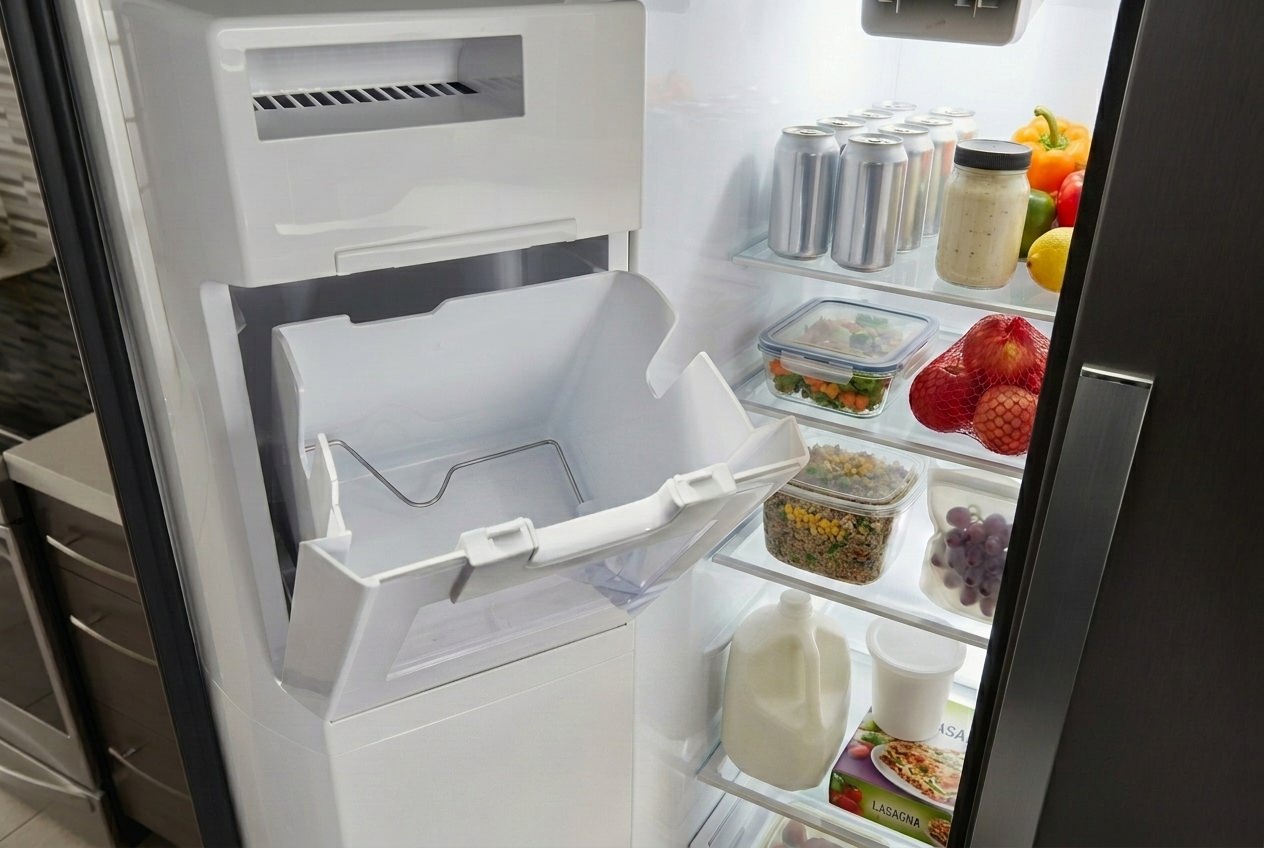
When customers reach out to us about a Whirlpool refrigerator, the complaint is often simple: the ice bin is empty. The refrigerator is running, the freezer feels cold, but there is no ice. At first, many assume it’s a temporary glitch. By the time they call us, days have usually passed with no change.
In our experience servicing Whirlpool refrigerators across Atlanta and Georgia, ice maker problems are rarely sudden. They develop quietly. Ice production slows, cubes get smaller, or the ice maker stops altogether without warning. That’s why a whirlpool ice maker not working is one of the most common issues we diagnose on Whirlpool units, especially in the WRF and WRS series.
In this article, we’re sharing how we approach these problems in our daily work. We’ll explain how Whirlpool ice makers are designed to operate, what stops them from producing ice, and how to tell when the issue is simple versus when it requires professional repair. Our goal is to help you understand what’s happening inside your refrigerator before frustration sets in.
How Whirlpool Ice Makers Are Designed to Work
Every Whirlpool ice maker follows a predictable process. When one part of that process fails, ice production stops completely.
In the WRF and WRS series we service most often, ice production depends on four conditions working together:
- The freezer must maintain the correct temperature
- Water must reach the ice maker at proper pressure
- The ice mold must freeze fully before harvesting
- The ice maker must release cubes into the bin
If any of these steps is interrupted, the system does not reset itself automatically. From the outside, the refrigerator still looks fine. Inside, the ice maker has simply stopped doing its job.
Understanding this sequence is key. In our practice, most ice maker repairs are not about replacing the ice maker itself, but about restoring one of these missing conditions.

Why Freezer Temperature Is Always Our First Check
Before we touch a water line or remove a panel, we always confirm freezer temperature.
Whirlpool ice makers will not cycle unless the freezer stays within freezer temperature 0-5F. Even small deviations can stop ice production. We regularly see situations where the freezer feels cold, but airflow or load conditions keep the ice maker area just warm enough to prevent freezing.
This often happens after:
- Large grocery loads
- Extended door openings
- Airflow obstruction near the ice maker
From our experience, customers are surprised to learn that ice makers are far more sensitive to temperature than frozen food. Food may stay frozen while the ice maker quietly shuts down.
Once we confirm temperature is stable and within range, we move on to water delivery.
Water Supply Issues We See Every Week
Water delivery problems account for a large percentage of Whirlpool ice maker service calls we handle.
One of the most common causes is a clogged water filter 6 months or older. Filters restrict water flow gradually, so the change is easy to miss. The refrigerator may still dispense water, but the ice maker no longer receives enough volume to complete a cycle.
Water pressure is just as important. Whirlpool ice makers rely on consistent pressure at the valve. If pressure drops below water inlet valve 20 psi, the valve may open partially or fail to deliver water at all.
When water supply is the issue, we often hear customers describe:
- Smaller ice cubes before ice stops completely
- Ice makers that cycle but never drop ice
- Silence where water flow should be heard
In these cases, restoring proper flow often resolves the problem without replacing the ice maker itself.
Mechanical Shutoff Arms and Simple Stops
Some Whirlpool ice makers include a mechanical shutoff arm designed to stop production when the bin is full. In our service work, we frequently find this arm engaged unintentionally.
If the control arm position down is incorrect, the ice maker remains disabled. This can happen when ice jams the bin, when items shift in the freezer, or when the arm is bumped during loading.
It’s a simple detail, but one that stops ice production completely. We always check this before moving on to deeper diagnostics.
Frozen Fill Tubes: A Common Whirlpool Ice Maker Failure We See
Another issue we diagnose frequently in Whirlpool WRF and WRS models is a frozen water fill tube.
The fill tube is the small channel that delivers water from the refrigerator’s internal valve into the ice maker mold. When this tube freezes, water cannot enter the ice maker at all. The result looks simple from the outside: the ice maker is intact, powered, and ready, but nothing happens.
In our experience, this problem often follows a partial fill or a delayed water shutoff. A small amount of water remains in the tube, freezes, and creates a blockage. From that point on, ice production stops completely.
Some homeowners attempt to resolve this with a frozen fill tube hairdryer approach. While gentle warming can temporarily clear the ice, we treat this as a diagnostic step only. If the tube freezes again, the cause has not been corrected.
In our practice, recurring fill tube freezing usually points to a valve or timing issue inside the refrigerator, not something outside of it.
Door Wiring Issues in Whirlpool WRS Series Models
Side-by-side Whirlpool refrigerators in the WRS series introduce another point of failure we see often: wiring that runs through the freezer door.
These models route power and signals through a wiring harness freezer door to supply the ice maker and dispenser. Over time, normal door movement can stress these wires. When that happens, ice production may stop suddenly or become intermittent.
From the customer’s perspective, the symptoms are confusing:
- The ice maker stops producing ice
- The dispenser may behave unpredictably
- Resetting the refrigerator changes nothing
Because the issue is hidden inside the door, it’s not visible without proper inspection. In our experience, this is one of the most commonly misdiagnosed causes of no ice in Whirlpool side-by-side units.
When we encounter this problem, the fix involves restoring proper electrical continuity within the refrigerator system itself.

Ice Blockages Inside the Dispenser System
Not all ice maker issues start at the mold. In some cases, ice is being produced but cannot move where it should.
An ice blockage dispenser issue occurs when ice clumps together inside the chute or bin area. This prevents new ice from dispensing and can also interfere with ice maker operation if the system believes the bin is full.
We often see this after:
- Partial melting and refreezing
- High humidity exposure
- Long periods without dispensing ice
Customers may believe the ice maker has stopped, when in reality ice is trapped inside the dispenser path. Clearing the blockage restores normal function, but repeated blockages usually indicate a temperature or airflow imbalance inside the freezer.
When the Ice Maker Itself Is Not the Problem
One of the most important points we share with customers is this: the ice maker assembly is not always the failed part.
In many Whirlpool service calls, we find the ice maker responding correctly. The problem lies in one of the supporting systems:
- Water delivery inside the refrigerator
- Temperature conditions near the ice maker
- Electrical communication within the unit
Replacing the ice maker without addressing these factors often leads to the same failure repeating.
Our approach focuses on identifying why the ice maker stopped responding rather than assuming it failed on its own.
What We Recommend Checking Before Scheduling Repair
Before calling us, there are a few refrigerator-specific things homeowners can safely observe without tools or disassembly.
We recommend noting:
- Whether the freezer is holding freezer temperature 0-5F
- Whether the ice maker shutoff arm is in the control arm position down
- Whether ice is present but stuck due to an ice blockage dispenser
If these conditions are correct and ice production has not resumed, the issue is almost always internal to the refrigerator system and requires professional diagnosis.
Why Whirlpool Ice Maker Problems Rarely Resolve on Their Own
In our years of servicing Whirlpool refrigerators, one pattern is consistent: ice maker issues tend to persist once they begin.
A refrigerator may continue cooling normally, giving the impression that the problem is minor. In reality, the ice system has already fallen out of sequence. Waiting rarely restores normal operation, and repeated resets often delay the real fix.
Addressing the issue early usually keeps the repair focused and contained. Waiting often leads to additional stress on components that were not part of the original failure.
Our Approach to Whirlpool Ice Maker Repair in Atlanta and Georgia
As an appliance repair service, we diagnose and repair the systems that control ice production inside Whirlpool WRF and WRS models, without involving unrelated household systems.
Our experience allows us to pinpoint failures efficiently, avoid unnecessary part replacements, and restore consistent ice production.
When customers call us for a whirlpool ice maker not working issue, our goal is simple: find the cause, fix it correctly, and make sure it stays fixed.
Final Thoughts
From our perspective, Whirlpool ice maker not working is rarely a mystery. It’s a system signalizing that one condition it depends on is no longer being met.
The value in understanding this issue is not learning how to fix it yourself. It’s knowing when the problem has moved beyond settings or simple checks. When that point is reached, the smartest move is addressing the cause directly instead of letting frustration build.
Our job is to restore consistent ice production, not just get ice to appear once and disappear again.
FAQ
1. Why is my Whirlpool ice maker not working if the freezer feels cold?
Because ice makers are more temperature-sensitive than frozen food. Even small deviations from freezer temperature 0-5F near the ice maker can stop the cycle while food remains frozen.
2. Can a clogged water filter really stop ice production?
Yes. A clogged water filter 6 months or older can restrict internal water flow enough to prevent the ice maker from filling, even if water still dispenses normally.
3. What does it mean if there is no ice but no error message?
Most Whirlpool ice maker failures do not trigger error codes. Issues like frozen fill tubes, wiring problems, or blocked dispensers stop production quietly.
4. Do Whirlpool WRS side-by-side models have unique ice maker issues?
They do. We frequently see problems related to the wiring harness freezer door, which supplies power and signals to the ice maker and dispenser.
5. Should I replace the ice maker if there is no ice?
Not automatically. In many cases we service, the ice maker is responding correctly and the issue lies elsewhere in the refrigerator system. Proper diagnosis prevents unnecessary part replacement.