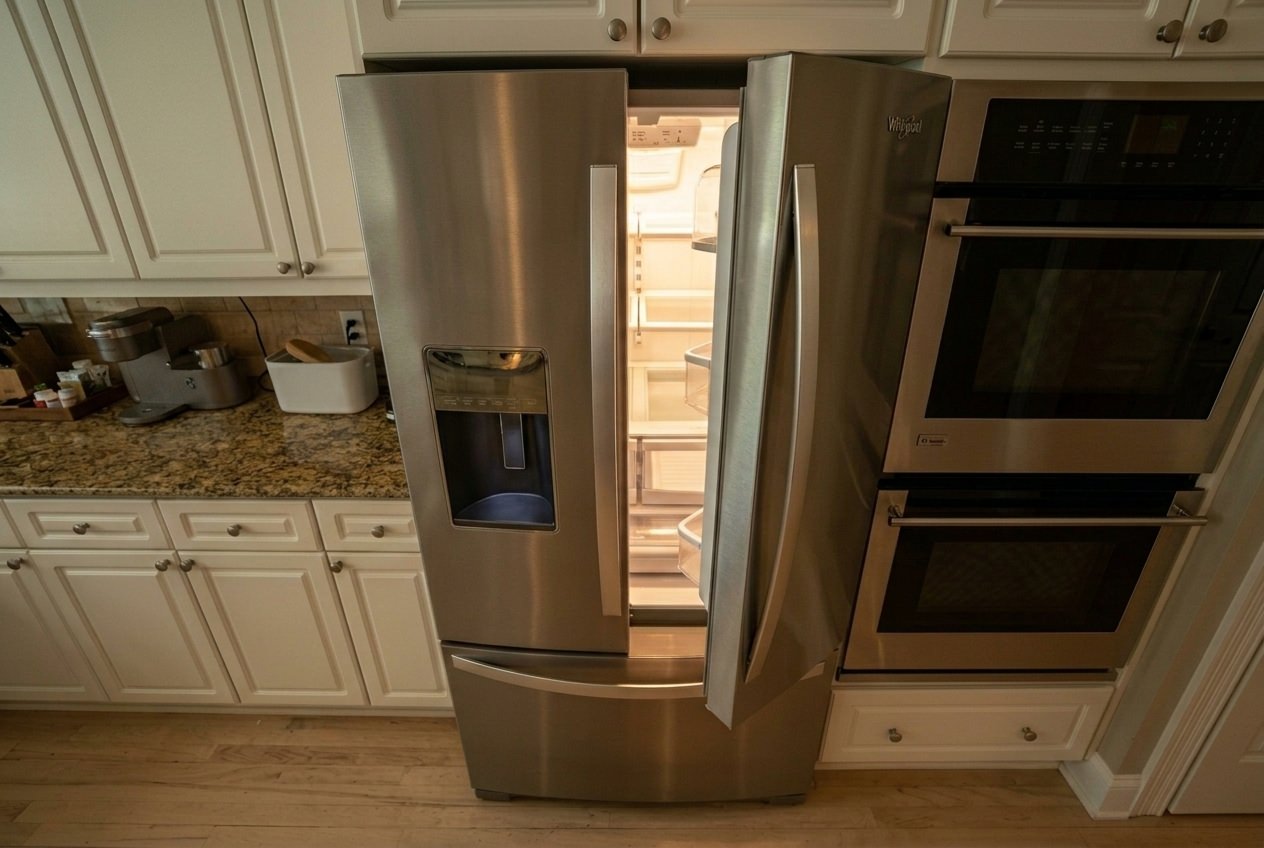
When a Whirlpool refrigerator stops cooling properly, most customers don’t think about compressors right away. They notice food temperatures creeping up. The freezer doesn’t recover like it used to. The refrigerator seems to be running, but something feels off.
That uncertainty is usually what brings customers to us.
In our work servicing Whirlpool WRF and WRS series refrigerators across Atlanta and Georgia, compressor concerns often surface after other explanations have been ruled out. Settings haven’t changed. Power is stable. The refrigerator is on, but cooling no longer returns to normal. At that point, the compressor becomes the focus, and with it comes understandable concern about cost and repair options.
This article explains how we approach suspected whirlpool compressor failure in real service situations. We’ll explain to you what the compressor does, why it may stop running without being permanently damaged, and how we determine whether the issue involves startup components, protection systems, or the compressor itself. Our goal is to help you understand what’s happening before assumptions take over, and to show when professional diagnosis makes the difference between a manageable repair and a much larger problem.
What the Compressor Does in Whirlpool WRF and WRS Refrigerators
The compressor is the heart of the cooling system. Its job is to move refrigerant through the sealed system so heat can be removed from inside the refrigerator. When it runs properly, cooling happens quietly in the background and goes unnoticed.
In Whirlpool WRF and WRS series models, the compressor does not operate alone. It depends on several supporting components to start, run, and protect itself from damage. These include electrical startup devices, safety protections, and control signals.
When any one of these supporting parts fails, the compressor may stop running even though it is still mechanically sound. From the homeowner’s perspective, the result looks the same: the refrigerator stops cooling and food temperatures begin to rise.
That distinction matters. In our practice, many service calls labeled as compressor failure turn out to be startup or protection issues that prevented the compressor from operating.
What We Notice First When the Compressor Is Not Running
When a customer tells us the refrigerator is not cooling, one of the first questions we ask is whether the compressor is attempting to start.
A compressor not running can present itself in different ways depending on what caused the shutdown. Sometimes the unit is completely silent. Other times, customers report intermittent sounds or clicking.
These early observations help us narrow the problem before touching the appliance:
- Does the refrigerator attempt to start and stop repeatedly
- Is there a rhythmic start relay clicking sound
- Does cooling stop suddenly after working normally
We do not ask customers to open panels or test electrical parts. We ask them to notice behavior. That information often tells us whether the compressor is being blocked by a safety system or whether a deeper failure is likely.
What Often Stops a Whirlpool Compressor From Starting
In our service work, a compressor that is not running is rarely dead on arrival. More often, it is being prevented from starting by one of its supporting components.
Whirlpool compressors rely on startup devices to initiate operation safely. When these components fail, the compressor never reaches a running state, even though it may still be mechanically intact.
One of the most common signs we hear described is start relay clicking. Customers notice a faint click every few minutes, followed by silence. This is not the compressor trying to run and failing randomly. It is a protection system responding to a startup problem.
Another common situation involves the overload protector tripped condition. When the compressor draws too much current or overheats, the overload shuts it down to prevent permanent damage. The refrigerator may attempt to restart later, only to shut down again.
From our perspective, these symptoms signal that the compressor is being protected, not ignored.

Simple Observations We Ask Customers to Make
Before we arrive, there are a few safe observations that help us narrow the issue. These are not repairs. They do not involve tools or disassembly. They simply help us understand how the system is behaving.
We may ask customers to:
- Listen for repeated clicking sounds
- Note whether the compressor ever becomes warm to the touch
- Observe whether cooling stops suddenly or fades gradually
Sometimes we recommend a controlled power reset, allowing the refrigerator to remain unplugged for a reset 5-10 minutes period. If the compressor attempts to start again afterward and fails, that information is valuable for diagnosis.
What we avoid is encouraging repeated resets. If a compressor is being shut down by a protection system, forcing repeated restarts can increase stress on already-failing components.

Symptoms We See and What They Usually Mean
Over time, we’ve learned that certain symptoms consistently point to certain failure paths. This table reflects what we see most often in Whirlpool WRF and WRS series refrigerators.
Symptom Observed | What It Usually Indicates | Risk Level |
Repeated clicking, no cooling | Failed startup component or protection shutdown | Medium |
Compressor silent, never warm | Electrical supply or control issue | Medium |
Compressor hot, shuts down | overload protector tripped | High |
Unit cools briefly, then stops | Startup failure escalating | High |
No response after reset | Possible locked compressor | Very High |
This progression matters. Early-stage issues are often repairable without replacing the compressor. Later-stage issues reduce options and increase cost.
Conditions That Make Problems Worse Over Time
Some external conditions inside the refrigerator cabinet increase stress on the compressor and accelerate failure.
One of the most common is dirty condenser coils. When heat cannot dissipate properly, the compressor runs hotter and longer than intended. Over time, this increases the likelihood of protection shutdowns and permanent damage.
Another contributor is a capacitor defective condition. The capacitor helps deliver the extra power needed to start the compressor. When it weakens, startup attempts fail, current spikes, and protection systems activate more frequently.
These issues often work together. A struggling startup component paired with heat buildup creates a cycle that becomes harder to stop the longer it continues.
When a Compressor Is Truly Locked
A locked compressor is one that can no longer start mechanically, even when electrical components are functioning correctly. This is the scenario homeowners fear most, and understandably so.
In our practice, true compressor lockup is far less common than people assume. However, when it does occur, the symptoms are usually clear:
- The compressor draws power but cannot turn
- Protection devices activate immediately
- Repeated restarts worsen the condition
This is where professional diagnosis becomes essential. Locked compressors cannot be confirmed visually or through sound alone. They require testing that goes beyond homeowner observation.
Understanding Whirlpool’s Compressor Warranty
One point we always clarify for customers is the compressor 10-year warranty offered by Whirlpool on many models.
This warranty typically covers the compressor part itself, not labor or related components. That distinction matters. In some cases, repair remains worthwhile. In others, the overall cost may still be significant.
Our role is to explain:
- Whether the compressor is truly the failed component
- Whether the warranty applies to the specific model and failure
- What the total repair realistically involves
Without proper diagnosis, warranty assumptions often lead to frustration.
When Professional Diagnosis Protects You
Compressor-related symptoms sit at the boundary between manageable repairs and major decisions. That’s why we approach these calls carefully.
Here’s how we frame the level of professional involvement based on what we find:
Issue Identified | DIY Observation Only | Professional Repair Needed |
Power reset behavior | Yes | No |
Startup sounds | Yes | No |
Electrical testing | No | Yes |
Sealed system diagnosis | No | Yes |
Compressor replacement | No | Yes |
This isn’t about discouraging homeowners. It’s about preventing missteps that turn a repairable situation into a costly one.
How We Help Customers Decide What Makes Sense
When compressor-related problems come up, the real question our customers want answered is not “what failed?” but “what should I do next?”
Our role is to help make that decision clearer, not heavier.
In our experience with Whirlpool WRF and WRS series refrigerators, compressor-related repairs fall into two very different categories. Some involve supporting components that failed first and prevented the compressor from running. Others involve damage to the compressor itself.
What matters most in that decision is not the name of the part, but the context around it:
- How the refrigerator has been behaving leading up to the failure
- Whether protection systems have been cycling repeatedly
- How long the unit has been operating under stress
- Whether warranty coverage applies
When we diagnose early-stage problems, repairs are often focused and contained. When symptoms have been present for a long time, the scope can widen quickly. That’s why timing plays such a large role in cost and outcome.
Our approach is always to explain the findings clearly, outline the realistic options, and let the customer decide with full information in front of them.
Why Waiting Often Makes Compressor Problems Worse
Compressor-related issues tend to follow a predictable path. They don’t stay neutral.
A compressor that is struggling to start places extra load on startup components. Protection systems trip more often. Heat builds up. Each failed start increases stress on the system as a whole.
What we see far too often is a refrigerator that could have been repaired earlier with a limited fix, but wasn’t addressed until the compressor itself was damaged. At that point, options narrow.
This is why we emphasize professional diagnosis once compressor symptoms appear. It’s not about urgency for urgency’s sake. It’s about preventing a manageable situation from turning into a permanent one.
Final Thoughts
From our perspective, compressor problems are less about fear and more about clarity.
The word “compressor” carries weight, but the reality is more nuanced. Many issues that stop a compressor from running start outside the compressor itself. Others develop gradually and leave warning signs along the way.
Understanding what those signs mean, and when they cross the line from observation to action, is what protects both the refrigerator and the investment in it.
Our work is focused on finding the real cause, not just the most intimidating explanation.
FAQ
1. Does start relay clicking always mean compressor failure?
No, start relay clicking often indicates that the compressor is being prevented from starting due to a failed startup component or protection response. In many cases, the compressor itself is still functional.
2. What does it mean when the overload protector tripped?
When the overload protector tripped, it means the compressor was drawing excessive current or overheating. This is a safety response designed to prevent permanent damage, but repeated trips signal a deeper problem that needs attention.
3. Can dirty condenser coils really affect the compressor?
Yes, dirty condenser coils reduce heat dissipation, which forces the compressor to run hotter and longer. Over time, this increases stress on electrical and mechanical components and raises the risk of shutdowns.
4. How do you know if the compressor is locked?
A locked compressor cannot start even when electrical components are working properly. This condition requires professional testing and cannot be confirmed through sound or visual inspection alone.
5. Is the compressor covered under warranty?
Many Whirlpool models include a compressor 10-year warranty for the part itself. Labor and related components are usually not included. We help customers understand how warranty coverage applies to their specific situation before moving forward.