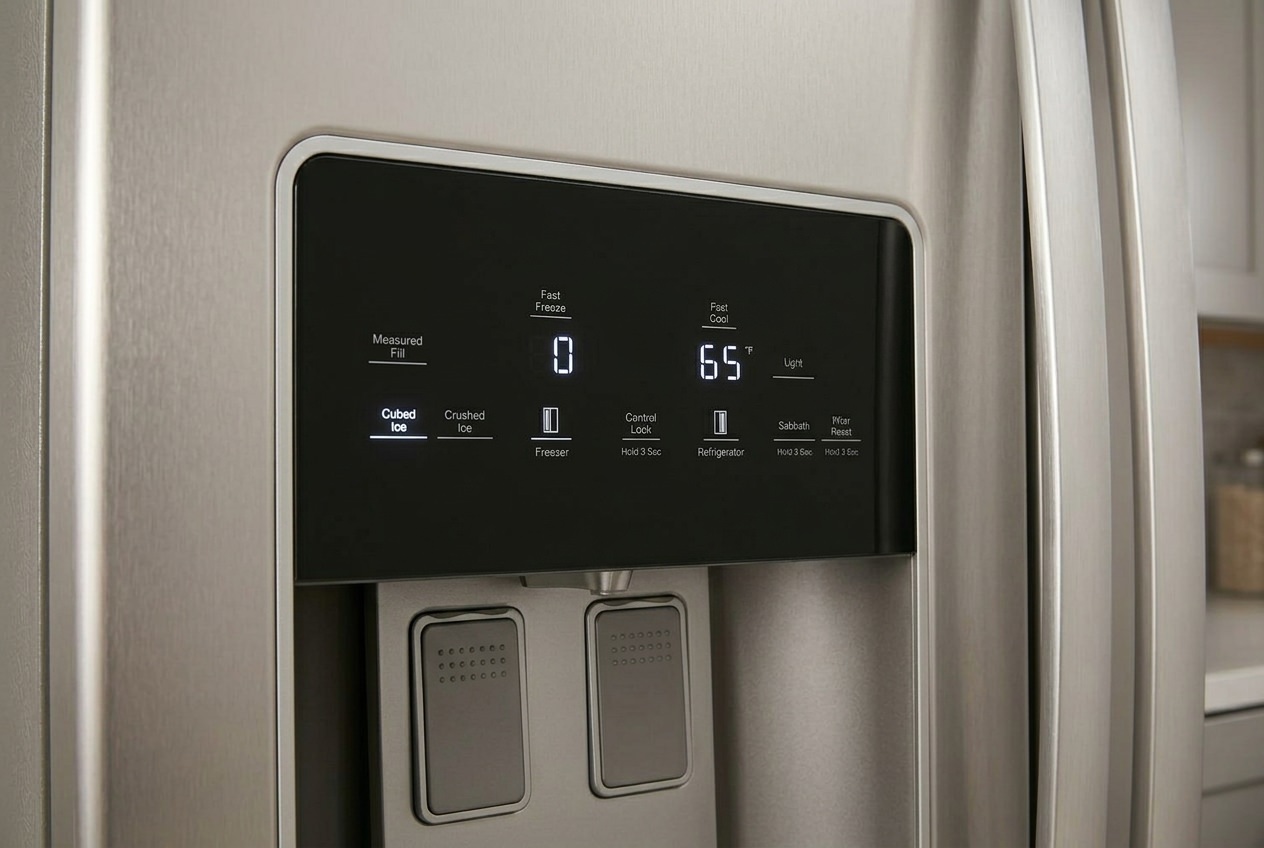
When a Whirlpool refrigerator can’t hold a steady temperature, the issue rarely announces itself loudly. It shows up in patterns. Food near the back wall freezes. Items near the door feel warmer than they should. The display still shows the right settings, yet something isn’t consistent.
We handle whirlpool temperature problems in WRF and WRS series refrigerators throughout Atlanta and Georgia every week. What customers describe most often isn’t complete failure. It’s uncertain, because the refrigerator is still running. The freezer works. But cooling doesn’t feel stable anymore.
Temperature instability isn’t just inconvenient. When temperature fluctuating becomes frequent, it affects food safety, compressor performance, and long-term reliability. The difficulty is that the cause isn’t always obvious. It may involve airflow, environment, configuration, or internal sensor feedback.
In this article, we’ll explain why regulation drifts out of balance, what signs tell us the issue is progressing, and how we determine when professional diagnosis becomes necessary.
When Cooling Stops Being Predictable
Whirlpool WRF and WRS refrigerators are designed to maintain temperature 37F 3C in the refrigerator compartment and 0F -18C in the freezer. Minor shifts happen during normal use. Recovery should be steady and quick.
The difference between normal behavior and a developing issue is consistency.
When cooling becomes unreliable, customers report:
- Daily variations instead of occasional ones
- Freezer frost forming unevenly
- Food spoiling even though settings remain unchanged
The system is still operating, but it is no longer stabilizing efficiently. That shift from predictable to unpredictable is where the real problem begins.

The Pattern We See Before Larger Failures
Temperature instability tends to follow a progression. It rarely jumps from minor inconvenience to complete breakdown overnight.
Here’s the pattern we commonly observe:
Stage | What You Notice | What It Suggests |
Subtle | Slight uneven cooling | Airflow imbalance or minor sealing issue |
Repeating | Cold pockets and warmer zones | Circulation or environmental stress |
Persistent | Daily temperature fluctuating | Sensor or regulation imbalance |
Escalating | Extended compressor run cycles | System strain increasing |
The earlier the issue is addressed, the more contained the repair typically remains.
Airflow: The Silent Disruptor
Cold air must move freely for a refrigerator to stay balanced. If circulation slows or becomes uneven, temperature begins shifting from one area to another.
One frequent cause we see is blocked air vents overpacked with containers or bulk packaging. When vents are obstructed, cold air cannot distribute evenly. It collects in one section while bypassing another.
Another contributor is door seals dirty damaged. Even small leaks introduce warm air continuously. The refrigerator compensates by running longer cycles, but because warm air keeps entering, stability never fully returns.
Airflow issues rarely cause dramatic shutdowns. They create gradual inconsistency, which over time stresses the system.
When the Environment Pushes the Limits
Temperature control depends not only on internal components but also on external conditions.
Whirlpool refrigerators are engineered to operate within an ambient temperature 55-110F range. Outside that window, regulation becomes unpredictable.
In garage installations or areas exposed to seasonal swings, we often see freezer stability affected first. When ambient temperatures drop or rise significantly, the refrigerator’s internal logic adjusts. If conditions fall outside recommended limits, consistent balance becomes harder to maintain.
This isn’t a malfunction. It’s a design limitation responding to the environment.
Configuration Issues That Cause Mechanical Problems
Not all instability is caused by failing components.
We occasionally encounter refrigerators left in demo showroom mode after installation. In this mode, lighting and display functions appear normal, but cooling behavior is restricted. Temperature stability won’t return until that mode is properly disabled.
In some cases, we recommend a controlled power interruption — unplugging the unit for a reset 5-10 minutes period — to clear temporary control irregularities. If stability returns and holds, the issue may have been transient.
If temperature fluctuating resumes quickly, the underlying cause lies deeper in the regulation system.
When Sensor Feedback Is No Longer Accurate
Temperature regulation relies on internal sensors providing precise information to the control board.
Under normal conditions, a thermistor 2.5kΩ 20C reading aligns with expected resistance at room temperature. When sensor values drift out of range, the control board reacts to incorrect data.
This can result in:
- Cooling cycles ending too early
- Extended run times without proper stabilization
- Daily temperature fluctuating without visible obstruction
Sensor-related imbalance does not always produce error codes. That’s why consistent instability requires proper evaluation rather than repeated setting adjustments.
When Instability Turns Into System Stress
Temperature swings don’t stay isolated to food compartments. They affect the mechanical side of the refrigerator as well.
When cooling becomes inconsistent, the compressor compensates. It runs longer cycles. It starts more frequently. It shuts down and restarts to chase a moving target. Over time, that extra activity increases wear on electrical components and shortens the margin for error.
Here’s how temperature instability escalates if left unresolved:
Condition | Immediate Impact | Long-Term Risk |
Minor daily variation | Food quality inconsistency | Increased compressor cycling |
Repeated uneven cooling | Localized frost buildup | Sensor strain and control misreads |
Constant temperature fluctuating | Continuous compensation cycles | Premature compressor and board wear |
Ignored instability for months | Extended high-load operation | Major component failure |
We don’t present this to alarm customers. We present it because temperature instability is rarely harmless when it becomes persistent.
When to Stop Adjusting Settings
One of the most common reactions to inconsistent cooling is adjusting temperature controls repeatedly. Lowering the refrigerator setting. Raising the freezer setting. Resetting again.
Occasional adjustments are reasonable. Constant adjustment usually means the system is compensating for something it cannot correct on its own.
If you notice:
- Daily temperature fluctuating despite correct settings
- Stability that returns briefly, then drifts again
- Uneven cooling even after checking airflow and seals
It’s no longer a settings issue. It’s a regulation issue.
Repeated changes often mask the underlying cause rather than solving it.

How We Diagnose Whirlpool Temperature Problems
When customers call us for whirlpool temperature problems, we don’t begin by replacing parts. We begin by confirming behavior.
Our evaluation typically includes:
- Verifying actual internal temperatures against display readings
- Inspecting airflow pathways and circulation
- Checking seal integrity
- Confirming configuration (including demo showroom mode)
- Testing sensor response and control behavior
In WRF and WRS series refrigerators, instability usually ties back to airflow imbalance, environmental stress, or sensor feedback drift. Identifying which category the issue belongs to prevents unnecessary part replacement.
We focus on isolating the cause rather than reacting to the symptom.
Why Early Diagnosis Protects the Appliance
Temperature problems often grow gradually. That gradual progression makes them easy to tolerate for a while.
The risk lies in the system’s response. A refrigerator constantly compensating for instability operates under higher stress than one maintaining steady cycles. Over time, that stress narrows the gap between a manageable repair and a larger one.
Addressing instability early typically keeps the solution contained. Waiting increases the likelihood that additional components become involved.
Final Thoughts
A Whirlpool refrigerator should feel dependable. When cooling becomes inconsistent, that dependability is what disappears first.
Temperature instability rarely corrects itself once it becomes a pattern. It reflects imbalance somewhere in the system: airflow, environment, configuration, or internal feedback. Understanding that difference allows you to act before the issue grows beyond simple correction.
Our role is to restore balance, not just lower a setting and hope for the best.
FAQ
1. Why is my Whirlpool refrigerator temperature fluctuating even though the settings are correct?
If the display shows proper settings but the internal temperature shifts daily, the issue is usually airflow imbalance, environmental stress, or inaccurate sensor feedback rather than a simple setting error.
2. Can blocked air vents really cause uneven cooling?
Yes, blocked air vents overpacked with food restrict circulation. Cold air cannot distribute evenly, which creates warm and cold zones inside the cabinet.
3. Does ambient temperature affect refrigerator performance?
Absolutely. Whirlpool units are designed to operate within an ambient temperature 55-110F range. Outside that range, consistent regulation becomes more difficult.
4. What does a thermistor reading mean?
A properly functioning sensor typically aligns with a thermistor 2.5kΩ 20C resistance at room temperature. If that reading drifts, the control board may receive inaccurate data, leading to temperature instability.
5. Should I just reset the refrigerator?
A controlled reset 5-10 minutes power cycle can clear minor irregularities. If temperature fluctuating returns quickly after reset, the issue likely requires professional diagnosis.