Bosch Temperature Sensor Replacement - Cost & Repair Atlanta Georgia
Most homeowners don’t call for service the first time a Bosch refrigerator feels off. They lower the temperature a notch, move the milk away from the door, blame the grocery load, and give the appliance another day. Fairly, yes, that’s a reasonable instinct. Refrigerators cycle. Doors get opened. Atlanta kitchens get warm. A refrigerator doesn’t need to be treated like an emergency every time it works a little harder than usual.
The problem starts when the pattern repeats.
The fresh-food section runs warm even after the setting is adjusted. Produce freezes in one drawer and wilts in another. The freezer alarm returns without an obvious reason. The compressor seems to stay on longer than it used to. A refrigerator thermometer shows one temperature while the display suggests something else.
At that point, the issue is about finding out whether the refrigerator is reading temperature correctly in the first place.
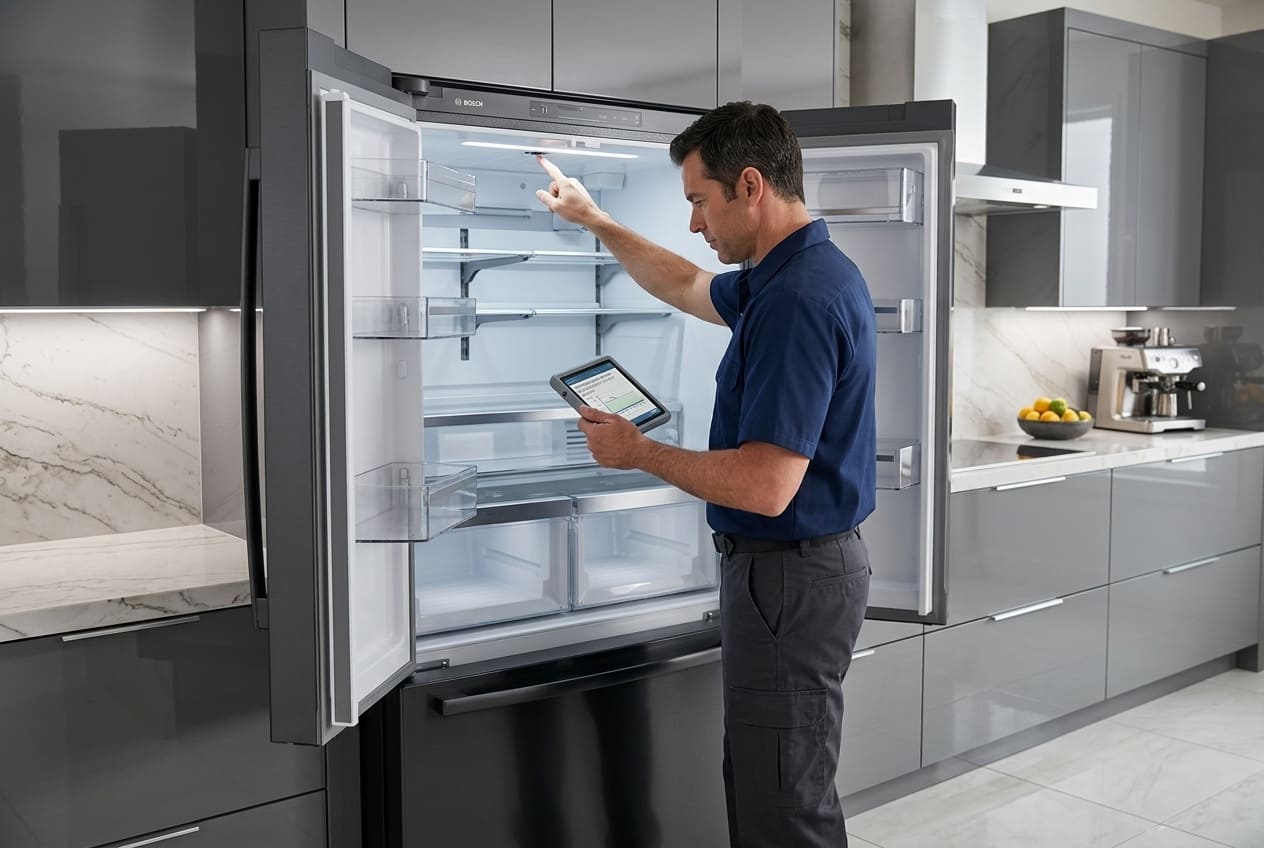
At Appliance Repair Master, our technicians have repaired Bosch refrigerators across Atlanta and Georgia for more than 15 years. When a Bosch refrigerator has unstable temperature, one of the components we test is the Bosch temperature sensor, often called a thermistor. This part helps the control system understand the temperature inside the refrigerator or freezer compartment. If the reading is wrong, the appliance can cool too aggressively, not cool enough, run for too long, or respond poorly after normal door openings.
A temperature sensor is not the first part to replace just because a refrigerator seems warm. It is one part in a larger temperature-control system that includes:
- airflow,
- fans,
- door gaskets,
- evaporator performance,
- wiring, controls,
- and the sealed refrigeration system.
That is why we test before replacing parts.
“A temperature sensor is a small part, but it can make a refrigerator behave like the whole cooling system is confused. The repair only makes sense after the reading has been tested against the real temperature inside the cabinet.”

Quick look: when the Bosch temperature sensor belongs in the diagnosis
What the homeowner notices | What our technicians consider |
|---|---|
Refrigerator temperature changes from day to day | Sensor drift, airflow restriction, fan issue, control behavior |
Food freezes in the fresh-food section | Thermistor reading, damper behavior, vent position, loading pattern |
Refrigerator runs for unusually long periods | Continuous running diagnosis, gasket condition, condenser airflow, sensor signal |
Freezer alarm returns after normal use | Freezer sensor, door seal, defrost issue, fan operation |
Display setting looks normal, but temperature feels wrong | Actual cabinet temperature, thermistor resistance, control-board reading |
Cooling improves after reset, then slips again | Sensor circuit, wiring, board behavior, airflow, frost buildup |
Pro tip: a bad sensor can imitate several bigger failures, but several bigger failures can also imitate a bad sensor. The repair starts with separating those possibilities.
What a Bosch refrigerator temperature sensor does
A Bosch refrigerator uses temperature input to decide how hard the cooling system should work. In many models, that input comes from a thermistor. A thermistor is a temperature-sensitive resistor; as temperature changes, its resistance changes. The control board reads that change and uses it as part of the cooling decision.
When the sensor is accurate, the refrigerator can respond normally to daily use. It adjusts after the doors are opened, recovers after groceries are loaded, and keeps the fresh-food and freezer compartments within the expected range. When the sensor drifts or fails, the refrigerator may be making decisions from bad information.
That is how a small component can create a large annoyance. The refrigerator may run longer than necessary because it thinks the compartment is still warm. It may stop cooling too early because it believes the target temperature has already been reached. It may overcool one area, undercool another, or keep triggering temperature warnings that do not make sense to the homeowner.
That doesn’t mean the sensor is always guilty. The sensor needs to be tested when temperature behavior becomes inconsistent.

Temperature sensor, thermistor, NTC sensor: what homeowners are really asking about
Parts terminology can make this repair sound more complicated than it is. Homeowners may ask for a thermostat, a refrigerator sensor, a Bosch temperature sensor, an NTC sensor, or a thermistor. In daily repair language, these requests often point to the same concern: the refrigerator is not managing temperature correctly.
Term | Plain-English meaning |
|---|---|
Temperature sensor | The part that reports temperature to the refrigerator control system |
Thermistor | A sensor whose resistance changes as temperature changes |
NTC sensor | A common thermistor type used in refrigerators |
Refrigerator sensor | General homeowner or parts-counter term |
Thermostat | Sometimes used casually, though modern refrigerators often use electronic sensing and control rather than an old-style mechanical thermostat |
For repair, the label matters less than the test. The real question is whether the sensor’s electrical reading matches the actual temperature inside the cabinet.

The symptoms that make us test the Bosch thermistor
A thermistor problem rarely announces itself with one neat symptom. It usually shows up as a pattern that keeps returning after the obvious checks have already been tried.
Refrigerator section runs warm
A warm fresh-food section is the most common reason homeowners suspect a temperature sensor. The important detail is whether the refrigerator is failing to cool or whether the control system is misreading the compartment.
If the sensor seems colder than the compartment really is, the control board may stop calling for cooling too early. The display can look reasonable while the actual cabinet temperature is not where it should be.
Before we blame the thermistor, we check the basics that matter in kitchens: food blocking vents, weak airflow, gasket leaks, frost behind the panel, fan operation, condenser condition, and actual temperature recovery.
Fresh food freezes
A refrigerator that freezes lettuce, berries, eggs, or drinks is failing to manage temperature evenly.
A bad sensor can contribute if it makes the control board believe the compartment is warmer than it really is. The refrigerator keeps cooling, and food near vents or the rear wall gets hit first. The same symptom can also come from a stuck damper, poor loading, wrong settings, blocked airflow, or control trouble.
This is one of those repairs where the location of the frozen food matters. One frozen corner tells a different story from a whole fresh-food compartment that is running too cold.
The refrigerator runs almost all the time
A Bosch refrigerator that seems to run every time you walk into the kitchen needs a continuous running diagnosis, not a quick guess.
A drifting thermistor can make the refrigerator chase a temperature it has already reached. But long run times can also come from a dirty condenser, warm room conditions, weak fan, door gasket leak, heavy grocery load, frost restriction, or sealed-system trouble.
The sensor is part of the question. It is not the whole question.
The display doesn’t match the refrigerator thermometer
This is one of the cleaner clues. If the display or setting looks normal but a separate refrigerator thermometer shows a meaningful difference, sensor testing moves higher on the list.
The mismatch may come from a sensor, a control-board interpretation issue, wiring, airflow, or sensor placement. We compare readings instead of trusting one number.
Temperature alarms return
A one-time alarm after a door was left open is not the same as repeated alerts during normal use. Repeated alarms deserve attention because they show the refrigerator is either losing temperature, failing to recover, or reporting temperature incorrectly.
In field work, a reset can be useful once, but repeat errors need diagnosis. If the alarm keeps returning after the obvious causes are removed, the refrigerator needs more than setting changes.

How our technicians test a Bosch temperature sensor
A thermistor replacement should be earned by the evidence. Replacing the sensor because it is cheaper than a control board or compressor may seem practical, but it is still hard to guess if nobody tested it.
Our process is straightforward.
1. Measure the real temperature
We check the refrigerator and freezer with a thermometer instead of relying only on the display. The display shows us what the appliance is set to or what the system believes. The thermometer demonstrates what the food is experiencing.
2. Check airflow
Airflow problems can look exactly like sensor problems. A blocked vent, overloaded shelf, weak fan, frost restriction, or misplaced container can create uneven cooling without any sensor failure.
3. Inspect the gasket and door behavior
A door that closes but doesn’t seal well can keep warm air entering the cabinet. That forces the refrigerator to run longer and makes temperature readings less stable.
4. Look for frost where it shouldn’t be
Frost behind interior panels or around air channels can interfere with temperature control. If the evaporator area is restricted, replacing a sensor may do nothing.
5. Perform resistance testing with a multimeter
This is the key sensor test. During resistance testing with a multimeter, we measure the thermistor’s resistance and compare it with the expected behavior at the measured temperature. A good thermistor should change predictably as temperature changes.
We are looking for an open circuit, a shortened sensor, indices far outside the expected range, or a sensor that responds but doesn’t track temperature accurately. That last one is a subtle failure. A completely dead part is easy to condemn. A sensor that lies by a few degrees can waste far more time.
“The worst thermistor is not always the one that fails completely. Sometimes it is the one that keeps sending a believable but wrong performance.”

Bosch temperature sensor replacement cost in Atlanta
The sensor itself is usually not the expensive part of this repair. For many refrigerators, a thermistor costing $20-$100 range is a reasonable part-only expectation, depending on the model, supplier, and sensor design. Some Bosch temperature sensors cost more, especially when the part is model-specific or sold with a harness.
The model-specific approach matters because two Bosch refrigerators that look similar in the kitchen may not use the same sensor. The full repair price depends on more than the part number.
What affects the final repair cost?
Cost factor | Why it changes the price |
|---|---|
Exact Bosch model | The sensor and access path depend on the full model number |
Sensor location | Some sensors are easy to reach; others sit behind panels or air channels |
Diagnostic time | Temperature problems need confirmation before parts are replaced |
Frost or ice buildup | Access may require careful thawing or panel removal |
Wiring condition | A bad connector can mimic a bad thermistor |
Control-board response | A good sensor can still be misread by a failing board |
Built-in or tight installation | Access can take longer in custom cabinetry |
A $20-$100 part does not mean a $20-$100 repair. The full service may include diagnosis, access labor, sensor testing, replacement, reassembly, and temperature verification after the repair.
KGN34VL3A model sensor access: why the exact model number matters
The model number is not an insignificant detail on Bosch refrigerators. It decides the part, the diagram, and the access route.
On KGN-style refrigerators, including KGN34VL3A, sensor access can vary by the full E-Nr version. A slash number such as KGN34VL3A/01 or KGN34VL3A/07 can point to a specific appliance variant with its own documents, parts, and service information. That is why the full model number matters before ordering parts or opening panels.
A temperature sensor may sit near the refrigerator air channel, freezer compartment wall, evaporator area, storage drawer zone, control housing, or a harness path behind an interior cover. Some panels use clips that do not forgive rough handling. Some sensors are routed through tight channels. Some are hidden behind the very frost pattern that made the homeowner suspect a sensor in the first place.
That is why generic repair videos can be risky. A refrigerator that looks close enough on screen may not be close enough inside the cabinet.
Technician tip
Before opening a Bosch refrigerator for sensor access, we confirm the full model number, identify the likely sensor location, and plan the least destructive path to the part.
Continuous running diagnosis: when the refrigerator will not take a break
A Bosch refrigerator that runs too often can sound like a compressor problem, a thermostat problem, or a sensor problem depending on who is listening. In the field, it can be any of those – or none of them.
Long run times are sometimes normal after a large grocery load, a lot of door openings, or a warm kitchen. They are not normal when the refrigerator never seems to settle, food temperatures remain unstable, or the compressor works hard without the cabinet reaching the right range.
Here is how we understand the situation.
Possible cause | What it does to the refrigerator |
|---|---|
Bad thermistor | Sends the board the wrong temperature signal |
Door gasket leak | Lets warm, humid air enter the cabinet |
Blocked vents | Prevents cold air from moving through the compartment |
Dirty condenser | Makes it harder for the system to reject heat |
Weak fan | Reduces air movement and temperature consistency |
Frost restriction | Blocks airflow through the evaporator area |
Control-board fault | Misreads or mishandles temperature input |
Sealed-system weakness | Runs longer because cooling capacity is reduced |
A Bosch temperature sensor can absolutely be part of a continuous running diagnosis. It should not be the only part of the diagnosis.
When thermistor replacement is the right repair
A Bosch thermistor should be replaced when testing confirms that it is giving the wrong information.
Replacement makes sense when the resistance is outside the expected range, the sensor response doesn’t change properly with temperature, the circuit is open or shorted, the cabinet temperature and sensor reading disagree, and wiring or connector checks don’t point somewhere else.
Replacement doesn’t make sense when the true issue is airflow, fan failure, door sealing, frost buildup, dirty condenser coils, control-board behavior, refrigerant loss, or compressor performance.
That distinction protects the homeowner. A thermistor is small and often less expensive than other refrigerator components, but replacing the wrong part is still a bad repair.
What happens during Bosch thermistor replacement
A clean repair feels almost uneventful because the diagnostic work has already done the hard part.
- We ask about the pattern:
- when the temperature changed,
- whether the problem affects the refrigerator or freezer,
- whether food is freezing or warming,
- whether alarms have appeared,
- whether the unit was recently moved,
- and whether the issue changed after a reset.
2. Then we take temperature readings. We check:
- airflow,
- door sealing,
- frost,
- fan behavior,
- and control response.
If the thermistor belongs in the suspect list, we access it carefully and test it with a multimeter. If the sensor fails, we replace it with the correct part for that Bosch model.
3. After replacement, the refrigerator still needs time to stabilize. We don’t advise homeowners to judge the repair five minutes later. Cooling systems recover over hours, especially after doors have been open during service. What matters is whether the appliance begins responding correctly and continues moving toward stable temperature.
What homeowners can check before calling for service
A few checks are useful before scheduling repairs. They can also help us diagnose the appliance faster.
☐ Check the refrigerator and freezer settings
☐ Move food away from interior vents
☐ Make sure the doors close without resistance
☐ Look for a dirty, torn, or loose gasket
☐ Listen for fan operation
☐ Note whether food is freezing in one area or throughout the compartment
☐ Check whether the issue started after a large grocery load
☐ Look for frost buildup on rear interior panels
☐ Take a photo of any error or alarm
☐ Write down the full Bosch model number if available
Don’t remove interior panels, probe wiring, or thaw hidden ice with sharp tools. A refrigerator interior looks friendly until a clip snaps, a harness gets damaged, or a panel is forced from the wrong side.

All Bosch models are not the same
This topic applies across all Bosch models, but the repair doesn’t look the same across all Bosch refrigerators.
A compact Bosch refrigerator, a KGN-style bottom-freezer unit, a French-door model, and a built-in refrigerator can use different sensors, different access points, and different control logic. Some models monitor several zones. Some use separate sensors for refrigerator, freezer, evaporator, or drawer areas. Some have more complex airflow paths than others.
The correct part depends on the full model number. The correct diagnosis depends on how that model manages temperature.
That is why Appliance Repair Master doesn’t quote sensor replacement as though every Bosch refrigerator is identical.
Why this repair should not be handled by guesswork
Temperature problems overlap more than homeowners expect.
A warm refrigerator may need thermistor replacement. It may also need an evaporator fan, gasket repair, defrost diagnosis, condenser cleaning, control-board testing, or sealed-system evaluation.
A refrigerator that freezes food may have a bad sensor, but it may also have a damper or airflow problem.
A refrigerator that runs continuously may be reacting to bad temperature input, or it may simply be fighting warm air through a poor seal.
The sensor is important because it is part of the decision-making chain. It is not magic. It can’t fix a blocked air path, a weak compressor, or a fan that has stopped moving air.
That is why our technicians test the chain instead of chasing one part.
Practical cheat sheet: Bosch refrigerator temperature issues
Symptom | First homeowner check | Technician-level diagnosis |
|---|---|---|
Refrigerator warm | Check settings and blocked vents | Actual temperature, airflow, fan, thermistor, sealed system |
Fresh food freezing | Check vent placement and settings | Sensor, damper, airflow pattern, control response |
Freezer alarm | Check door closure and recent loading | Freezer sensor, fan, defrost, gasket, recovery rate |
Constant running | Check gasket and recent grocery load | Continuous running diagnosis |
Display mismatch | Use a refrigerator thermometer | Sensor resistance, wiring, control-board reading |
Cooling changes after reset | Monitor whether the issue returns | Sensor circuit, board behavior, airflow, frost inspection |
Bosch Temperature Sensor Replacement in Atlanta Georgia
Appliance Repair Master provides Bosch refrigerator temperature diagnosis and component repair across Atlanta and surrounding Georgia communities.
Our technicians bring more than 15 years of practical repair experience. We test before replacing parts, explain the repair before doing the work, and help homeowners understand whether the issue is a sensor, airflow problem, control fault, or deeper cooling-system concern.
We service:
- Bosch temperature sensor testing
- Bosch thermistor replacement
- Bosch refrigerator temperature problems
- Bosch refrigerator running continuously
- Bosch refrigerator freezing fresh food
- Bosch freezer temperature alarms
- Bosch display and temperature mismatch
- KGN34VL3A model sensor access
- Bosch Component Repair for refrigerator controls, fans, sensors, and cooling faults

Conclusion
Bosch refrigerator temperature problem deserves more than setting changes and guesswork. If the refrigerator is warming, freezing food in the wrong place, running continuously, showing repeat alarms, or giving a temperature reading that doesn’t match the cabinet, the sensor may be part of the problem. The right repair starts with proof. Call Appliance Repair Master for Bosch temperature sensor replacement and refrigerator repair in Atlanta & GA.
FAQ
1. What is a Bosch temperature sensor?
A Bosch temperature sensor is the part that helps the refrigerator monitor internal temperature. In many models, this sensor is a thermistor, which changes resistance as temperature changes.
2. Is a thermistor the same as a temperature sensor?
In refrigerator repair, homeowners often use the terms together. A thermistor is a type of temperature sensor. It gives the control system information about compartment temperature.
3. What are signs of a bad Bosch refrigerator thermistor?
Common signs include unstable temperature, fresh food freezing, refrigerator section running warm, freezer alarms, long compressor run times, or a display temperature that does not match the real cabinet temperature.
4. How much does Bosch thermistor replacement cost?
The part-only thermistor cost can often fall around $20-$100, depending on model and supplier. The full repair cost depends on diagnosis, access labor, exact Bosch model, wiring condition, and whether other temperature-control issues are present.
5. Can a bad temperature sensor make a Bosch refrigerator run continuously?
Yes. If the sensor sends the wrong reading, the refrigerator may keep calling for cooling. Continuous running can also come from gasket leaks, blocked vents, dirty condenser coils, fan problems, frost buildup, control faults, or sealed-system issues.
6. How do technicians test a Bosch temperature sensor?
Technicians perform resistance testing with a multimeter, compare the reading to the actual cabinet temperature, inspect wiring and connectors, and check whether the control system responds correctly.
7. Is KGN34VL3A model sensor access difficult?
It can be. On KGN-style Bosch refrigerators, the access path depends on the exact model version and sensor location. Some sensors require removing shelves, drawers, interior covers, air channels, or rear panels.
8. Should I replace the thermistor myself?
DIY replacement can be risky if the diagnosis is uncertain or the sensor is behind interior panels. Replacing a good sensor will not fix airflow, fan, defrost, gasket, control-board, or sealed-system problems.
9. Do all Bosch models use the same temperature sensor?
No. Bosch refrigerators use model-specific parts. The correct sensor depends on the full model number and version.
10. Who provides Bosch temperature sensor replacement in Atlanta?
Appliance Repair Master provides Bosch refrigerator temperature sensor testing, thermistor replacement, and Bosch Component Repair in Atlanta & Georgia. Call us for same-day service.