
A Kenmore freezer that suddenly gets loud is trying to tell you something — and the type of sound it’s making is the most direct clue you have. Grinding is different from buzzing. Clicking is different from rattling. Each points to a different component, a different urgency level, and a different fix.
At Appliance Repair Master, noise calls are among the most common Kenmore service requests we handle in Atlanta. The good news: the majority trace back to one of two components — the evaporator fan or the condenser fan — and both are straightforward DIY repairs. The less common causes, like a failing compressor, require a different approach entirely.
This guide starts with the sound itself, because that’s where you are right now.
Kenmore Freezer Noise Identification Guide
Before touching anything, listen carefully and use this table to narrow down the source:
Sound | Most Likely Cause | Urgency |
Loud buzzing or humming | Evaporator or condenser fan motor | Medium — fix soon |
Grinding / scraping | Fan blade hitting ice buildup or worn motor bearings | High — fix immediately |
Repeated clicking | Start relay failing; compressor trying to start | High — may need pro |
Rattling / vibrating | Loose parts, unlevel unit, drain pan loose | Low — easy fix |
Squealing / screeching | Fan motor bearing failure | High — replace soon |
Popping / cracking | Normal defrost cycle or ice shifting | Low — usually normal |
Constant loud hum | Compressor running hot (dirty coils or internal wear) | Medium to High |
Chattering / buzzing during ice fill | Water inlet valve cycling | Low to Medium |
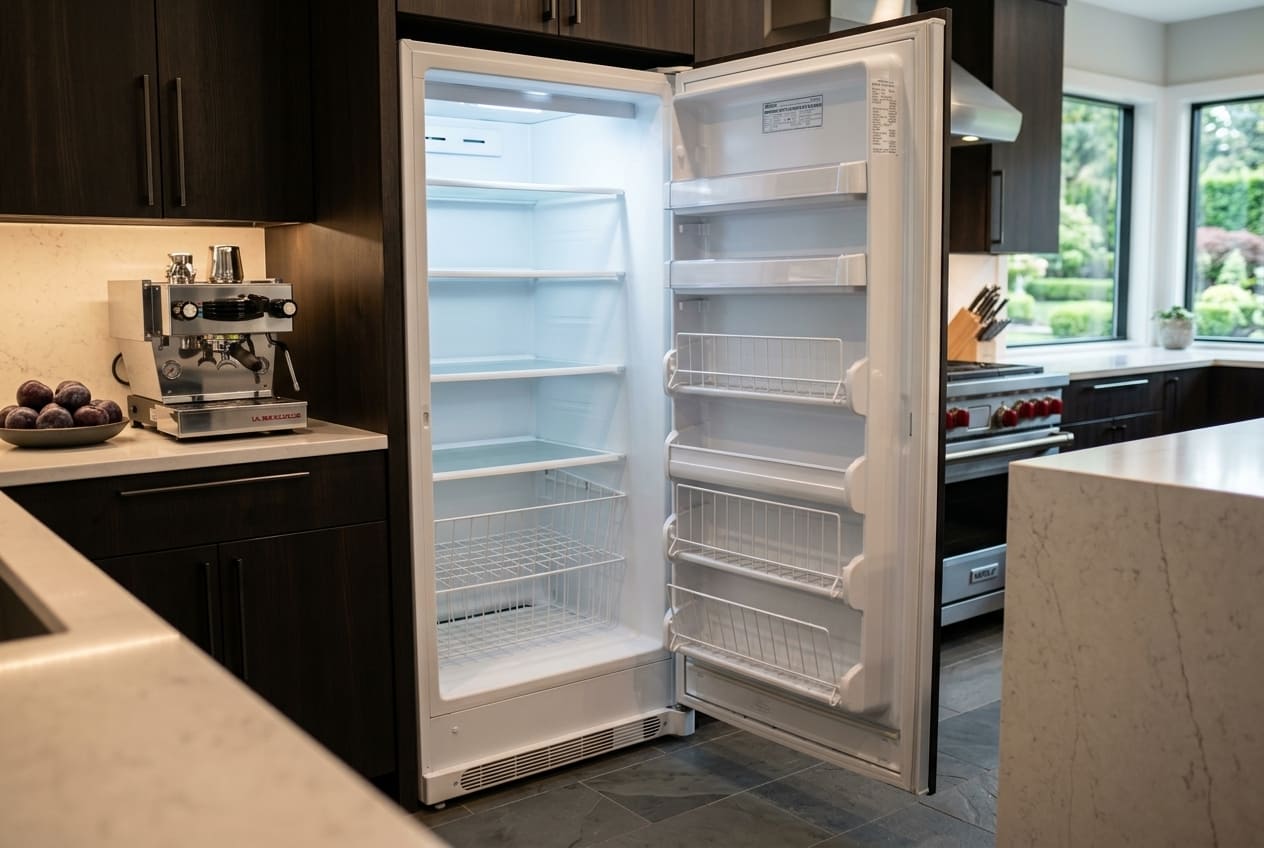
The single most useful diagnostic test: Open the freezer door while the noise is happening. If it stops immediately — the evaporator fan is the source. The door switch cuts power to the fan when the door opens. If the noise continues, the problem is elsewhere — condenser fan, compressor, or drain pan.
Most Common Causes of a Noisy Kenmore Freezer
Evaporator Fan Motor or Blade
This is the #1 cause of sudden loud noise in Kenmore freezers, and the door test above confirms it instantly. The evaporator fan circulates cold air through the freezer compartment. When its motor bearings wear out, it produces a grinding or squealing sound. When the fan blade accumulates ice from a defrost system issue or a compromised door seal, the blade clips the ice with every rotation — a rhythmic scraping that gets progressively worse.
The evaporator fan blade is the cause of noise in 78% of cases on the KENMORE 253.24092103 (a Frigidaire-built upright freezer) — making it the most statistically dominant single cause across the entire Kenmore freezer lineup.
On the KENMORE 253.28432803, the same pattern holds: evaporator fan blade accounts for 69% of noise complaints, with the compressor run capacitor a distant second at 11%.
Condenser Fan Motor or Blade
The condenser fan sits at the bottom rear of the unit, drawing air across the condenser coils to dissipate heat. Unlike the evaporator fan, it runs independently of the door switch — so the noise persists whether the door is open or closed.
Common causes of condenser fan noise:
- Dust and debris buildup around the blade, causing imbalance and vibration
- Worn motor bearings producing a low grinding or buzzing sound
- Obstructions — a piece of debris or a loose wire touching the spinning blade
The noise from a failing condenser fan tends to be lower-pitched than evaporator fan noise and comes from the back of the unit rather than the interior.
Ice Buildup Around the Evaporator Fan

When the defrost system isn’t keeping up — whether due to a failing defrost heater, a bad bi-metal thermostat, or a door seal that’s letting warm air in — frost accumulates around the evaporator coils and fan housing. The fan blade starts clipping the ice, producing a grinding or scraping sound that worsens over time.
A manual defrost (unplug the unit, leave the door open for 24 hours) will temporarily stop the noise. If it returns within a few weeks, the defrost system itself needs attention — the ice is a symptom, not the root cause.
If your freezer is also leaking water during defrost cycles, ice buildup around the fan is often part of the same underlying problem.
Compressor Noise
A healthy compressor produces a low, steady hum — present but unobtrusive. When that hum becomes noticeably louder or takes on a laboring quality, two things are usually happening:
- Dirty condenser coils are forcing the compressor to work harder and run longer to maintain temperature. This is fixable with a coil cleaning.
- Internal compressor wear — the compressor is genuinely struggling. This is a more serious situation.
The clicking-then-humming pattern is a specific and important symptom: the compressor is trying to start, failing, and trying again. This almost always points to a bad start relay — a $15–$50 part that’s one of the easiest repairs on the list.
On KENMORE 795.71033010 (an LG-built bottom-freezer), clicking from the back of the unit combined with ice accumulation inside the freezer is a documented failure pattern — often involving the compressor control board rather than the relay itself. This is a more complex diagnosis that typically warrants professional evaluation.
The KENMORE 795.74023.412 (Kenmore Elite, LG-built) shows a related pattern: loud humming that stops when the door is opened, followed by gradual cooling loss. This is the evaporator fan struggling against ice buildup — but on 795-series models, it can also precede compressor failure if left unaddressed.
Water Inlet Valve
The water inlet valve produces a brief buzzing or chattering sound each time it opens to fill the ice maker. This is normal. A valve that buzzes loudly, chatters continuously, or makes noise outside of ice-fill cycles may have mineral deposits restricting the solenoid, or the solenoid itself may be failing.
If the buzzing is short and periodic — roughly every 90 minutes to 2 hours — it’s the ice maker cycling normally. If it’s constant or unusually loud, the valve is worth inspecting. See our Kenmore ice maker troubleshooting guide for a full valve diagnosis.
Freezer Not Level — Vibration and Rattling
An unlevel freezer vibrates against the floor, and that vibration amplifies through the cabinet. The drain pan underneath the unit is a common rattler — it sits loosely in a tray and can vibrate against the frame if the unit isn’t sitting flat. Loose items stored on top of the freezer make this worse.
This is the easiest fix on the list and costs nothing.
How to Fix a Noisy Kenmore Freezer (Step-by-Step)
Work from cheapest and most common to most expensive and rare.
Fix 1 — Replace the Evaporator Fan Motor
Difficulty: Moderate | Time: 30–45 min | Cost: $15–$60 for the motor
The evaporator fan is behind the rear interior panel of the freezer compartment.
Steps:
- Unplug the freezer and remove all food.
- Remove the rear interior panel — typically 2–4 screws at the top and clips along the sides. Set the panel aside carefully.
- Locate the fan motor housing. Disconnect the wire harness (note the connector orientation).
- Remove the mounting screws (usually 2) and pull the motor out.
- Transfer the fan blade to the new motor if it’s not included with the replacement — the blade slides or clips onto the motor shaft.
- Install in reverse order. Make sure the blade spins freely before reinstalling the panel.
- Plug in and confirm the noise is gone.
Find the correct motor using your full model number. The motor for a 253-series Frigidaire-built Kenmore differs from a 795-series LG-built model.
Fix 2 — Replace the Condenser Fan Motor
Difficulty: Moderate | Time: 20–30 min | Cost: $15–$50 for the motor
The condenser fan is at the bottom rear of the unit, accessible by pulling the freezer away from the wall and removing the rear access panel.
Steps:
- Unplug the unit and pull it away from the wall.
- Remove the rear lower access panel (usually 4–6 screws).
- Locate the condenser fan motor next to the compressor. Disconnect the wiring.
- Remove the mounting bracket screws and swap the motor.
- While you’re there, vacuum any dust and debris from the condenser coil area — this takes 5 minutes and prevents future noise.
- Reinstall the panel and test.
Fix 3 — Clean the Condenser Coils
Difficulty: Easy | Time: 15 min | Cost: $0 (or $10 for a coil brush)
Dirty condenser coils force the compressor to run harder and longer, which increases both noise and energy consumption. This is a maintenance task that should be done annually.
Steps:
- Unplug the unit and pull it away from the wall.
- Remove the rear lower access panel.
- Use a coil brush or vacuum with a brush attachment to remove dust from the coil fins. Work gently — the fins bend easily.
- Vacuum the floor area under the unit while you’re there.
If the compressor noise improves after a coil cleaning but doesn’t go away entirely, the compressor itself may have internal wear.
Fix 4 — Replace the Start Relay
Difficulty: Easy | Time: 10 min | Cost: $10–$40
The start relay is a small component plugged into the side of the compressor. When it fails, the compressor clicks repeatedly as it tries and fails to start.
The rattle test: Unplug the freezer, pull the unit away from the wall, and remove the rear access panel. Locate the start relay on the side of the compressor — it’s a small plastic component that pulls straight off. Shake it next to your ear. If it rattles, it’s bad. Replace it.
This is one of the most satisfying DIY repairs because the diagnosis is so clean and the fix is so fast.
Fix 5 — Defrost the Evaporator to Clear Ice Buildup
Difficulty: Easy | Time: 24 hours | Cost: $0
If the grinding noise is caused by the fan blade hitting ice:
- Unplug the freezer.
- Remove all food and place it in a cooler.
- Leave the door open for 24 hours, or place a fan in front of the open door to speed up the thaw.
- Mop up any water that collects at the base.
- Plug back in and monitor.
If the noise returns within 2–3 weeks, the defrost heater, bi-metal thermostat, or defrost timer has failed and needs replacement. A door that won’t close properly can also cause ice to build up around the evaporator fan — worth checking if the defrost system tests out fine.
Fix 6 — Level the Freezer and Secure Loose Components
Difficulty: Easy | Time: 10 min | Cost: $0
- Use a level on top of the unit. Adjust the front leveling legs until the unit is level side-to-side and slightly tilted back (front legs slightly higher than rear — this helps the door self-close).
- Pull out the drain pan from under the front of the unit and confirm it’s seated properly in its tray.
- Check the rear access panel screws — loose panel screws are a surprisingly common source of rattling.
- Remove anything stored on top of the freezer.
Kenmore Freezer Noise Repair Costs at a Glance
Repair | DIY Cost | Professional Cost |
Evaporator fan motor | $15–$60 | $100–$300 |
Condenser fan motor | $15–$50 | $100–$300 |
Start relay | $10–$30 | $80–$200 |
Condenser coil cleaning | $0–$10 | $75–$150 |
Manual defrost | $0 | N/A |
Compressor replacement | Pro only | $300–$800 |
The fan motor repairs are the sweet spot for DIY — low part cost, moderate difficulty, and they solve the majority of noise complaints. The compressor is the one case where the math almost never favors DIY: it requires EPA-regulated refrigerant handling and specialized equipment.
Normal vs. Abnormal Kenmore Freezer Sounds
Not every noise is a problem. Here’s how to tell the difference:
Normal sounds — nothing to worry about:
- A gentle, steady hum (compressor running)
- A soft click every few hours (defrost timer cycling)
- Water dripping or gurgling during a defrost cycle
- Ice dropping into the bin (a thud or clatter every 90 minutes or so)
- A brief buzz when the ice maker fills with water
- Popping or cracking sounds as the cabinet expands and contracts with temperature changes
Abnormal sounds — investigate promptly:
- Grinding or scraping that doesn’t stop
- A loud buzz or hum that’s noticeably louder than usual
- Repeated clicking from the back of the unit (compressor trying to start)
- Squealing or screeching from inside the freezer compartment
- Any noise accompanied by a burning smell — unplug immediately
The “is it normal?” question is one of the most common things we hear from Kenmore owners. If the sound is new, louder than before, or accompanied by any change in cooling performance, it’s worth investigating.
When to Call a Professional
Most Kenmore freezer noise issues are DIY-friendly. These are the exceptions:
- Compressor failure — if the start relay tests fine but the clicking continues, the compressor itself has failed. Replacement requires EPA-regulated refrigerant handling and is not a DIY repair.
- LG-built 795-series models with clicking + cooling loss — on these models, the compressor control board and the compressor often fail together. Diagnosing which one (or both) requires specialized equipment.
- Burning smell accompanying the noise — unplug the unit immediately and call a technician. This indicates an electrical fault.
- Noise returns within weeks of a manual defrost — the defrost system has a component failure (heater, bi-metal thermostat, or timer) that needs to be identified and replaced.
- Sealed system issues — if the noise is coming from the refrigerant lines or the compressor is confirmed failed, this is EPA-regulated territory.
Conclusion
A Kenmore freezer making loud noise almost always comes down to one of a handful of causes — and the door test tells you immediately whether the evaporator fan is involved. If the noise stops when you open the door, you’ve found your culprit. If it doesn’t, move to the condenser fan, the start relay, and the compressor — in that order.
Fan motor replacements are the most common fix and among the most cost-effective DIY repairs on any appliance. The start relay is even simpler. Condenser coil cleaning is free and prevents the compressor from working harder than it needs to.
For LG-built Kenmore Elite models (795-series), pay extra attention to the compressor area — these models have a documented history of compressor and control board issues that can present as noise before cooling loss sets in. Catching it early makes a difference.
FAQ
1. My Kenmore freezer started making a loud grinding noise overnight — it was completely quiet before. What's the most likely cause?
A sudden onset of grinding almost always means the evaporator fan blade has started hitting ice. This happens when frost builds up around the fan housing — often triggered by a door that wasn’t fully closed, a brief power outage that disrupted the defrost cycle, or a door seal that’s starting to fail. Do the door test: open the freezer door while the noise is happening. If it stops, that’s your answer. A manual defrost will confirm it.
2. My Kenmore freezer is making noise but still cooling fine. Should I still fix it?
Yes — a noisy freezer that’s still cooling is in the early stages of a component failure. Fan motor bearings that are grinding now will seize eventually, and when they do, cooling stops. Fixing it while the freezer is still working is always cheaper and less disruptive than waiting for a full breakdown.
3. The noise on my Kenmore freezer is coming from the back, not the inside. What should I check first?
Back-of-unit noise points to the condenser fan, the compressor, or the start relay. Open the door — if the noise doesn’t change, it’s not the evaporator fan. Pull the unit away from the wall and listen more carefully. A rhythmic buzzing near the bottom is usually the condenser fan. A clicking pattern from the compressor area is the start relay. A constant laboring hum from the compressor itself suggests either dirty coils or internal wear.
4. Is it normal for a Kenmore freezer to hum?
A gentle, steady hum is completely normal — that’s the compressor running. What’s not normal is a hum that’s noticeably louder than it used to be, a hum that pulses or surges, or a hum accompanied by any change in temperature. If the hum has gotten louder over the past few weeks, clean the condenser coils first — that alone often brings the noise back to normal.
5. My Kenmore Elite freezer makes a clicking sound every few minutes, then goes quiet. The freezer is still cold. What's happening?
This is the classic start relay failure pattern — the compressor is trying to start, failing, and trying again. The freezer stays cold temporarily because the compressor manages to run in short bursts. Left alone, it will eventually stop running altogether. The start relay is a $10–$40 part and a 10-minute repair. Do the rattle test: remove the relay from the side of the compressor and shake it. If it rattles, replace it.
6. My Kenmore freezer makes a loud popping sound every few hours. Is something wrong?
Popping and cracking sounds are almost always normal. They’re caused by the plastic cabinet expanding and contracting as the freezer cycles between cooling and defrost. Ice shifting inside the compartment also produces a thud or pop. If the popping is accompanied by any change in temperature or a new continuous noise, investigate further — but isolated pops on their own are not a concern.