Kenmore Freezer Temperature Too Warm? Fix It Before Food Spoils

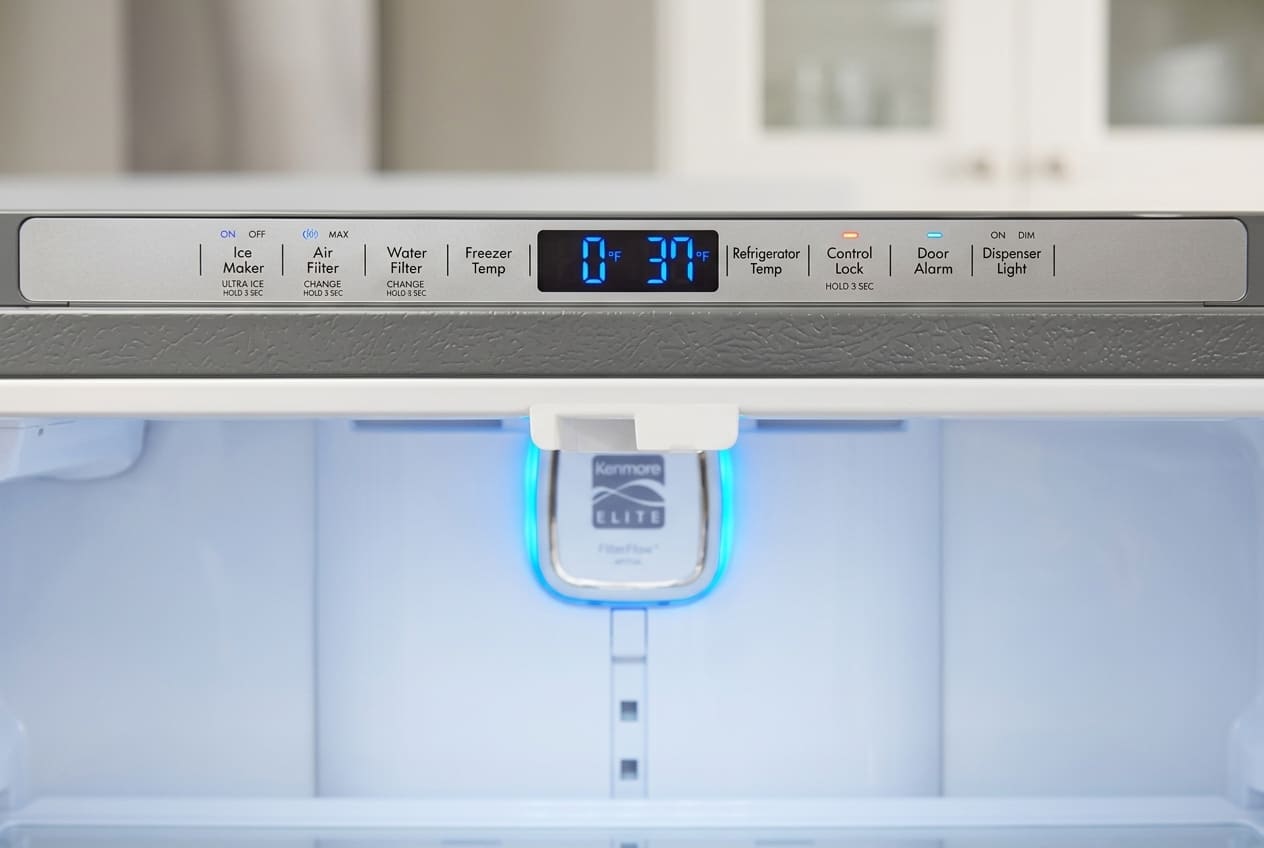
Close-up of Kenmore Elite refrigerator control panel with digital display showing freezer temperature at 0°F, featuring buttons for Ice Maker, Water Filter, Door Alarm and other settings.

Is your freezer completely dead — no cooling at all? That’s a different situation. This guide is for freezers that are still running and partially cold but can’t hold the right temperature. If your unit has stopped freezing entirely, see our comprehensive Kenmore freezer not freezing guide for a full diagnostic.

There’s a particular kind of frustration that comes with a freezer that’s almost working. The compressor hums, the light comes on, the ice cream is still there — but it’s soft. The temperature alarm keeps going off. Something is clearly off, but the unit isn’t dead. This is the “too warm” scenario, and it’s actually the more common presentation we see at Appliance Repair Master. The causes are usually less severe than a full failure, and many of them cost nothing to fix.

The key is knowing where to look — and in what order.

What Temperature Should Your Kenmore Freezer Be? (And How to Check)

The FDA-recommended safe temperature for frozen food storage is 0°F (−18°C). At this temperature, bacterial growth is halted and food quality is preserved long-term. Kenmore’s own guidelines align with this standard.

Don’t rely on the built-in dial alone. The numbered dials on most Kenmore freezers (typically a 1–7 scale) are relative settings, not calibrated temperature readings. A dial set to “4” might produce 5°F in one unit and 12°F in another, depending on ambient conditions, load, and the age of the thermostat.

The right way to check:

  • Place a standalone appliance thermometer in the center of the freezer, away from the walls and air vents
  • Leave it for at least 2–3 hours with the door closed
  • Read the temperature without opening the door if possible (or read immediately after opening)
  • Target: 0°F to 5°F for the freezer; if you’re reading above 10°F consistently, something needs attention

On Kenmore models with an electronic display (most Elite and 795-series units), the displayed temperature is more accurate — but it still reflects the sensor reading, not necessarily the actual air temperature throughout the compartment. A thermistor that’s reading incorrectly will show a false “normal” on the display while the actual interior temperature climbs.

Why Your Kenmore Freezer Is Too Warm — TOP 10 Causes

This is a temperature drift situation: the freezer is running, it’s cold, but it can’t reach or hold 0°F. Work through these causes from most to least common.

1. Overpacked Freezer Blocking Air Vents

The single most common cause of a Kenmore freezer running warm — and the one that costs nothing to fix.

Kenmore frost-free upright freezers circulate cold air through vents in the back wall and sometimes the side walls. When food is packed tightly against these vents, airflow obstructions prevent cold air from reaching the front and upper sections of the compartment. The result: the back is cold, the front is warm, and the temperature reading climbs.

The 75% rule: Don’t fill a frost-free upright beyond 75% capacity. Leave at least 1 inch of clearance around all rear vents. Chest freezers are less sensitive to this because cold air naturally settles, but even there, blocking the evaporator area causes problems.

Signs this is your issue: the freezer is coldest near the back wall and noticeably warmer near the door. Reorganizing the contents takes 10 minutes and sometimes solves the problem immediately.

2. Door Opened Too Frequently or Not Sealing Properly

Close-up of the silver Kenmore Elite emblem on the glossy white surface of a modern refrigerator, highlighting the premium appliance branding.

Every time the door opens, warm humid air enters. In a busy kitchen — or in summer without AC — this adds up fast. A freezer that’s opened 20+ times a day will struggle to maintain 0°F even with a perfectly functioning cooling system.

The more insidious version: a door that closes but doesn’t seal. A failing door gasket may not prevent the door from shutting, but it allows a steady trickle of warm air in around the frame. Condensation along the door frame or frost forming unevenly near the door edges are the telltale signs.

Dollar-bill test: Close the door on a folded bill. If it pulls out without resistance, the seal isn’t tight enough. See our Kenmore freezer door seal guide for a full gasket inspection and replacement walkthrough.

3. Dirty Condenser Coils

The condenser coils dissipate the heat pulled from inside the freezer. When they’re coated in dust and pet hair, heat can’t escape efficiently — the compressor runs longer and harder but can’t bring the temperature down to target.

This is a maintenance issue that compounds over time. A freezer that was holding 0°F fine last winter may start running at 10–15°F in summer simply because the coils haven’t been cleaned in 18 months and the ambient temperature is higher.

Location: Bottom rear of the unit, behind the lower access panel. On some models, behind the kick plate at the front base.

Cleaning: Unplug the unit, remove the access panel, vacuum the coil fins with a brush attachment. Takes 15 minutes. Kenmore recommends doing this every 6–12 months — more often in homes with pets.

4. Thermostat Set Incorrectly or Malfunctioning

Before assuming a component failure, verify the setting. Dial controls get bumped. Kids adjust them. Someone cleaning the freezer accidentally turns the dial toward the warmer end.

On dial-controlled models (most 253-series uprights): The scale runs 1 (warmest) to 7 (coldest). Setting 4 is a reasonable starting point for 0°F, but the exact correspondence varies by model. After any adjustment, give the unit 24 hours to stabilize before evaluating the result — a fully loaded freezer doesn’t respond to thermostat changes instantly.

On electronic models (Elite, 795-series): Check that the display shows the correct target temperature. Some models have a “demo mode” or “showroom mode” that disables cooling while keeping the display active — worth checking if the unit was recently moved or had a power interruption.

If the thermostat itself has failed — stuck in a partially open position — the compressor runs intermittently or not at all. Test with a multimeter: at the coldest setting, the thermostat should show continuity. 

5. Defrost System Malfunction — Frost Blocking the Evaporator

This is the most common mechanical cause of a Kenmore freezer running too warm, and it’s a slow-developing problem that catches people off guard.

Frost-free Kenmore freezers run automatic defrost cycles — typically every 8–12 hours — to melt any frost that accumulates on the evaporator coils. When the defrost system fails (heater, bi-metal thermostat, or timer), frost builds up unchecked. Over days and weeks, it gradually encases the coils, reducing their ability to cool the air passing over them. The freezer gets progressively warmer — not all at once, but a degree or two at a time.

The defrost thermostat (bi-metal) is the cause of “too warm” in 99% of cases on the KENMORE 253.28262803 — a Frigidaire-built upright. The same part is the dominant fix across multiple 253-series models including the KENMORE 253.9284014 (75% of cases) and KENMORE 253.24452104 (75% of cases).

How to confirm: Remove the rear interior panel inside the freezer. If the evaporator coils are coated in a thick layer of frost or ice, the defrost system has failed. A manual defrost (unplug, door open for 24 hours) will temporarily restore normal temperatures. If the frost returns within 2–3 weeks, the defrost heater, bi-metal thermostat, or timer needs replacement.

Defrost system failure can also cause water leaks during defrost cycles — if you’re seeing both symptoms, they share the same root cause.

6. Evaporator Fan Not Running at Full Speed

A dying evaporator fan motor may still spin — just slowly. Reduced airflow means cold air doesn’t circulate effectively from the coils to the rest of the compartment. The freezer is coldest right near the evaporator but noticeably warmer toward the front and top.

This is different from a fan that’s stopped entirely (which causes more dramatic cooling loss). A partially failing motor produces a gradual temperature rise that’s easy to mistake for a thermostat issue.

Test: With the door closed, listen for the fan. Open the door — it should stop. Close it — it should restart within seconds. If the sound is weaker than usual, or the fan takes longer to reach speed, the motor bearings are wearing out.

On the KENMORE 795.74025 (LG-built Elite), a documented case shows the freezer running 24°F (set to 0°F) and the fridge at 53°F — with the evaporator fan identified as the primary culprit after a thermistor replacement provided only temporary improvement. The fan was running but not circulating air effectively due to ice buildup around the housing.

7. Condenser Fan Not Running Properly

The condenser fan motor at the bottom rear of the unit draws air over the condenser coils and the compressor. When it slows down or stops, the compressor overheats and its thermal overload protection kicks in — the compressor shuts off prematurely, and the freezer warms up.

This tends to be more pronounced in warm environments. A garage freezer in Georgia summer is a classic scenario: the condenser fan is already working harder than usual, and any reduction in its performance pushes the compressor over the thermal limit.

Check: Pull the unit away from the wall and listen at the back while the compressor is running. The condenser fan should be audible. If the compressor is running but the fan isn’t, the motor has failed or something is obstructing the blade. 

8. Door Gasket Letting Warm Air In

A subtle gasket failure — a small crack, a twisted section, or a section that’s lost its magnetic grip — may not be obvious visually. But it allows a continuous stream of warm air into the compartment, raising the temperature gradually and causing the compressor to run almost constantly trying to compensate.

Signs: Frost forming unevenly near the door frame, condensation on the exterior around the door seal, or the compressor running noticeably more than it used to.

Clean the gasket with warm soapy water first — a dirty gasket can lose its seal without being damaged. If cleaning doesn’t restore the seal, replacement is straightforward. 

9. High Ambient Temperature

Standard residential freezers are rated to operate in ambient temperatures between approximately 55°F and 110°F. When the room temperature exceeds this range — a garage in Atlanta in July, for example — the unit simply can’t keep up. The compressor runs continuously but can’t overcome the heat load.

Garage-ready vs. standard models: Some Kenmore models are specifically rated for wider temperature ranges. If you’re running a standard upright in an unconditioned garage, check the model’s operating temperature spec in the owner’s manual. If the ambient temperature regularly exceeds 95–100°F, a standard model will struggle even when fully functional.

This isn’t a repair issue — it’s a placement issue. Moving the freezer to a climate-controlled space, or adding ventilation to the garage, solves it without touching a single component.

10. Thermistor Sending Incorrect Data

The thermistor is a small temperature sensor that feeds real-time readings to the control board. If it sends data that’s warmer than actual — or sends no data at all — the board may not call for enough cooling, and the freezer drifts warm while appearing to function normally.

This is particularly relevant on electronically controlled models. On the KENMORE 795.71033 (LG-built Elite), a documented case shows the freezer stabilizing at 38°F with the compressor running and coils showing zero frost — a pattern consistent with a thermistor or control board issue rather than a mechanical failure.

Test: Check resistance with a multimeter. The resistance value should change as temperature changes — a thermistor that reads the same regardless of temperature has failed.

Kenmore Freezer Temperature Too Warm? We Fix It in Atlanta & Across GA
If the temperature keeps climbing despite your best troubleshooting — or you'd rather have a technician run the diagnosis — Appliance Repair Master handles Kenmore freezer temperature problems across Atlanta and the greater Georgia area, same-day or next-day. We carry defrost thermostats, fan motors, thermistors, and gaskets on our trucks, hold EPA certification for sealed system work, and back every repair with a service warranty.

How to Fix a Kenmore Freezer That's Too Warm

Start with the free fixes. Most “too warm” complaints resolve before you reach Step 4.

Step 1 — Check and Adjust the Temperature Setting

Verify the thermostat is set to the coldest position (7 on a dial scale, or 0°F on an electronic display). After adjusting, wait a full 24 hours before evaluating — the freezer needs time to reach its new equilibrium, especially if it’s fully loaded.

Step 2 — Reorganize Contents for Proper Airflow

Move items away from the rear vents. Leave at least 1 inch of clearance around all air vents. Don’t stack items against the back wall. If the freezer is over 75% full, remove some items temporarily and see if the temperature drops.

Step 3 — Inspect and Clean the Door Gasket

Wipe the gasket with warm soapy water and a soft cloth — dirt and food residue can prevent a proper seal. Dry thoroughly. Run the dollar-bill test around the entire perimeter. If the seal fails in any section, the gasket needs replacement.

Step 4 — Clean the Condenser Coils

Unplug the unit, pull it away from the wall, remove the rear lower access panel, and vacuum the coil fins. This takes 15 minutes and is free. If the temperature improves after cleaning, the coils were the issue — schedule this as annual maintenance going forward.

Step 5 — Verify Fan Motor Operation

Evaporator fan: Close the door and listen. Open the door — the fan should stop. Close it — it should restart within seconds. To test directly, press the door switch manually with the door open; the fan should run.

Condenser fan: Listen at the back of the unit while the compressor is running. Both fans should be audible. If either is silent or unusually slow, test with a multimeter for continuity. Replace if no continuity. 

Step 6 — Check the Defrost System

Remove the rear interior panel and inspect the evaporator coils. A thick frost coating confirms defrost system failure. Perform a manual defrost to restore cooling temporarily, then test the heater, bi-metal thermostat, and timer individually with a multimeter. Replace only the failed component. 

Step 7 — Test the Thermostat and Thermistor

For the cold control thermostat: disconnect the wiring and test for continuity at the coldest setting. For the thermistor: test resistance at room temperature and verify it changes as temperature changes. Replace whichever fails. 

How to Adjust Temperature on Different Kenmore Freezer Models
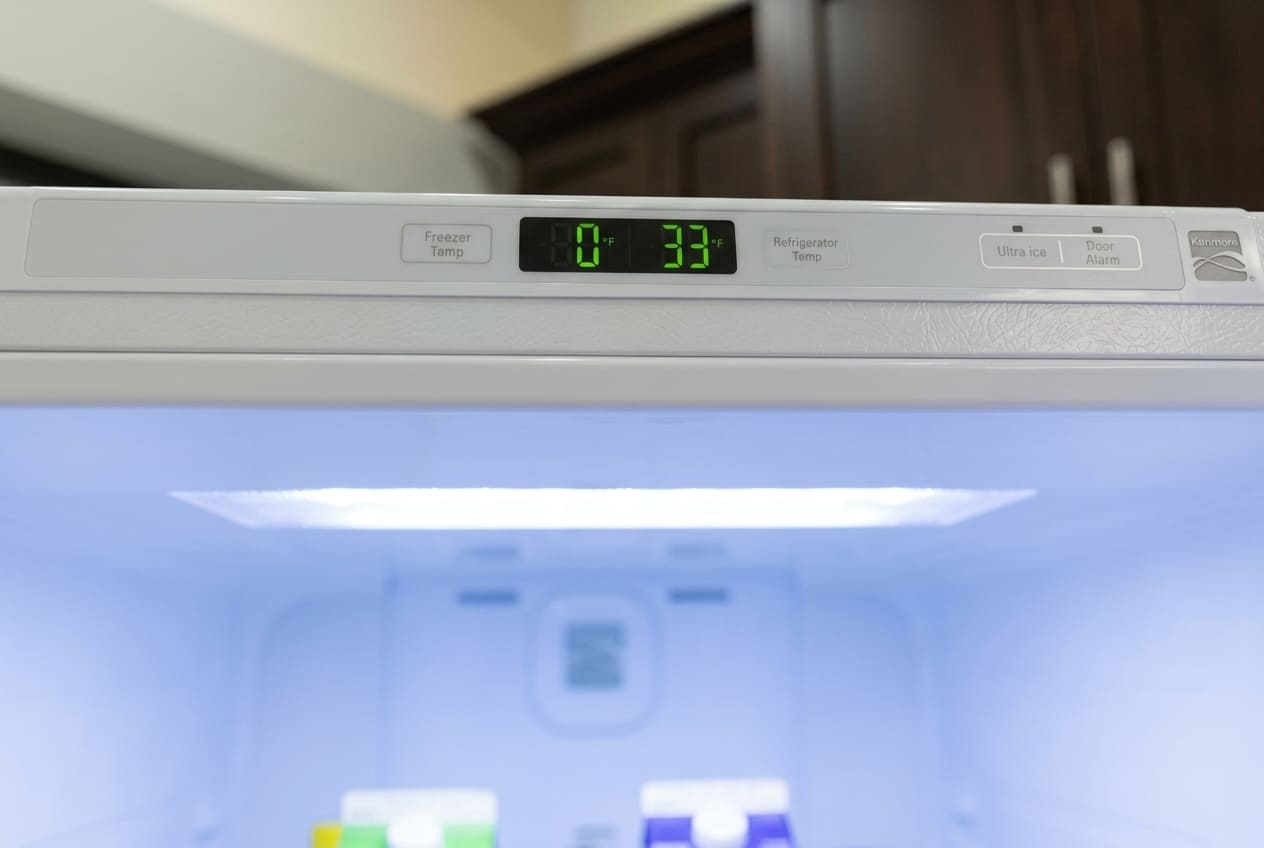
Close-up of a Kenmore refrigerator digital control panel with green LED display reading freezer temperature at 0°F and refrigerator at 38°F, featuring Ultra Ice and Door Alarm buttons.

Dial-controlled uprights (253-series, Frigidaire-built):
The dial runs from 1 (warmest) to 7 (coldest). Setting 4 is a reasonable starting point for 0°F. After any adjustment, allow 24 hours for the temperature to stabilize before making further changes. The dial is typically located inside the freezer compartment, near the top.

Electronic panel models (Elite, 795-series, LG-built):
Use the temperature buttons on the front panel to set the target. The recommended setting is 0°F for the freezer. Some models require holding the button for 3 seconds to change the setting. If the display shows a temperature but the unit isn’t cooling to that level, the thermistor or control board may be misreporting.

Chest freezers:
The thermostat knob is usually located inside the compartment, near the top edge. It operates on a similar 1–7 or Min–Max scale. Chest freezers are less sensitive to airflow issues but more sensitive to ambient temperature — in a hot garage, even the maximum setting may not achieve 0°F.

Save Your Food — What to Do When Your Freezer Is Too Warm Right Now

If you’re reading this because your freezer is warm right now, here’s what to do immediately:

  1. Don’t open the door. A closed freezer maintains its temperature for approximately 24–48 hours if full, or 12–24 hours if half-full. Every time you open it, you lose that buffer.
  2. Check the actual temperature. If food is above 40°F and has been there for more than 2 hours, the FDA’s 2-hour rule applies — it may not be safe to refreeze without cooking first.
  3. Move critical items. Transfer meat, fish, and anything with high spoilage risk to a neighbor’s freezer or a cooler with ice. Ice cream and bread can tolerate more temperature fluctuation than proteins.
  4. Document the situation. If you lose significant food value, take photos of the contents and the temperature reading before discarding anything. Some homeowner’s insurance policies cover food loss from appliance failure.
  5. Don’t add warm food. If you’re trying to preserve what’s left, don’t open the door to add anything new.

Kenmore Freezer Temperature Fix — Costs at a Glance

Repair

DIY Cost

Professional Cost

Reorganize contents / clear vents

$0

N/A

Clean condenser coils

$0–$10

$75–$150

Door gasket replacement

$30–$80

$150–$350

Fan motor (each)

$15–$60

$100–$300

Thermostat

$15–$60

$100–$300

Defrost thermostat (bi-metal)

$20–$70

$120–$400

Thermistor

$10–$50

$80–$250

Sealed system repair

Pro only

$400–$800+

When to Call a Professional

Most “too warm” issues are DIY-friendly. These are the exceptions:

  • Temperature won’t drop below 20°F despite cleaning coils, clearing vents, and confirming fans are running — the sealed system may have a slow refrigerant leak
  • Compressor is hot to the touch but the freezer isn’t cooling — thermal overload or internal compressor wear
  • 795-series LG-built Elite models with temperature drift and zero frost on the evaporator — this pattern can indicate a refrigerant issue or a failing compressor that requires EPA-regulated diagnosis
  • Control board failure — if all components test fine but the freezer still can’t regulate temperature, the board may need substitution testing to confirm
  • Food loss documentation — if you need a written repair assessment for an insurance claim, a professional service call provides that
Kenmore Freezer Repair — Atlanta & GA Areas
Appliance Repair Master diagnoses and repairs Kenmore freezer temperature problems across Atlanta and surrounding Georgia communities, same-day or next-day. Whether it's a $20 defrost thermostat on a 253-series upright or a sealed system evaluation on a Kenmore Elite, we get the diagnosis right the first time. Call now to book your service.

Conclusion

A Kenmore freezer running too warm is almost always traceable to one of a handful of causes — and the most common ones are free or nearly free to fix. Start with the basics: thermostat setting, vent clearance, door seal, condenser coils. These four checks alone resolve the majority of “too warm” complaints without touching a single component.

For frost-free upright models in the 253-series, the defrost thermostat is the dominant mechanical cause — documented at 75–99% of “too warm” cases across multiple models. It’s a $20–$70 part and a straightforward DIY repair. For LG-built Elite models, pay attention to the thermistor and evaporator fan before assuming a compressor issue — the symptoms can look similar but the fixes are very different in cost and complexity.

The food safety section in this guide exists for a reason: a warm freezer is a time-sensitive problem. Don’t wait a week to diagnose it.

FAQ

1. My Kenmore freezer is running constantly but the temperature keeps rising. What's most likely wrong?

A freezer that runs non-stop but can’t hold temperature is usually dealing with one of three things: dirty condenser coils preventing heat dissipation, a defrost system failure with frost blocking the evaporator coils, or a door seal that’s letting warm air in continuously. The compressor is working — it just can’t overcome the heat load. Start with the coils (free fix), then check for frost buildup on the evaporator, then do the dollar-bill test on the door seal.

The alarm triggers when the internal temperature exceeds a set threshold — typically around 15–20°F depending on the model. If the freezer feels cold to the touch but the alarm is going off, the temperature is likely hovering in the 15–25°F range rather than at 0°F. This is the “too warm” scenario: cold enough to feel cold, not cold enough to be safe. Check the thermostat setting first, then look for vent obstructions and frost buildup on the evaporator.

Cold air is denser and sinks, so a slight temperature gradient from top to bottom is normal. But a significant difference — more than 5–8°F — usually means the evaporator fan isn’t circulating air effectively. Either the fan motor is weakening, the vents near the top are blocked by food, or frost buildup is restricting airflow from the evaporator. Check the vents first, then test the fan.

Ambient temperature is almost certainly the factor. As the room temperature rises, the freezer has to work harder to maintain 0°F. If the condenser coils haven’t been cleaned recently, this is the time they’ll start causing problems — the combination of higher ambient temperature and reduced coil efficiency can push the freezer over its limit. Clean the coils first. If the freezer is in a garage or unconditioned space, check whether the ambient temperature is exceeding the unit’s rated operating range.

Give it a full 24 hours. A fully loaded freezer takes time to respond to thermostat changes — the thermal mass of all that frozen food slows the process. If the temperature hasn’t moved after 24 hours, the thermostat adjustment either wasn’t sufficient or the thermostat itself has failed. Test it with a multimeter: at the coldest setting, it should show continuity. If it doesn’t, the thermostat needs replacement.

Yes. The display shows the reading from the thermistor sensor, not the actual air temperature throughout the compartment. If the thermistor is positioned near the evaporator (the coldest spot) or is reading incorrectly, the display can show 0°F while the actual temperature in the middle of the compartment is significantly higher. Place a standalone thermometer in the center of the freezer and compare. If there’s a significant discrepancy, the thermistor is the likely culprit.

Contact Us

Content

appliancerepairmaster.com Terms and Conditions of Use

TERMS AND CONDITIONS OF USE

Company Name: Appliance Repair Master

Location: 1816 Briarwood Industrial Ct NE, Atlanta, GA 30329

Effective Date: June 5, 2026

Last Updated: June 5, 2026

By accessing or using this website, web page, client portal, mobile application, or any related content, functionality, services, emails, text messages, posts, or other electronic communications (collectively, the “Site”), or by requesting or receiving services from Appliance Repair Master (“Company,” “we,” “us,” or “our”), you agree to be bound by these Terms and Conditions of Use (“Terms”), our Privacy Policy, and all applicable laws and regulations.

If you do not agree to these Terms, you must not access or use the Site or services.

1. Ownership & Intellectual Property

The Site and all contents, features, and functionality, including information, software, text, images, video, audio, and design, are owned by Appliance Repair Master, its licensors, or content providers and are protected by U.S. and international intellectual property laws.

We reserve the right to withdraw or amend the Site or any services without notice. We are not liable if any part of the Site is unavailable.

2. Use License

Permission to use the Site is granted as a limited, non-exclusive, non-transferable license. This license automatically terminates if you violate these Terms and may be terminated by Appliance Repair Master at any time.

You may not:

  • modify or copy materials
  • use materials for commercial or public display
  • decompile or reverse engineer software
  • engage in scraping, data mining, or harvesting
  • remove proprietary notices
  • transfer or mirror materials on another server

3. Posting Content

“Content” includes text, images, video, audio, comments, reviews, testimonials, or feedback you submit.

By posting Content publicly or providing it to us in any form (including through review platforms, social media tags, or direct messages), you grant Appliance Repair Master a worldwide, perpetual, irrevocable, royalty-free, sublicensable, transferable license to use, reproduce, modify, adapt, publish, translate, distribute, and display such Content in any media now known or later developed.

Content must not infringe third-party rights, contain confidential information of others, or violate laws. We may remove Content at any time without notice.

4. Services & Appointments

By requesting services, you confirm you are the owner of the appliance and property, or are authorized to act on the owner’s behalf, and you grant our technicians access to the service area. Appointment times are estimates and may change due to operational conditions, traffic, parts availability, or prior job complexity.

We make commercially reasonable efforts to arrive within the scheduled window but do not guarantee arrival at a specific time.

5. Diagnostic & Service Fees

A diagnostic fee, trip fee, or service call fee may apply to each appointment and is payable whether or not you choose to proceed with the recommended repair. Current fee amounts will be disclosed at the time of scheduling.

If you authorize repair work after diagnosis, the diagnostic fee may be applied toward the total repair cost at our discretion.

6. Estimates, Authorization & Pricing

Before performing repair work beyond diagnosis, our technician will provide an estimate of parts and labor. By authorizing the work (verbally, in writing, electronically, or by signing a work order), you agree to pay the quoted amount.

Final pricing may vary if:

  • additional issues are discovered during the repair
  • additional parts are required
  • the scope of work changes with your approval

You will be notified of any material change before additional charges are incurred. Pricing is exclusive of applicable taxes.

7. Payments

Payment is due in full at the time of service unless otherwise agreed in writing. We accept the payment methods disclosed at the time of service.

Non-payment may result in:

  • service refusal or suspension
  • collection actions and reporting to credit bureaus
  • reasonable attorneys’ fees, court costs, and collection costs

Returned payments may be subject to a returned-payment fee, and unpaid balances may accrue interest at the maximum rate allowed by Georgia law.

8. Parts Policy

Unless otherwise specified, we use new, OEM (original equipment manufacturer), or OEM-equivalent parts. Used, refurbished, or customer-supplied parts may be installed only at the customer’s request and are not covered by our workmanship warranty.

Removed defective parts become the property of Appliance Repair Master unless you request their return at the time of service.

9. Communications Consent (Calls, SMS & Email)

By providing your phone number and contact information to Appliance Repair Master, you expressly consent and agree that Appliance Repair Master may contact you at the phone number(s) and email address(es) you provide using:

  • live and automated telephone calls (including pre-recorded or artificial voice messages)
  • text messages (SMS) and multimedia messages (MMS)
  • email
  • push notifications and in-app messages

Purposes of communications include, but are not limited to:

  • appointment scheduling, confirmations, reminders, and changes
  • service updates and “technician on the way” notifications
  • diagnostic findings, estimates, and approval requests
  • invoicing, payment receipts, and collection
  • warranty follow-up and quality assurance
  • customer support
  • service reminders, satisfaction surveys, and review requests
  • promotional offers, discounts, and marketing communications

Disclosures (TCPA / E-SIGN Act):

  • Messages are sent only by Appliance Repair Master; we do not share your phone number with third-party advertisers.
  • Communications may be delivered using automated technology, including autodialers.
  • Message frequency varies based on your interactions with us.
  • Message and data rates may apply through your wireless carrier.
  • Carriers are not liable for delayed or undelivered messages.
  • Consent to receive marketing communications is not a condition of purchasing any goods or services from us.

Opt-out and help:

  • Reply STOP to any marketing text to unsubscribe from marketing texts.
  • Reply HELP for assistance, or contact us using the information in Section 28.
  • You may unsubscribe from marketing emails using the link in any marketing email.
  • You may request removal from calling lists by contacting us directly.

Even after opting out of marketing messages, you may continue to receive transactional and service-related messages necessary to complete or follow up on a service you requested. Your consent is documented electronically and retained in accordance with the Electronic Signatures in Global and National Commerce Act (E-SIGN).

10. Recording of Calls

Telephone calls to or from Appliance Repair Master may be monitored or recorded for quality assurance, training, dispute resolution, and compliance purposes. By continuing the call after this disclosure (provided verbally or in writing), you consent to such recording. Georgia is a one-party consent state under O.C.G.A. § 16-11-62.

11. Service Documentation, Photos, Videos & Media Use

11.1 Documentation

By requesting or receiving services from Appliance Repair Master, you acknowledge and agree that our technicians, employees, and authorized representatives may capture photographs, video recordings, audio recordings, and other media of the appliance(s), parts, work areas, model and serial numbers, and surrounding service areas before, during, and after the service.

11.2 Authorized Uses

You agree that Appliance Repair Master may use, reproduce, modify, edit, publish, distribute, display, and transmit such media for any lawful business purpose, including but not limited to:

  • documentation of the work performed
  • quality control and internal review
  • technician training and performance evaluation
  • warranty claims and dispute resolution
  • insurance, regulatory, and compliance purposes
  • internal and external reporting
  • marketing, advertising, public relations, and promotional materials
  • the Company website, social media accounts (Facebook, Instagram, TikTok, YouTube, X, LinkedIn, and similar), online listings, search advertising, and printed materials
  • before-and-after comparisons and case studies
  • AI-assisted training and automated quality review

11.3 Grant of Rights

You grant Appliance Repair Master a non-exclusive, royalty-free, fully paid-up, perpetual, irrevocable, worldwide, sublicensable, and transferable right and license to use the media described above for the purposes listed in Section 11.2. You acknowledge that you will not receive any compensation, royalty, or other consideration for the use of such media.

11.4 Limitations on What We Capture

We make commercially reasonable efforts to limit media to the equipment and service-related areas and to avoid capturing:

  • recognizable faces of household members
  • minor children
  • personal documents, mail, or sensitive personal information
  • artwork, photographs, or other identifiable personal items

If a household member inadvertently appears in media used for marketing, we will, upon written request and reasonable verification, blur or remove the identifying features or remove the media from publicly accessible channels.

11.5 Property Address

We will not publicly publish your street address or full property address in marketing materials without your separate written consent. General references to neighborhood, city, or region (e.g., “Atlanta, GA” or “Atlanta metro”) may be used.

11.6 Opt-Out

If you do not wish to have media of your appliance or service area used for marketing or public-facing purposes, you must notify us in writing before the start of the service appointment at [email protected]. Opt-out requests do not affect our right to capture and retain media for documentation, warranty, training, insurance, and dispute-resolution purposes described in Section 11.2.

11.7 Release

You release Appliance Repair Master, its officers, employees, contractors, and assigns from any and all claims, demands, or causes of action arising out of the authorized uses described in this Section 11, including any claim for invasion of privacy, right of publicity, defamation, or copyright infringement.

12. Reviews & Testimonials

If you provide a review, testimonial, rating, photograph, or written or video feedback to Appliance Repair Master or post one publicly (including on Google, Yelp, Facebook, Nextdoor, the Better Business Bureau, or similar platforms), you grant Appliance Repair Master the right to share, reproduce, and display that content across our marketing channels, with attribution to your first name and last initial only unless you consent in writing to additional identification.

13. Limitations on Service & Pre-Existing Conditions

Appliance Repair Master is not responsible for:

  • pre-existing conditions, hidden defects, or latent failures
  • damage or failure of components not serviced by us
  • failures that become apparent during or after service due to age, wear, or unrelated issues
  • conditions caused by improper prior installation, modifications, or unauthorized repairs

Appliance systems may have multiple underlying issues. While we aim to diagnose accurately, additional repairs may be required, and we do not guarantee that one repair will resolve all symptoms.

14. Refrigerant, Sealed Systems & Hazardous Materials

Repairs involving refrigerants, sealed systems, gas lines, or other hazardous materials are performed in compliance with applicable EPA Section 608 regulations and Georgia law. You acknowledge that:

  • sealed-system repairs may not fully restore original performance on aging units
  • refrigerant disposal and recovery fees may apply
  • we are not liable for damage resulting from undisclosed prior tampering with sealed systems, refrigerant charges, or refrigerant types

15. Smart Appliances & Connected Data

If your appliance is connected to Wi-Fi, a mobile app, or another network, we may temporarily disconnect or reset the appliance during service. You are responsible for re-pairing the appliance with your network and account credentials after the repair. We do not store, access, or copy data from your connected appliance beyond what is necessary to perform the requested service.

16. Customer Preparation & Property Access

You agree to:

  • provide safe and unobstructed access to the appliance and service area
  • secure pets in a separate room during the technician’s visit
  • ensure children are supervised and away from the work area
  • disclose any known hazards (mold, asbestos, pest infestation, structural issues, electrical defects)
  • remove perishable contents from refrigerators or freezers prior to certain repairs, when requested
  • have an adult (18+) present for the duration of the appointment

We are not liable for damage resulting from:

  • unsafe working conditions
  • undisclosed hazards
  • improper prior installations
  • code violations or non-compliant modifications
  • inability to access the appliance due to obstructions

Technicians reserve the right to refuse, pause, or terminate service if conditions are unsafe, abusive, or otherwise unreasonable.

17. Cancellation, Rescheduling & Trip Fee Policy

Cancellations or rescheduling with less than 24 hours’ notice may be subject to a cancellation or trip fee.

If a technician is dispatched and one of the following occurs, a service fee may still apply:

  • no one is present to grant access
  • the technician is denied access or asked to leave
  • the appliance is not at the service address
  • unsafe conditions prevent the work from being performed

18. Workmanship Warranty

Subject to the exclusions below, Appliance Repair Master warrants:

  • Labor / workmanship: [30 / 60 / 90] days from the date of completed service
  • Parts installed by us: the lesser of the manufacturer’s parts warranty or [90 days] from installation

This warranty applies only to:

  • the specific repair performed
  • the specific component(s) replaced
  • the original customer at the original service address
  • appliances used in normal, single-family residential settings

This warranty does NOT cover:

  • customer-supplied parts
  • damage from misuse, abuse, accident, power surge, flood, fire, or acts of God
  • normal wear and tear or consumable items
  • repairs or modifications made by unauthorized persons after our service
  • pre-existing conditions or unrelated failures
  • commercial, rental, or shared-use environments unless agreed in writing
  • cosmetic damage that does not affect appliance function

To make a warranty claim, you must contact us within the warranty period using the information in Section 28 and provide proof of the original service. Our sole obligation under this warranty is, at our option, to re-perform the labor or replace the failed part. No refunds, replacements of the appliance, or compensation for incidental or consequential damages are provided under this warranty.

19. Disclaimer of Warranties

EXCEPT FOR THE LIMITED WORKMANSHIP WARRANTY IN SECTION 18, THE SITE, SERVICES, AND MATERIALS ARE PROVIDED “AS IS” AND “AS AVAILABLE” WITHOUT WARRANTIES OF ANY KIND.

TO THE FULLEST EXTENT PERMITTED BY LAW, APPLIANCE REPAIR MASTER DISCLAIMS ALL WARRANTIES, EXPRESS OR IMPLIED, INCLUDING BUT NOT LIMITED TO IMPLIED WARRANTIES OF MERCHANTABILITY, FITNESS FOR A PARTICULAR PURPOSE, AND NON-INFRINGEMENT. WE DO NOT WARRANT THAT THE SITE IS FREE FROM HARMFUL CODE, AND YOU ARE RESPONSIBLE FOR YOUR OWN SAFEGUARDS.

This Section does not waive any non-disclaimable rights you may have under Georgia law, including those under O.C.G.A. § 11-2-314 and § 11-2-315.

20. Limitation of Liability

TO THE FULLEST EXTENT PERMITTED BY LAW, APPLIANCE REPAIR MASTER, ITS AFFILIATES, LICENSORS, SERVICE PROVIDERS, OFFICERS, EMPLOYEES, CONTRACTORS, AND AGENTS ARE NOT LIABLE FOR ANY:

  • INDIRECT, INCIDENTAL, CONSEQUENTIAL, SPECIAL, OR PUNITIVE DAMAGES
  • LOSS OF PROFITS, REVENUE, BUSINESS, OR DATA
  • LOSS OR SPOILAGE OF FOOD, MEDICATION, OR OTHER CONTENTS OF A REFRIGERATOR, FREEZER, OR WINE STORAGE UNIT
  • WATER DAMAGE, FLOODING, MOLD, OR PROPERTY DAMAGE RESULTING FROM APPLIANCE FAILURE BEFORE, DURING, OR AFTER SERVICE
  • ELECTRICAL DAMAGE, FIRE, OR DAMAGE TO CONNECTED PROPERTY
  • LOSS OF USE OR INCONVENIENCE

Our total aggregate liability for any claim arising out of or related to the Site, the Services, or these Terms shall not exceed the greater of (a) the amount paid by you to Appliance Repair Master for the specific service giving rise to the claim, or (b) $500.

These limitations apply regardless of the legal theory (contract, tort, negligence, strict liability, or otherwise) and even if we have been advised of the possibility of such damages. Some jurisdictions do not allow certain limitations, in which case our liability is limited to the maximum extent permitted by law.

21. Indemnification

You agree to defend, indemnify, and hold harmless Appliance Repair Master and its affiliates, officers, employees, contractors, and agents from any claims, damages, losses, liabilities, costs, or expenses (including reasonable attorneys’ fees) arising from:

  • your violation of these Terms
  • your misuse of the Site or services
  • your violation of any law or third-party right
  • undisclosed hazards or conditions at the service location
  • inaccurate information you provide to us

22. Revisions & Accuracy

Site materials may contain errors. Appliance Repair Master may make changes at any time without notice and does not commit to updating materials.

23. Third-Party Links & Services

Links to third-party websites are provided for convenience only. Appliance Repair Master does not control or endorse third-party content. If we use a third-party SMS or messaging platform, your participation may also be subject to that provider’s own terms, including provisions for opt-in, opt-out, frequency, fees, privacy, arbitration, and dispute resolution.

24. Governing Law, Venue & Dispute Resolution

These Terms are governed by the laws of the State of Georgia, without regard to conflict-of-law principles.

Informal Resolution. Before initiating any formal proceeding, the parties agree to attempt to resolve disputes informally by contacting Appliance Repair Master in writing.

Binding Arbitration. If informal resolution fails, any dispute arising out of or relating to these Terms or the services shall be resolved by binding individual arbitration administered by the American Arbitration Association (AAA) under its Consumer Arbitration Rules, in DeKalb County, Georgia, or another mutually agreed location. Judgment on the award may be entered in any court of competent jurisdiction.

Class Action Waiver. You and Appliance Repair Master agree that any dispute will be brought in your individual capacity only, and not as a plaintiff or class member in any purported class, collective, consolidated, or representative proceeding. The arbitrator may not consolidate claims and may not preside over any form of representative proceeding.

Exceptions. Either party may bring a small-claims-court action, and either party may seek injunctive relief in court to protect intellectual property rights, without waiving arbitration of other claims.

Limitation of Actions. Any claim arising out of these Terms or the services must be brought within one (1) year after the cause of action accrues, or be forever barred, except where applicable law prohibits such a limitation.

25. Force Majeure

Appliance Repair Master is not liable for any delay or failure to perform resulting from causes beyond our reasonable control, including but not limited to acts of God, natural disasters, severe weather, public health emergencies, pandemics, war, terrorism, civil unrest, labor disputes, government action, utility failures, supply-chain disruptions, parts shortages, or internet/telecommunications outages.

26. General Provisions

Modifications. Appliance Repair Master may revise these Terms at any time. Continued use of the Site or services after changes are posted constitutes acceptance of the updated Terms.

Entire Agreement. These Terms, together with our Privacy Policy and any signed work orders or invoices, constitute the entire agreement between you and Appliance Repair Master and supersede all prior oral or written agreements.

Severability. If any provision is held invalid or unenforceable, the remaining provisions remain in full force and effect.

No Waiver. Failure to enforce any provision is not a waiver of our right to do so later.

Assignment. You may not assign these Terms without our written consent. We may assign these Terms in connection with a merger, acquisition, or sale of assets.

Survival. Sections that by their nature should survive termination (including Sections 11, 19, 20, 21, and 24) survive.

Headings. Headings are for convenience only and do not affect interpretation.

Notices. Legal notices to Appliance Repair Master must be sent in writing to the address in Section 28. Notices to you may be sent to the email or address you provided.

27. Compliance with Georgia Law

Appliance Repair Master operates in compliance with all applicable federal, state, and local laws, including the laws of the State of Georgia and applicable regulations in Atlanta, DeKalb County, and the greater Atlanta metropolitan area.

Nothing in these Terms limits any non-waivable rights granted to consumers under Georgia law, including under the Georgia Fair Business Practices Act (O.C.G.A. § 10-1-390 et seq.) and the Uniform Commercial Code as adopted in Georgia.

28. Contact Information

For questions, warranty claims, opt-out requests, or communications preferences, contact us at:

Appliance Repair Master

📍 1816 Briarwood Industrial Ct NE, Atlanta, GA 30329

📞 Phone: (770) 659-7597 

📧 Email: [email protected]

🌐 Website: https://appliancerepairmaster.com

For SMS assistance, reply HELP to any message you receive, or STOP to opt out of marketing texts.

appliancerepairmaster.com Privacy Policy

PRIVACY POLICY

Company Name: Appliance Repair Master

Effective Date: June 5, 2026

Last Updated: June 5, 2026

Your privacy is important to us. This Privacy Policy explains how Appliance Repair Master (“Company,” “we,” “us,” or “our”) collects, uses, protects, and discloses information when you use our website, web pages, client portal, mobile applications, and related services (collectively, the “Site” and “Services”).

This Privacy Policy applies only to this Site and Services and does not apply to any other websites or offline services unless explicitly stated.

BY USING THE SITE OR SERVICES, YOU CONSENT TO THIS PRIVACY POLICY. PLEASE READ IT CAREFULLY.

1. Personal Information We Collect

Depending on how you interact with us, we may collect the following categories of Personal Information:

Contact Information

  • First and last name
  • Mailing or service address
  • Email address
  • Phone number

Identifiers & Technical Information

  • IP address
  • Device and browser information
  • Log files and timestamps
  • Account or authentication information (where applicable)

Financial Information

  • Payment card or banking details (processed securely through third-party payment processors; we do not store full payment details)

Demographic Information

  • Age or age range
  • Gender or general demographic data (if voluntarily provided)

Geolocation Data

  • Approximate location based on IP address or service address

Internet & Electronic Activity

  • Pages viewed and interactions with the Site
  • Browsing and navigation behavior
  • Referral sources and usage patterns

Commercial Information

  • Services requested or purchased
  • Appointment and transaction history

Audio & Visual Information

  • Before-and-after photos or videos of serviced areas
  • Call recordings or chat transcripts where permitted by law

Inferences

  • Preferences or tendencies inferred from usage and interactions to improve services and communications

2. How We Use Your Information

We may use Personal Information for the following purposes:

Service & Transactional Purposes

  • Schedule, manage, and complete service requests
  • Communicate appointment confirmations and updates
  • Process payments and billing
  • Provide customer support

Operational & Analytical Purposes

  • Improve the Site and Services
  • Monitor performance and usage trends
  • Diagnose technical issues

Marketing & Promotional Purposes (With Consent)

  • Send promotional emails, text messages, or calls
  • Provide personalized offers or service reminders
  • Conduct promotions or loyalty initiatives

Content & Reviews

  • Display reviews or feedback you voluntarily submit
  • Use photos or media only with explicit marketing consent

Security, Fraud Prevention & Legal Compliance

  • Protect against fraud or misuse
  • Enforce agreements
  • Comply with legal obligations and lawful requests

3. Communications (Calls, SMS & Email)

By providing your contact information, you consent to receive phone calls, text messages (SMS/MMS), and emails related to:

  • service updates
  • appointment confirmations
  • billing and customer support

Marketing communications are sent only where permitted and consented to.

You may manage your communication preferences at any time:

  • SMS: Reply STOP to opt out
  • Email: Use the unsubscribe link in marketing emails
  • Calls: Contact us to request removal from calling lists

Even if you opt out of marketing communications, we may still contact you for transactional or service-related purposes.

4. Photos & Service Documentation

During service, we may capture photos or videos of:

  • appliances
  • parts
  • work areas

These may be used for:

  • documentation of work performed
  • quality control
  • technician training
  • warranty and legal protection
  • insurance purposes
  • marketing, advertising, and public relations

We take reasonable steps to avoid capturing:

  • people
  • personal documents
  • identifying information

By using our services, you acknowledge and agree to this practice.

5. Sources of Information

We collect information from:

  • you directly (forms, calls, messages, bookings)
  • service providers acting on our behalf (CRM, analytics, SMS platforms, payment processors)
  • third-party sources where permitted by law
  • cookies and similar technologies

6. Sharing of Personal Information

We do not sell, rent, or trade Personal Information.

We may share information with:

  • service providers necessary to operate our business
  • contractors or technicians performing services
  • affiliates under common ownership, where permitted
  • legal authorities when required by law

All third parties are required to protect your information.

7. Business Transfers

In the event of a merger, acquisition, reorganization, bankruptcy, asset sale, or similar business transaction, your Personal Information may be transferred to a successor entity as part of the assets. We will use reasonable efforts to ensure the receiving party honors the commitments made in this Privacy Policy or notify you of any material changes.

8. Cookies & Tracking Technologies

We may use cookies, web beacons, pixel tags, clear GIFs, local storage, and similar technologies to:

  • improve Site functionality
  • analyze usage
  • support marketing and analytics

The cookies we use may include:

  • Session Cookies — to operate the Site during your visit
  • Preference Cookies — to remember settings and preferences
  • Security Cookies — for authentication and fraud prevention
  • Analytics & Advertising Cookies — to measure performance and reach

We may use third-party analytics tools, including Google Analytics, to understand how users interact with the Site. You can opt out of Google Analytics by installing the Google Analytics Opt-Out Browser Add-on.

You can control cookies through your browser or device settings. Disabling cookies may affect certain features.

9. Do Not Track & Global Privacy Control

Some browsers transmit “Do Not Track” (DNT) signals or Global Privacy Control (GPC) signals. Because there is no industry consensus on how to interpret DNT signals, we do not currently respond to DNT signals. Where required by applicable law, we will honor valid GPC signals as a request to opt out of sale or sharing of Personal Information.

10. Session Replay Technology

We use session replay technology to understand how users interact with our Site. This may record actions such as scrolling, clicks, navigation paths, and cursor movements.

Session replay data is used for:

  • quality assurance
  • customer support
  • fraud prevention and security
  • Site optimization

This data may be collected and stored by third-party service providers acting on our behalf.

11. Chatbot Technology

We use chatbots and virtual assistants to provide customer support. When you interact with a chatbot:

  • information you provide is collected
  • chat transcripts may be stored
  • conversations may be reviewed for quality, training, and security

Chats may be escalated to a human representative when necessary.

12. Advertising & Online Tracking

We and our authorized partners may collect information across devices and platforms to measure advertising performance and deliver relevant marketing.

Advertising and tracking preferences are device- and browser-specific and must be managed separately on each device or browser you use.

13. Managing Your Preferences

You may manage your preferences at any time:

  • opt out of marketing emails via unsubscribe links
  • opt out of SMS by replying STOP
  • request changes to call preferences by contacting us

14. Your Privacy Rights

Depending on where you live, you may have the following rights regarding your Personal Information:

  • Right to Know / Access — request confirmation of whether we process your information and what we collect
  • Right to Correct — request correction of inaccurate information
  • Right to Delete — request deletion of your Personal Information, subject to legal exceptions
  • Right to Portability — request a copy of your information in a portable format
  • Right to Opt Out — opt out of sale, sharing for cross-context advertising, or significant automated profiling
  • Right to Non-Discrimination — exercise your rights without being discriminated against

To exercise any of these rights, contact us using the information in Section 23. We will verify your identity before processing the request. We aim to respond within 45 days, or as required by applicable law. You may also designate an authorized agent to submit a request on your behalf.

California residents may additionally request, once per calendar year, a list of categories of Personal Information disclosed to third parties for direct marketing purposes (“Shine the Light” — Cal. Civ. Code § 1798.83).

15. Sale or Sharing of Personal Information

We do not sell Personal Information for monetary consideration. To the extent that the use of cookies or advertising tools may be considered “sharing” under certain state laws (such as California, Colorado, or Virginia), you may opt out by adjusting your browser cookie settings, transmitting a Global Privacy Control signal, or contacting us directly.

16. Sensitive Personal Information

We do not knowingly collect categories of sensitive personal information (such as Social Security number, government ID, precise geolocation, racial or ethnic origin, religious beliefs, health data, biometric data, or financial account login credentials) for purposes other than providing the requested Services, preventing fraud, or complying with the law.

17. Data Retention

We retain Personal Information only as long as necessary to:

  • provide the Services requested
  • fulfill the purposes outlined in this Privacy Policy
  • comply with our legal, tax, accounting, and warranty obligations
  • resolve disputes and enforce our agreements

Typical retention periods:

  • Service and transaction records: up to 7 years (to comply with tax and warranty obligations)
  • Marketing preferences and opt-outs: retained indefinitely to honor your choice
  • Website analytics data: typically up to 26 months
  • Call recordings and chat transcripts: up to 12 months, unless needed for dispute resolution

When information is no longer needed, we securely delete, anonymize, or aggregate it.

18. Data Security

We maintain reasonable administrative, technical, and physical safeguards designed to protect your information, which may include:

  • encryption of data in transit (SSL/TLS)
  • access controls and authentication requirements for employees and contractors
  • secure third-party payment processors (PCI-compliant)
  • regular review of internal data-handling procedures

However, no system is completely secure, and you use the Site and Services at your own risk.

19. Data Breach Notification

In the event of a confirmed breach of unencrypted personal information, we will notify affected individuals in accordance with applicable law, including Georgia’s data breach notification statute (O.C.G.A. § 10-1-910 et seq.) and other applicable state and federal laws. Notification will be made in the most expedient time possible without unreasonable delay, except where a law enforcement agency advises that notification would impede an investigation.

20. Aggregated & De-Identified Data

We may aggregate or de-identify Personal Information so that it can no longer reasonably be linked to you. We may use, disclose, and retain such aggregated or de-identified information for any lawful business purpose, including analytics, research, and reporting, without further notice.

21. Third-Party Links

Our Site may contain links to third-party websites. We are not responsible for their privacy practices or content. Accessing third-party sites is at your own risk.

22. Children’s Privacy

Our Services are intended for adults. We do not knowingly collect Personal Information from children under 16 years of age. If such information is identified, it will be deleted. Parents or guardians who believe a child has provided us with information may contact us at the address in Section 23 to request deletion.

23. International Data Processing

Your information may be processed or stored in the United States or other jurisdictions where our service providers operate. If you access the Site from outside the United States, you acknowledge that your information may be transferred to, stored, and processed in the U.S., where data protection laws may differ from those in your jurisdiction.

24. Disclaimer

This Privacy Policy describes our general privacy practices and does not create contractual rights beyond those provided by applicable law. We cannot guarantee absolute security of electronic data transmissions.

25. Changes to This Privacy Policy

We may update this Privacy Policy from time to time. Changes become effective when posted, and the “Last Updated” date at the top will be revised. For material changes, we will provide additional notice (such as a website banner or email) where required. Continued use of the Site or Services constitutes acceptance of the revised policy.

26. Access, Correction & Requests

You may request access to, correction of, or deletion of your Personal Information by contacting us using the information below. We will respond in accordance with applicable law.

27. Contact & Official Correspondence

Appliance Repair Master

1816 Briarwood Industrial Ct NE, Atlanta, GA 30329

📞 Phone: (770) 659-7597 

📧 Email: [email protected]

🌐 Website: https://appliancerepairmaster.com

For privacy-related requests, please include “Privacy Request” in the subject line so we can route your inquiry promptly.