Slip a dollar bill into the door of your Marvel Freezer and pull. If it slides out without any resistance, your door seal has already lost its grip — and your Freezer has likely been compensating for it for longer than you realize.
A Marvel Freezer door not sealing properly can raise the internal temperature by 10°F within a few hours. That’s usually when the Hi alarm fires, the compressor starts running nonstop, and whatever you’re storing starts warming to a point that causes real damage.
There are two distinct problems that bring people to this page. The first is a door that closes physically but doesn’t form an airtight seal — cold air escapes slowly, warm air creeps in, and the unit works harder than it should. The second is a door that won’t close all the way, stopped by an obstruction, a hinge problem, or a leveling issue.
Both problems share overlapping causes, and both will eventually trigger Marvel’s Do (door ajar) alarm — the flashing LED and periodic beep that most owners notice first before they diagnose what’s actually wrong. This guide covers both, from root cause to repair.
The Science Behind the Magnetic Seal on Marvel Freezer Doors
Marvel’s door sealing system relies on a flexible gasket — typically made from PVC or rubber — with a magnetic strip embedded along its perimeter. When the door closes, that magnetic strip draws the gasket flush against the cabinet frame, forming a continuous airtight barrier. No gaps, no airflow, no temperature loss.
The door also has a sensor or switch that signals the control board when the door is closed. When the signal is missing — either because the door is physically open or because the switch is faulty — the control board starts counting. After five minutes, it triggers the Do alarm.
A few mechanical factors determine how well this system holds up over time:
- Gasket condition — the magnetic strip only works if the gasket material is still pliable and undamaged. Cracked or stiff gaskets lose their ability to conform to the frame.
- Hinge alignment — even a slight misalignment pulls the door out of plane with the cabinet opening, leaving a gap the gasket can’t bridge.
- Unit leveling — Marvel designs its undercounter models so the front sits slightly higher than the rear. This causes the door to swing closed naturally under gravity. When the unit isn’t level, the door drifts open instead.
Correct seal behavior | Problem signs | |
Gasket feel | Slight resistance when pulling door open | Door opens easily with no resistance |
Paper test | Paper held firmly when door is closed | Paper slides out without resistance |
Interior temperature | Stable at setpoint within 24–48 hrs | Gradually rising; Hi alarm appears |
Do alarm | Never triggers during normal use | Fires repeatedly or continuously |
Frost/condensation | Minimal; only near vents | Buildup along door frame or bottom edge |
Why Marvel Freezer Doors Stop Sealing — Five Root Causes
Cause 1: Worn, Cracked, or Damaged Door Gasket
The gasket is the most common culprit, and the paper test is the fastest way to check it. Close the door on a dollar bill or a standard sheet of paper. Try to pull it out. On a good seal, you should feel real resistance — the paper shouldn’t slide. If it glides out cleanly, the gasket has lost its magnetic grip.
Run your fingers around the full perimeter of the closed door. Pay attention to the corners — gasket material tends to crack or harden there first, especially in units that see frequent temperature changes. A gasket that looks intact but feels stiff or brittle is failing even if there are no visible tears.
Before assuming replacement is necessary, try cleaning first. Gaskets accumulate grease, food residue, and mold that can prevent a clean seal even when the material itself is fine. Wipe the entire gasket with warm soapy water, dry it, and re-test. If the paper test still fails after cleaning, the gasket needs to come out.
On Marvel undercounter models like the MO24 series, gaskets attach either via visible screws around the door liner or via a push-in dart gasket. Knowing which type your model uses before attempting replacement matters — the snap-clip system is easy to damage if you don’t know what you’re working with.
Cause 2: Misaligned Hinges
A Marvel Freezer door won’t close correctly when the hinges are out of alignment, even slightly. You’ll typically see an uneven gap between the door and the cabinet frame — wider at the top or bottom depending on which hinge has shifted.
Most Marvel undercounter doors have adjustment screws that allow minor hinge correction without replacement. A quarter-turn on the right screw can sometimes bring the door back into plane with the frame. The catch: if the hinges themselves are bent, worn, or have lost their spring tension, adjustment alone won’t hold. The hinge hardware needs to be replaced.
Cause 3: Incorrect Leveling
Marvel’s installation instructions specify that the front of the unit should sit slightly higher than the rear — roughly a quarter-inch of forward tilt. This isn’t cosmetic; it’s functional. That slight tilt lets the door swing closed under its own weight when released, keeping the magnetic gasket pressed against the frame without the user having to push it shut.
When the unit is tilted the wrong way, the door drifts open on its own. Adjust the leveling feet at the base of the unit using a level for reference. Turning the feet clockwise raises them, counterclockwise lowers them. Check all four corners, then test the door swing on a flat, still surface.
Cause 4: Obstructions Inside the Unit
This one gets overlooked because people aren’t usually looking inside the Freezer when they’re focused on the door. A shelf pushed slightly forward, or frost buildup along the bottom door edge can all prevent the door from closing fully.
Before calling a technician, run through these five interior checks:
- Are any bottles or containers extending past the interior door plane?
- Are shelves fully seated in their tracks, not tilting or protruding?
- Is there visible ice buildup along the bottom door edge or on the evaporator area near the door?
- Are any food items or containers touching the door gasket directly?
- Is the unit overpacked — items creating pressure against the door from inside?
Ice buildup along the door edge is worth noting specifically: it’s usually a symptom of a failing seal rather than the primary cause, but it can become a physical obstruction that worsens the sealing problem. If you find ice there, that’s a signal to inspect the gasket immediately.
Cause 5: Understanding the Do (Door Ajar) Alarm
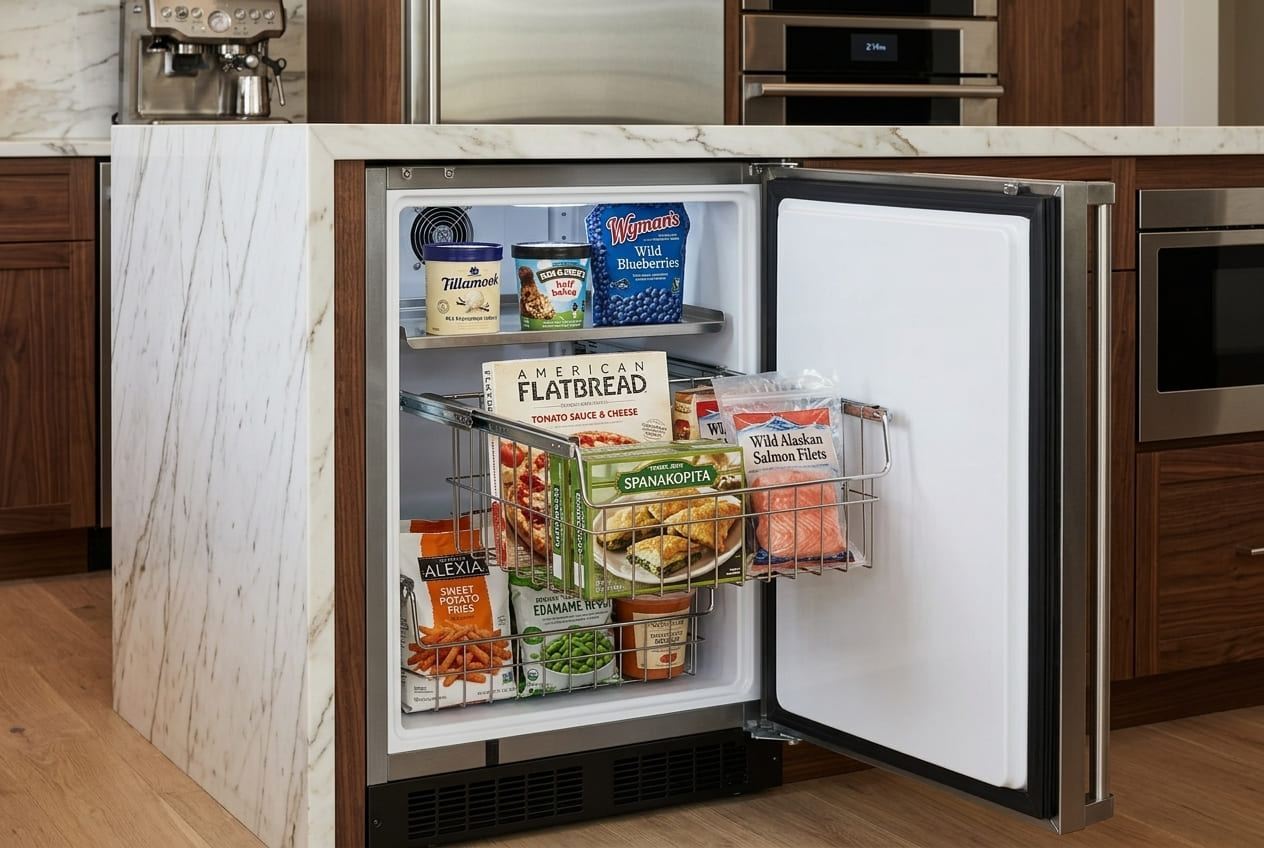
The Do alarm is the most visible signal of a door problem, and it’s the reason many people search for answers. When your Marvel’s LED flashes and you hear a beep every 60 seconds, the Do alarm has activated.
Here’s what the Do alarm actually tells you: the door sensor registered the door as open for more than 10 minutes. That can mean the door is literally standing open, or it can mean the door is physically closed but the door switch or sensor isn’t detecting it as closed.
The Do alarm is an indicator, not a cause. Silencing it — by holding the alarm silence button for three to five seconds — makes the beeping stop, but it doesn’t fix whatever is keeping the door sensor from registering a closed state. If the alarm returns immediately after you silence it and the door appears closed, the sensor itself is likely the issue. See the FAQ section below for more on that scenario, and for a full code reference, see our Marvel Freezer Error Codes guide.
Three DIY Tests to Confirm Whether Your Marvel Door Seal Is Failing
Test 1: The Paper Pull Test
Close the door on a standard sheet of paper, then try to pull it free. Do this in at least four spots around the door perimeter — the two side midpoints, the top center, and the bottom center. A working seal holds the paper firmly at all four points. If the paper pulls free at any of them, that section of the gasket has lost its seal.
Test 2: The Flashlight Test
Place a lit flashlight inside the Freezer, close the door completely, and turn off the lights in the room. Stand outside the closed door and look around the entire perimeter for light leaking through. Any visible light means there’s a gap — and that gap is where warm air is entering and cold air is escaping.
Test 3: The Condensation Check
Open the door and look at the inner surface of the door frame and the front face of the cabinet. If you see water droplets, frost, or a condensation line running along the door edge, warm humid air is entering regularly. This is slower evidence of a seal problem than the paper test, but it’s especially useful for catching intermittent leaks that happen overnight when you’re not opening and closing the door.
What You Can Fix Yourself — and What You Should Leave to a Pro
Not every Marvel Freezer door repair requires a technician. Some issues are genuinely owner-accessible; others can cause additional damage if you go in without the right approach.
Repair task | DIY? | Notes |
Cleaning a dirty or grimy gasket | Yes | Warm soapy water, dry thoroughly, re-test seal |
Adjusting leveling feet | Yes | Use a level; check all four corners |
Removing door obstructions | Yes | Reorganize contents, check shelf seating |
Silencing the Do alarm | Yes | Hold alarm silence button 3–5 seconds |
Gasket replacement (screw-mount type) | Experienced DIY | Requires knowing the exact attachment type for your model |
Gasket replacement (push-in type) | No — Pro | Incorrect technique cracks the door liner |
Hinge adjustment | Experienced DIY | Only if hinges are not bent or worn |
Hinge replacement | No — Pro | Requires door removal and realignment |
Door switch/sensor diagnosis or replacement | No — Pro | Involves control board interaction; misdiagnosis common |
Control board reset after persistent Do alarm | No — Pro | Board inspection needed to confirm the cause |
The gasket question comes up most often. Marvel’s undercounter models — including the popular MO24 lineup — use an embedded snap-clip retainer on many configurations. Owners who try to pry the gasket out without knowing this often crack the door liner, turning a $100 gasket replacement into a significantly more expensive door repair. If you don’t know which attachment type your model uses, check the owner’s manual before touching the gasket.
A Technician's Approach to Marvel Freezer Door Problems: What to Expect
When a technician from Appliance Repair Master arrives to diagnose a Marvel Freezer door repair in Atlanta, the inspection follows a specific order — not just a visual once-over.
- Step 1: Gasket inspection. The technician checks for physical tears, hardening, or deformation along the full perimeter. Corners and the bottom horizontal section receive particular attention since those areas degrade fastest.
- Step 2: Door alignment with a level. A level is placed against the door face. Even a two-degree deviation from plumb can cause the gasket to press unevenly against the frame, sealing on one side and gapping on the other.
- Step 3: Hinge inspection and adjustment. Hinge screws are checked for looseness, and the hinge mechanism is tested for spring tension. If a hinge has bent — usually from the door being pulled open too forcefully over time — adjustment screws can’t compensate for the physical distortion.
- Step 4: Door switch sensor test. A multimeter test checks whether the door switch is registering correctly. A door can be physically closed and mechanically sealed while the switch still signals the control board that it’s open — causing the Do alarm to fire persistently.
- Step 5: Control board check for persistent Do alarm. If the door switch tests fine but the alarm keeps returning, the control board is inspected for a stored fault. In some cases, a board reset resolves it; in others, the board itself has developed a fault. Where refrigerant handling becomes relevant during a broader inspection — for instance, if a compressor issue is suspected alongside the door problem — our technicians are EPA certified for that work.
Professional repair eliminates the guesswork. A door that appears to be sealing fine but keeps triggering the alarm almost always has a sensor or board issue that no amount of gasket cleaning or leveling adjustment will fix.
Keep Your Marvel Door Sealing Right: A Maintenance Checklist

The most common reason door seals fail prematurely is neglect — not age. A few minutes of routine maintenance extends gasket life significantly and keeps the Do alarm from becoming a regular occurrence.
Monthly:
- Wipe the door gasket with a damp cloth to remove grease, food residue, and any mold starting to form in the corners.
- Do a quick paper test at the top and bottom of the door to catch seal degradation early.
- Listen for any unusual behavior when the door closes — it should close smoothly and seat with a slight magnetic pull.
Every six months:
- Check and re-verify the unit’s leveling — feet can shift over time, especially if the unit is bumped or moved.
- Inspect the hinge area for debris and check hinge screws for looseness.
- Look at the door edge for any ice buildup that could indicate a slow seal failure
Year-round:
- Don’t overfill the unit — items packed against the door opening prevent a full seal and increase the risk of obstructions.
- Treat the Do alarm as an early warning, not a nuisance. If it fires when the door appears closed, that’s the sign to investigate rather than just silence it.
Temperature problems often start at the door. If your Marvel is running warmer than its setpoint and you’ve already ruled out door issues, take a look at our guide on Marvel freezer temperature problems — dirty condenser coils and thermistor faults are the next most common culprits.
Conclusion
A Marvel Freezer door not sealing and a Marvel Freezer door that won’t close are two symptoms of the same underlying category of problem — and both are fixable once you’ve identified the specific cause.
The order of diagnosis matters. Start with the simplest checks: leveling feet, interior obstructions, and a gasket wipe-down. Move to the paper and flashlight tests to confirm whether the gasket is the issue. Escalate to professional inspection when you’re dealing with hinge damage, snap-clip gaskets, door switch sensor faults, or a Do alarm that won’t clear after the door appears closed.
Letting either problem go has real consequences. A door that doesn’t seal keeps the compressor running almost continuously as it fights a losing battle against warm air intrusion. Over months, that kind of sustained strain accelerates wear on one of the most expensive components in the unit. What starts as a gasket job turns into a compressor conversation.
For anything beyond cleaning the gasket and adjusting the feet, getting a technician in quickly is the smarter call. If your Marvel is already running warm as a result of the door problem, see our guide on Marvel Freezer temperature issues — it covers what happens when a door seal failure goes unaddressed long enough to affect the whole system.
FAQ
1. My Marvel Freezer passes the paper test but still shows the Do alarm — what's going on?
The Do alarm is triggered by a door sensor or switch, not by the gasket. Your door may be physically closed and the gasket may be sealing fine, but if the door switch isn’t registering the closure, the control board still thinks the door is open. This is a sensor alignment or switch fault — not a gasket problem — and it requires a technician to diagnose and correct. Cleaning or adjusting the gasket won’t change anything.
2. Can I replace a Marvel Freezer door gasket on my own, or is it a job for a professional?
It depends on the model. Marvel undercounter Freezers use one of two attachment methods: visible screws around the door liner (more DIY-accessible) or an embedded snap-clip retainer inside the door liner (not DIY-friendly). If your model uses snap clips and you pry the gasket out incorrectly, you risk cracking the door liner — which creates a more expensive problem than the original seal failure. Check the owner’s manual for your specific model before attempting replacement. When in doubt, have a technician handle it.
3. My Marvel Freezer door has started to sag and no longer lines up with the frame — is this a hinge problem or a leveling problem?
Both can cause door sag, but they look different. If the entire unit is slightly tilted, the door may drift open on its own or hang slightly off-center — that’s usually a leveling issue, and adjusting the feet often resolves it. If the door hangs lower on the hinge side specifically, creating an uneven gap at the top corner, that’s hinge sag — a physical problem with the hinge hardware itself, not the unit’s overall tilt. A useful test: place the unit on a verified-level surface and check whether the door still sits unevenly. If it does, the hinges need attention.
4. There is ice building up along the bottom edge of my Marvel Freezer door — is this connected to the sealing problem?
Yes, directly. Ice buildup along the door edge is a textbook sign that warm, humid air is leaking into the Freezer through a compromised seal. Warm air carries moisture, and that moisture freezes on contact with the cold surfaces near the door opening. The irony is that this ice then becomes a physical obstruction, making the sealing problem worse. Thaw the ice carefully — never with a sharp tool — and inspect the gasket and door alignment immediately afterward.
5. Will ignoring a poorly sealing Marvel Freezer door eventually damage the compressor?
Yes, over time. When the seal fails, the compressor runs almost continuously trying to hold the setpoint against the warm air coming in. Extended periods of nonstop operation cause heat buildup, accelerated wear, and a shortened compressor lifespan. A gasket replacement that costs a fraction of a service call today can prevent a compressor replacement that costs significantly more down the road. The longer a seal failure goes unaddressed, the more expensive the eventual outcome.