Is your freezer completely dead — no cooling at all? That’s a different situation. This guide is for freezers that are still running and partially cold but can’t hold the right temperature. If your unit has stopped freezing entirely, see our comprehensive Kenmore freezer not freezing guide for a full diagnostic.
There’s a particular kind of frustration that comes with a freezer that’s almost working. The compressor hums, the light comes on, the ice cream is still there — but it’s soft. The temperature alarm keeps going off. Something is clearly off, but the unit isn’t dead. This is the “too warm” scenario, and it’s actually the more common presentation we see at Appliance Repair Master. The causes are usually less severe than a full failure, and many of them cost nothing to fix.
The key is knowing where to look — and in what order.
What Temperature Should Your Kenmore Freezer Be? (And How to Check)
The FDA-recommended safe temperature for frozen food storage is 0°F (−18°C). At this temperature, bacterial growth is halted and food quality is preserved long-term. Kenmore’s own guidelines align with this standard.
Don’t rely on the built-in dial alone. The numbered dials on most Kenmore freezers (typically a 1–7 scale) are relative settings, not calibrated temperature readings. A dial set to “4” might produce 5°F in one unit and 12°F in another, depending on ambient conditions, load, and the age of the thermostat.
The right way to check:
- Place a standalone appliance thermometer in the center of the freezer, away from the walls and air vents
- Leave it for at least 2–3 hours with the door closed
- Read the temperature without opening the door if possible (or read immediately after opening)
- Target: 0°F to 5°F for the freezer; if you’re reading above 10°F consistently, something needs attention
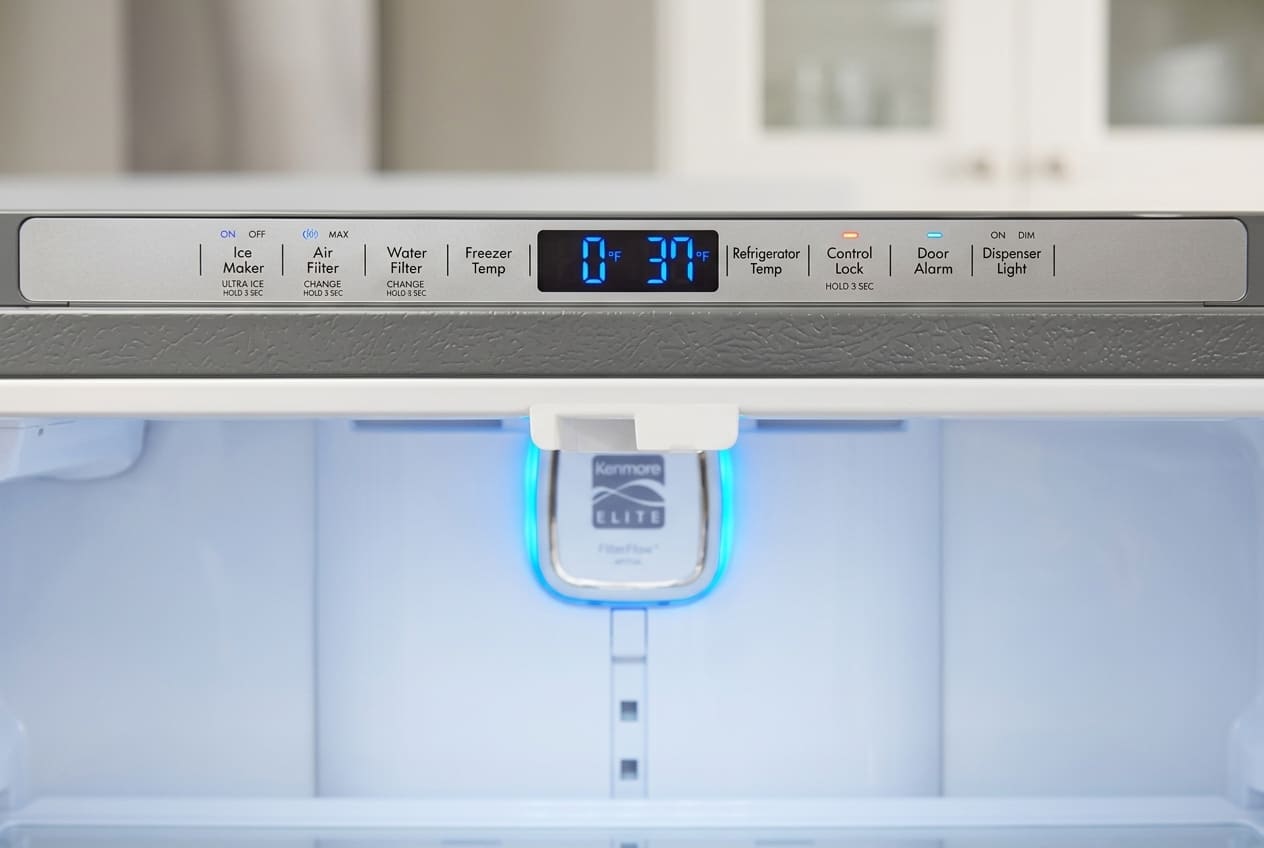
On Kenmore models with an electronic display (most Elite and 795-series units), the displayed temperature is more accurate — but it still reflects the sensor reading, not necessarily the actual air temperature throughout the compartment. A thermistor that’s reading incorrectly will show a false “normal” on the display while the actual interior temperature climbs.
Why Your Kenmore Freezer Is Too Warm — TOP 10 Causes
This is a temperature drift situation: the freezer is running, it’s cold, but it can’t reach or hold 0°F. Work through these causes from most to least common.
1. Overpacked Freezer Blocking Air Vents
The single most common cause of a Kenmore freezer running warm — and the one that costs nothing to fix.
Kenmore frost-free upright freezers circulate cold air through vents in the back wall and sometimes the side walls. When food is packed tightly against these vents, airflow obstructions prevent cold air from reaching the front and upper sections of the compartment. The result: the back is cold, the front is warm, and the temperature reading climbs.
The 75% rule: Don’t fill a frost-free upright beyond 75% capacity. Leave at least 1 inch of clearance around all rear vents. Chest freezers are less sensitive to this because cold air naturally settles, but even there, blocking the evaporator area causes problems.
Signs this is your issue: the freezer is coldest near the back wall and noticeably warmer near the door. Reorganizing the contents takes 10 minutes and sometimes solves the problem immediately.
2. Door Opened Too Frequently or Not Sealing Properly

Every time the door opens, warm humid air enters. In a busy kitchen — or in summer without AC — this adds up fast. A freezer that’s opened 20+ times a day will struggle to maintain 0°F even with a perfectly functioning cooling system.
The more insidious version: a door that closes but doesn’t seal. A failing door gasket may not prevent the door from shutting, but it allows a steady trickle of warm air in around the frame. Condensation along the door frame or frost forming unevenly near the door edges are the telltale signs.
Dollar-bill test: Close the door on a folded bill. If it pulls out without resistance, the seal isn’t tight enough. See our Kenmore freezer door seal guide for a full gasket inspection and replacement walkthrough.
3. Dirty Condenser Coils
The condenser coils dissipate the heat pulled from inside the freezer. When they’re coated in dust and pet hair, heat can’t escape efficiently — the compressor runs longer and harder but can’t bring the temperature down to target.
This is a maintenance issue that compounds over time. A freezer that was holding 0°F fine last winter may start running at 10–15°F in summer simply because the coils haven’t been cleaned in 18 months and the ambient temperature is higher.
Location: Bottom rear of the unit, behind the lower access panel. On some models, behind the kick plate at the front base.
Cleaning: Unplug the unit, remove the access panel, vacuum the coil fins with a brush attachment. Takes 15 minutes. Kenmore recommends doing this every 6–12 months — more often in homes with pets.
4. Thermostat Set Incorrectly or Malfunctioning
Before assuming a component failure, verify the setting. Dial controls get bumped. Kids adjust them. Someone cleaning the freezer accidentally turns the dial toward the warmer end.
On dial-controlled models (most 253-series uprights): The scale runs 1 (warmest) to 7 (coldest). Setting 4 is a reasonable starting point for 0°F, but the exact correspondence varies by model. After any adjustment, give the unit 24 hours to stabilize before evaluating the result — a fully loaded freezer doesn’t respond to thermostat changes instantly.
On electronic models (Elite, 795-series): Check that the display shows the correct target temperature. Some models have a “demo mode” or “showroom mode” that disables cooling while keeping the display active — worth checking if the unit was recently moved or had a power interruption.
If the thermostat itself has failed — stuck in a partially open position — the compressor runs intermittently or not at all. Test with a multimeter: at the coldest setting, the thermostat should show continuity.
5. Defrost System Malfunction — Frost Blocking the Evaporator
This is the most common mechanical cause of a Kenmore freezer running too warm, and it’s a slow-developing problem that catches people off guard.
Frost-free Kenmore freezers run automatic defrost cycles — typically every 8–12 hours — to melt any frost that accumulates on the evaporator coils. When the defrost system fails (heater, bi-metal thermostat, or timer), frost builds up unchecked. Over days and weeks, it gradually encases the coils, reducing their ability to cool the air passing over them. The freezer gets progressively warmer — not all at once, but a degree or two at a time.
The defrost thermostat (bi-metal) is the cause of “too warm” in 99% of cases on the KENMORE 253.28262803 — a Frigidaire-built upright. The same part is the dominant fix across multiple 253-series models including the KENMORE 253.9284014 (75% of cases) and KENMORE 253.24452104 (75% of cases).
How to confirm: Remove the rear interior panel inside the freezer. If the evaporator coils are coated in a thick layer of frost or ice, the defrost system has failed. A manual defrost (unplug, door open for 24 hours) will temporarily restore normal temperatures. If the frost returns within 2–3 weeks, the defrost heater, bi-metal thermostat, or timer needs replacement.
Defrost system failure can also cause water leaks during defrost cycles — if you’re seeing both symptoms, they share the same root cause.
6. Evaporator Fan Not Running at Full Speed
A dying evaporator fan motor may still spin — just slowly. Reduced airflow means cold air doesn’t circulate effectively from the coils to the rest of the compartment. The freezer is coldest right near the evaporator but noticeably warmer toward the front and top.
This is different from a fan that’s stopped entirely (which causes more dramatic cooling loss). A partially failing motor produces a gradual temperature rise that’s easy to mistake for a thermostat issue.
Test: With the door closed, listen for the fan. Open the door — it should stop. Close it — it should restart within seconds. If the sound is weaker than usual, or the fan takes longer to reach speed, the motor bearings are wearing out.
On the KENMORE 795.74025 (LG-built Elite), a documented case shows the freezer running 24°F (set to 0°F) and the fridge at 53°F — with the evaporator fan identified as the primary culprit after a thermistor replacement provided only temporary improvement. The fan was running but not circulating air effectively due to ice buildup around the housing.
7. Condenser Fan Not Running Properly
The condenser fan motor at the bottom rear of the unit draws air over the condenser coils and the compressor. When it slows down or stops, the compressor overheats and its thermal overload protection kicks in — the compressor shuts off prematurely, and the freezer warms up.
This tends to be more pronounced in warm environments. A garage freezer in Georgia summer is a classic scenario: the condenser fan is already working harder than usual, and any reduction in its performance pushes the compressor over the thermal limit.
Check: Pull the unit away from the wall and listen at the back while the compressor is running. The condenser fan should be audible. If the compressor is running but the fan isn’t, the motor has failed or something is obstructing the blade.
8. Door Gasket Letting Warm Air In
A subtle gasket failure — a small crack, a twisted section, or a section that’s lost its magnetic grip — may not be obvious visually. But it allows a continuous stream of warm air into the compartment, raising the temperature gradually and causing the compressor to run almost constantly trying to compensate.
Signs: Frost forming unevenly near the door frame, condensation on the exterior around the door seal, or the compressor running noticeably more than it used to.
Clean the gasket with warm soapy water first — a dirty gasket can lose its seal without being damaged. If cleaning doesn’t restore the seal, replacement is straightforward.
9. High Ambient Temperature
Standard residential freezers are rated to operate in ambient temperatures between approximately 55°F and 110°F. When the room temperature exceeds this range — a garage in Atlanta in July, for example — the unit simply can’t keep up. The compressor runs continuously but can’t overcome the heat load.
Garage-ready vs. standard models: Some Kenmore models are specifically rated for wider temperature ranges. If you’re running a standard upright in an unconditioned garage, check the model’s operating temperature spec in the owner’s manual. If the ambient temperature regularly exceeds 95–100°F, a standard model will struggle even when fully functional.
This isn’t a repair issue — it’s a placement issue. Moving the freezer to a climate-controlled space, or adding ventilation to the garage, solves it without touching a single component.
10. Thermistor Sending Incorrect Data
The thermistor is a small temperature sensor that feeds real-time readings to the control board. If it sends data that’s warmer than actual — or sends no data at all — the board may not call for enough cooling, and the freezer drifts warm while appearing to function normally.
This is particularly relevant on electronically controlled models. On the KENMORE 795.71033 (LG-built Elite), a documented case shows the freezer stabilizing at 38°F with the compressor running and coils showing zero frost — a pattern consistent with a thermistor or control board issue rather than a mechanical failure.
Test: Check resistance with a multimeter. The resistance value should change as temperature changes — a thermistor that reads the same regardless of temperature has failed.
How to Fix a Kenmore Freezer That's Too Warm
Start with the free fixes. Most “too warm” complaints resolve before you reach Step 4.
Step 1 — Check and Adjust the Temperature Setting
Verify the thermostat is set to the coldest position (7 on a dial scale, or 0°F on an electronic display). After adjusting, wait a full 24 hours before evaluating — the freezer needs time to reach its new equilibrium, especially if it’s fully loaded.
Step 2 — Reorganize Contents for Proper Airflow
Move items away from the rear vents. Leave at least 1 inch of clearance around all air vents. Don’t stack items against the back wall. If the freezer is over 75% full, remove some items temporarily and see if the temperature drops.
Step 3 — Inspect and Clean the Door Gasket
Wipe the gasket with warm soapy water and a soft cloth — dirt and food residue can prevent a proper seal. Dry thoroughly. Run the dollar-bill test around the entire perimeter. If the seal fails in any section, the gasket needs replacement.
Step 4 — Clean the Condenser Coils
Unplug the unit, pull it away from the wall, remove the rear lower access panel, and vacuum the coil fins. This takes 15 minutes and is free. If the temperature improves after cleaning, the coils were the issue — schedule this as annual maintenance going forward.
Step 5 — Verify Fan Motor Operation
Evaporator fan: Close the door and listen. Open the door — the fan should stop. Close it — it should restart within seconds. To test directly, press the door switch manually with the door open; the fan should run.
Condenser fan: Listen at the back of the unit while the compressor is running. Both fans should be audible. If either is silent or unusually slow, test with a multimeter for continuity. Replace if no continuity.
Step 6 — Check the Defrost System
Remove the rear interior panel and inspect the evaporator coils. A thick frost coating confirms defrost system failure. Perform a manual defrost to restore cooling temporarily, then test the heater, bi-metal thermostat, and timer individually with a multimeter. Replace only the failed component.
Step 7 — Test the Thermostat and Thermistor
For the cold control thermostat: disconnect the wiring and test for continuity at the coldest setting. For the thermistor: test resistance at room temperature and verify it changes as temperature changes. Replace whichever fails.
How to Adjust Temperature on Different Kenmore Freezer Models
Dial-controlled uprights (253-series, Frigidaire-built):
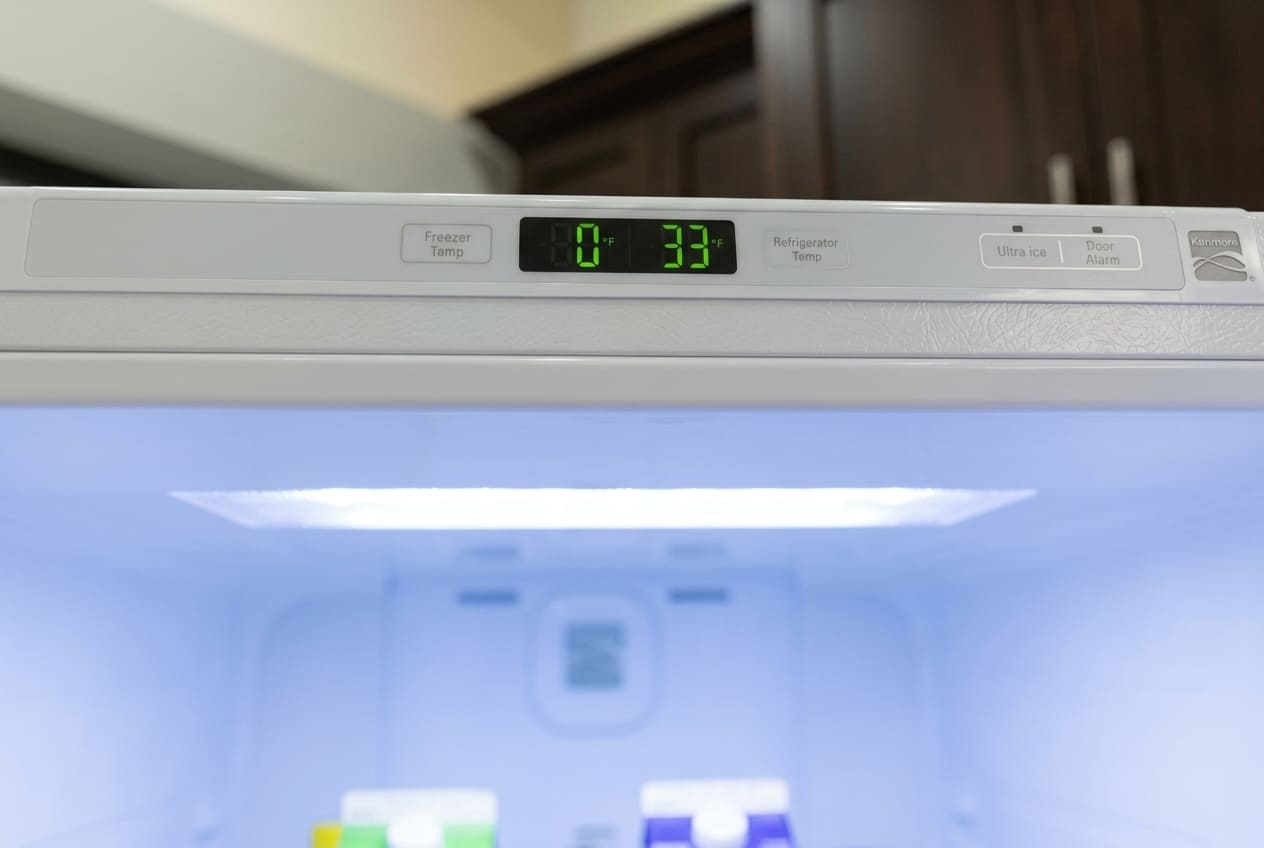
The dial runs from 1 (warmest) to 7 (coldest). Setting 4 is a reasonable starting point for 0°F. After any adjustment, allow 24 hours for the temperature to stabilize before making further changes. The dial is typically located inside the freezer compartment, near the top.
Electronic panel models (Elite, 795-series, LG-built):
Use the temperature buttons on the front panel to set the target. The recommended setting is 0°F for the freezer. Some models require holding the button for 3 seconds to change the setting. If the display shows a temperature but the unit isn’t cooling to that level, the thermistor or control board may be misreporting.
Chest freezers:
The thermostat knob is usually located inside the compartment, near the top edge. It operates on a similar 1–7 or Min–Max scale. Chest freezers are less sensitive to airflow issues but more sensitive to ambient temperature — in a hot garage, even the maximum setting may not achieve 0°F.
Save Your Food — What to Do When Your Freezer Is Too Warm Right Now
If you’re reading this because your freezer is warm right now, here’s what to do immediately:
- Don’t open the door. A closed freezer maintains its temperature for approximately 24–48 hours if full, or 12–24 hours if half-full. Every time you open it, you lose that buffer.
- Check the actual temperature. If food is above 40°F and has been there for more than 2 hours, the FDA’s 2-hour rule applies — it may not be safe to refreeze without cooking first.
- Move critical items. Transfer meat, fish, and anything with high spoilage risk to a neighbor’s freezer or a cooler with ice. Ice cream and bread can tolerate more temperature fluctuation than proteins.
- Document the situation. If you lose significant food value, take photos of the contents and the temperature reading before discarding anything. Some homeowner’s insurance policies cover food loss from appliance failure.
- Don’t add warm food. If you’re trying to preserve what’s left, don’t open the door to add anything new.
Kenmore Freezer Temperature Fix — Costs at a Glance
Repair | DIY Cost | Professional Cost |
Reorganize contents / clear vents | $0 | N/A |
Clean condenser coils | $0–$10 | $75–$150 |
Door gasket replacement | $30–$80 | $150–$350 |
Fan motor (each) | $15–$60 | $100–$300 |
Thermostat | $15–$60 | $100–$300 |
Defrost thermostat (bi-metal) | $20–$70 | $120–$400 |
Thermistor | $10–$50 | $80–$250 |
Sealed system repair | Pro only | $400–$800+ |
When to Call a Professional
Most “too warm” issues are DIY-friendly. These are the exceptions:
- Temperature won’t drop below 20°F despite cleaning coils, clearing vents, and confirming fans are running — the sealed system may have a slow refrigerant leak
- Compressor is hot to the touch but the freezer isn’t cooling — thermal overload or internal compressor wear
- 795-series LG-built Elite models with temperature drift and zero frost on the evaporator — this pattern can indicate a refrigerant issue or a failing compressor that requires EPA-regulated diagnosis
- Control board failure — if all components test fine but the freezer still can’t regulate temperature, the board may need substitution testing to confirm
- Food loss documentation — if you need a written repair assessment for an insurance claim, a professional service call provides that
Conclusion
A Kenmore freezer running too warm is almost always traceable to one of a handful of causes — and the most common ones are free or nearly free to fix. Start with the basics: thermostat setting, vent clearance, door seal, condenser coils. These four checks alone resolve the majority of “too warm” complaints without touching a single component.
For frost-free upright models in the 253-series, the defrost thermostat is the dominant mechanical cause — documented at 75–99% of “too warm” cases across multiple models. It’s a $20–$70 part and a straightforward DIY repair. For LG-built Elite models, pay attention to the thermistor and evaporator fan before assuming a compressor issue — the symptoms can look similar but the fixes are very different in cost and complexity.
The food safety section in this guide exists for a reason: a warm freezer is a time-sensitive problem. Don’t wait a week to diagnose it.
FAQ
1. My Kenmore freezer is running constantly but the temperature keeps rising. What's most likely wrong?
A freezer that runs non-stop but can’t hold temperature is usually dealing with one of three things: dirty condenser coils preventing heat dissipation, a defrost system failure with frost blocking the evaporator coils, or a door seal that’s letting warm air in continuously. The compressor is working — it just can’t overcome the heat load. Start with the coils (free fix), then check for frost buildup on the evaporator, then do the dollar-bill test on the door seal.
2. My Kenmore freezer temperature alarm keeps going off, but the freezer feels cold when I open it. What's happening?
The alarm triggers when the internal temperature exceeds a set threshold — typically around 15–20°F depending on the model. If the freezer feels cold to the touch but the alarm is going off, the temperature is likely hovering in the 15–25°F range rather than at 0°F. This is the “too warm” scenario: cold enough to feel cold, not cold enough to be safe. Check the thermostat setting first, then look for vent obstructions and frost buildup on the evaporator.
3. The top of my Kenmore upright freezer is noticeably warmer than the bottom. Is that normal?
Cold air is denser and sinks, so a slight temperature gradient from top to bottom is normal. But a significant difference — more than 5–8°F — usually means the evaporator fan isn’t circulating air effectively. Either the fan motor is weakening, the vents near the top are blocked by food, or frost buildup is restricting airflow from the evaporator. Check the vents first, then test the fan.
4. My Kenmore freezer was fine all winter but started running warm in summer. Nothing has changed. What's going on?
Ambient temperature is almost certainly the factor. As the room temperature rises, the freezer has to work harder to maintain 0°F. If the condenser coils haven’t been cleaned recently, this is the time they’ll start causing problems — the combination of higher ambient temperature and reduced coil efficiency can push the freezer over its limit. Clean the coils first. If the freezer is in a garage or unconditioned space, check whether the ambient temperature is exceeding the unit’s rated operating range.
5. I adjusted the thermostat on my Kenmore freezer but the temperature didn't change. How long should I wait?
Give it a full 24 hours. A fully loaded freezer takes time to respond to thermostat changes — the thermal mass of all that frozen food slows the process. If the temperature hasn’t moved after 24 hours, the thermostat adjustment either wasn’t sufficient or the thermostat itself has failed. Test it with a multimeter: at the coldest setting, it should show continuity. If it doesn’t, the thermostat needs replacement.
6. My Kenmore Elite freezer shows 0°F on the display but the food is soft. Can the display be wrong?
Yes. The display shows the reading from the thermistor sensor, not the actual air temperature throughout the compartment. If the thermistor is positioned near the evaporator (the coldest spot) or is reading incorrectly, the display can show 0°F while the actual temperature in the middle of the compartment is significantly higher. Place a standalone thermometer in the center of the freezer and compare. If there’s a significant discrepancy, the thermistor is the likely culprit.