
Use our guide like a homeowner-friendly diagnostic map
Verify first Check the actual compartment temperature before changing settings again. | Clear the easy stuff Move food away from vents, check doors, and give your Bosch fridge time to recover. | Call at the pattern Repeated warm indicators, alarms, slow recovery, or display mismatch require service. |
|---|
Bosch refrigerator set to 37°F should keep milk cold, produce fresh, and ice cream firm enough to scoop instead of slouch. When that stops happening, the number on the panel becomes only the opening clue.
For Atlanta homeowners with Bosch 800 or 500 Series refrigerators, temperature trouble usually falls into one of two camps. The first is normal recovery:
- a big grocery load,
- a busy kitchen,
- warm air from repeated door openings,
- or a short cooling cycle shift.
The second is a real performance issue:
- weak airflow,
- a fan problem,
- defrost cycle spikes,
- sensor trouble,
- temperature module failure,
- or a mismatch between the display and the actual compartment temperature.
Our article enables you to sort those two camps without turning the refrigerator into a weekend science project. You’ll learn how to verify the actual temperature, what fluctuation is worth watching, when the freezer can stay near range while the fresh-food section runs warm, and when it’s time for the Appliance Repair Master to step in.
We at Appliance Repair Master, repair Bosch temperature problems across Atlanta, GA. We diagnose actual vs display temperature issues, Bosch temperature fluctuating complaints, warm refrigerator sections, freezer alarms, defrost recovery problems, airflow faults, sensor issues, and Bosch 800/500 Series cooling failures.
Start With the Temperature Inside the Compartment
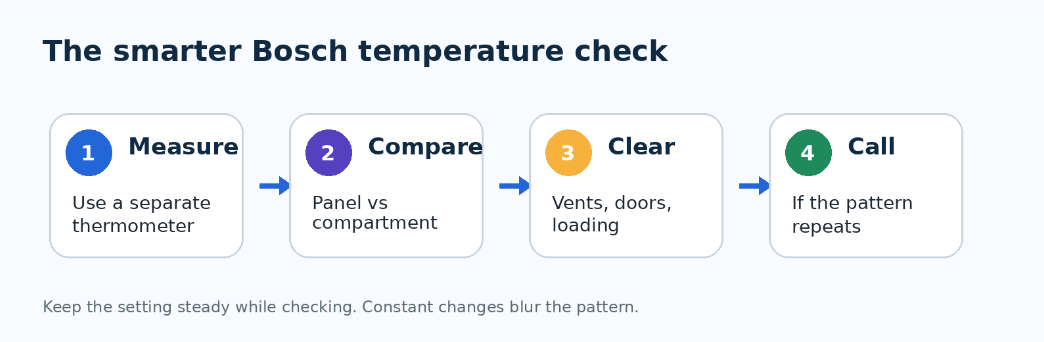
Before changing the setting again, get a number from inside the refrigerator.
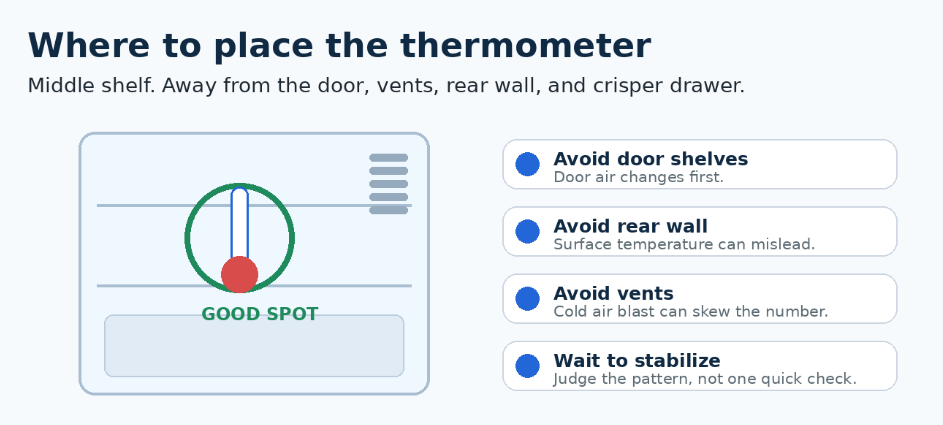
A separate refrigerator thermometer is cheap, simple, and more useful than repeated button pressing. Place it on a middle shelf in the fresh-food section. Keep it away from the door, rear wall, air vents, and crisper drawer. Let it sit long enough to stabilize.
For the freezer, place the thermometer between frozen items instead of against the wall. You’re checking the storage temperature around the food, not the coldest surface inside the drawer.
Once you have the number, compare it with the panel.
What you find | Best next move |
|---|---|
The temperature rises after groceries, then drops back to range | Leave the setting alone and monitor |
The refrigerator stays warmer than it should for several hours | Book a Bosch temperature diagnosis |
The display and thermometer keep showing different numbers | Have the sensors and controls checked |
The freezer stays near target, but the refrigerator section stays warm | Airflow, fan, damper, or defrost trouble is likely |
You change the setting, but the thermometer barely changes | Temperature module or control-side diagnosis is needed |
A short temperature rise after a grocery run isn’t unusual. A Bosch refrigerator that stays warm after it has had time to recover is different. At that point, pressing the temperature button again usually adds confusion instead of answers.
Appliance Repair Master can test the airflow, evaporator fan, damper, sensors, defrost behavior, and control response before anyone starts replacing parts.
How to run a better thermometer check
A quick glance at a thermometer can help, but a better check gives you a clearer pattern. Use two checks instead of one: one in the morning, one later in the day. If the refrigerator has been opened often, wait until the kitchen settles down before taking the second number.
Time | Refrigerator thermometer | Freezer thermometer | What happened before the check? |
|---|---|---|---|
Morning | ___°F | ___°F | Normal overnight use |
Afternoon | ___°F | ___°F | Groceries, cooking, door openings |
Evening | ___°F | ___°F | Dinner prep, kids, guests, cleanup |
Pro tip
Keep the refrigerator setting steady while you test. If you change the setting every few hours, the pattern gets muddy.

What is Considered Normal Temperature Swing
A refrigerator doesn’t sit on one exact number all day. It cools, pauses, cycles, recovers, and reacts to how the kitchen gets used.
Temperature can rise after:
- a full grocery load;
- warm containers placed inside;
- several rounds of door openings;
- a long dinner prep;
- a recent setting change;
- a normal defrost cycle;
- a hot Atlanta kitchen.
That kind of swing should settle. The key word is recover.
A healthy Bosch refrigerator might run higher for a while after heavy use, then return to its normal range. A struggling unit keeps running high, takes too long to settle, or repeats the same warm pattern without a clear trigger.
Usually normal | Worth scheduling service |
|---|---|
Temperature rises after groceries | Temperature stays high for hours |
Doors were opened many times | Warm readings happen with no clear trigger |
Cooling returns after a recovery window | Cooling improves, then drifts again |
Vents were blocked and improved after rearranging food | Vents are clear, but the section still runs warm |
One short fluctuation | Repeated temperature swings |
A normal swing has a reason and an end point. A repair-worthy swing keeps coming back.
If your Bosch keeps running high after the easy variables are gone, Appliance Repair Master should check the system before the issue turns into spoiled groceries or a larger cooling failure.
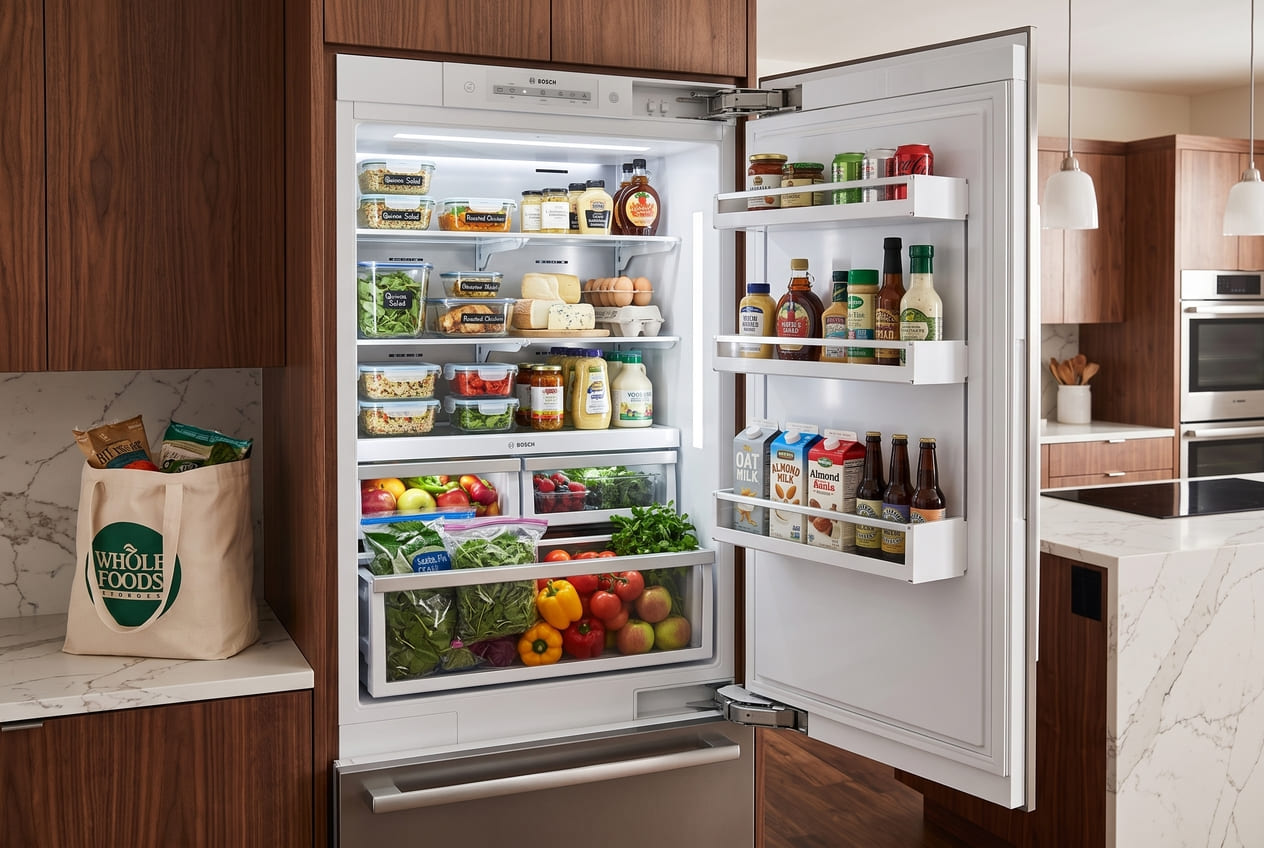
Quick homeowner tip: give the fridge a fair recovery window
A refrigerator can’t instantly erase the heat from warm groceries, hot leftovers, or repeated door openings. Give it time before judging the result. But don’t let that become an excuse for a refrigerator that stays warm all day.
A fair recovery window makes sense when | A service call makes more sense when |
|---|---|
the doors were open often | the temperature remains high after the recovery period |
the fridge was just loaded | the same pattern repeats the next day |
large warm items went inside | the freezer alarm returns |
the kitchen was hot | dairy and produce spoil faster than normal |
the settings were recently changed | the thermometer keeps disagreeing with the panel |
Actual vs Display Temperature: Why the Panel Isn’t Always Enough
The Bosch panel matters, but it doesn’t deserve blind trust.
The panel shows what the refrigerator is set to maintain or what the control system is reporting. The thermometer shows what the compartment is holding. Those two numbers should stay reasonably close over time. If they keep drifting apart, the refrigerator needs a closer look.
Actual vs display temperature problems can come from several places:
- a sensor reporting poorly;
- airflow blocked inside the compartment;
- a fan that isn’t moving cold air well;
- a damper that isn’t routing air properly;
- frost affecting circulation;
- a control or temperature module issue;
- frequent door openings or overloading that hides the real pattern.
Before you call, clean up the easy causes.
Move cartons and containers away from the rear vents. Leave space between large items. Make sure drawers slide in fully. Check that the doors close cleanly. Keep the setting steady long enough to compare results.
If the thermometer and panel still disagree, don’t keep lowering the temperature. A lower setting won’t fix a sensor that reports poorly, a fan that runs weakly, or frost that blocks airflow.

What temperature fluctuations look like in daily use
Homeowners usually notice this problem through small mismatches. The panel shows that the refrigerator should be cold, but the kitchen routine says otherwise.
Homeowner complaint | Possible direction |
|---|---|
“The display looks normal, but milk spoils faster.” | Test actual refrigerator temperature |
“The freezer setting is normal, but ice cream is soft.” | Test freezer temperature between frozen items |
“I lowered the setting, but nothing changed.” | Control response, sensor, fan, damper, or module check |
“The fridge is colder in one spot and warm in another.” | Airflow or loading pattern check |
“The alarm cleared, then came back.” | Recovery, door seal, sensor, or cooling diagnosis |
When the Freezer Is Near Range but the Refrigerator Runs Warm
This complaint comes up often: the freezer seems to be doing its job, but the refrigerator section won’t stay cold enough.
That usually points toward air movement.
Many Bosch refrigerator designs rely on controlled circulation between cooling components, vents, dampers, fans, and compartment sensors. If cold air isn’t reaching the fresh-food section properly, the freezer can stay closer to target while the refrigerator section runs warm.
Lowering the setting might help briefly, but it won’t solve poor airflow. The air still has to move.
Check the simple stuff first
- Move food away from vents.
- Avoid packing shelves wall-to-wall.
- Make sure tall containers aren’t blocking air paths.
- Confirm drawers and bins close fully.
- Check that both doors seal without obstruction.
- Give the refrigerator time to settle after rearranging.
Call Appliance Repair Master when
- the refrigerator section stays warm after vents are clear;
- the freezer remains near range while the refrigerator section stays high;
- frost appears near the rear panel;
- the fan sounds uneven, loud, or absent;
- the temperature improves briefly, then rises again;
- the same warm pattern returns after every grocery load.
Service promise
Appliance Repair Master checks the airflow route before recommending parts, so you’re not paying for guesses.
Airflow checklist for Bosch 800/500 Series refrigerators
□ Are containers pushed against the rear wall?
□ Are vents blocked by bags, cartons, or produce bins?
□ Are shelves packed so tightly that air can’t move?
□ Do drawers close all the way?
□ Does the door seal cleanly around the full edge?
□ Is frost visible near the rear panel?
□ Has the refrigerator been recently overloaded?
□ Did the issue start after a party, holiday, or large grocery run?
If airflow improves after rearranging food and the temperature returns to range, keep monitoring. If the problem returns with normal loading, the issue likely sits deeper in the system.
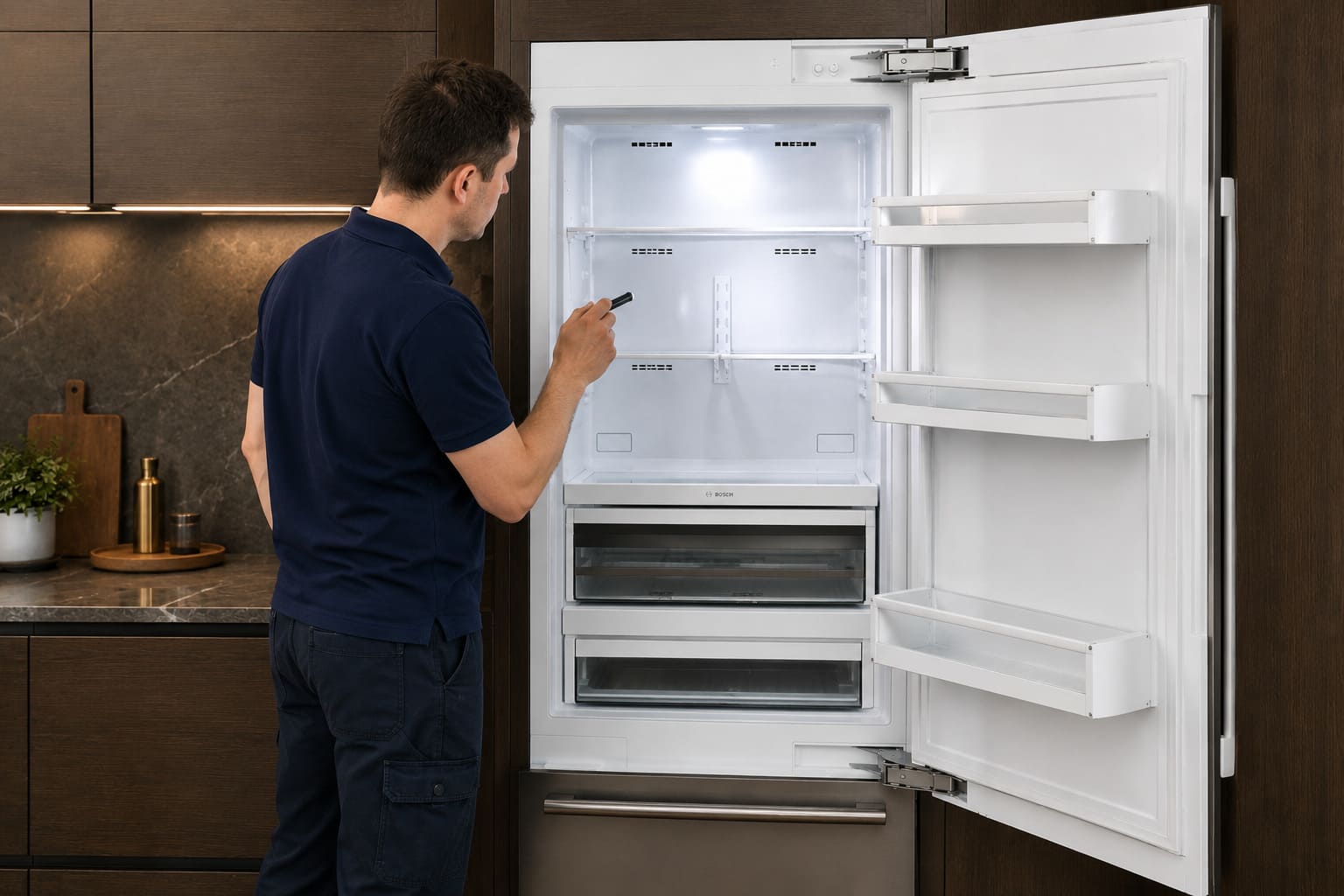
Defrost Cycle Spikes: Normal Background Work or Trouble?
Defrost cycle spikes sound technical, but the homeowner version is simple: frost-free refrigerators run background defrost activity so frost won’t choke airflow.
A short temperature bump during that process can be normal. The refrigerator should settle afterward. The concern is slow recovery.
If the temperature rises during or after a cycle and stays too warm, or if frost buildup appears with repeated warm readings, the defrost system needs attention. The cause can sit in the defrost heater, sensor, control response, drainage, fan operation, or frost blocking air movement.
Pattern | What it suggests |
|---|---|
Brief rise, then normal range returns | Monitor |
Rise after heavy door use, then steady cooling returns | Monitor and reduce door openings |
Repeated spikes with slow recovery | Book service |
Frost buildup plus a warm fresh-food section | Defrost or airflow diagnosis needed |
Freezer alarm keeps returning | Call Appliance Repair Master |
Thermometer stays warm after a recovery window | Service recommended |
Skip the knife, screwdriver, or hair dryer approach. Scraping ice or blasting heat into the wrong area can damage liners, sensors, plastic parts, or nearby wiring. If frost and temperature swings show up together, the smarter move is professional diagnosis.

Why defrost problems can fool homeowners
Defrost trouble often looks like a general cooling complaint. The refrigerator may run warm, then cool for a while, then run warm again. The freezer may seem close to range, but frost starts building where air should pass freely.
That’s why a defrost issue can get mistaken for:
- a bad thermostat;
- a weak compressor;
- a control-panel problem;
- a temperature module failure;
- a random door-opening problem;
- a setting issue.
A proper diagnosis looks at frost pattern, fan behavior, temperature recovery, sensor response, and airflow. Guessing from one symptom can send the repair in the wrong direction.
Temperature Module Failure
Temperature module failure sounds like a part name, but homeowners usually use it to describe a refrigerator that won’t behave consistently.
You might notice:
- the panel changes, but the compartment temperature barely moves;
- the refrigerator runs warm even after settings are corrected;
- the freezer and refrigerator behave differently;
- alarms return after resets;
- the display and thermometer keep disagreeing;
- cooling improves for a while, then slips again;
- the issue keeps returning after normal checks.
That doesn’t mean one electronic module is bad. Temperature control depends on a chain of parts: sensors, control board, fan, damper, defrost system, door switches, airflow paths, and sometimes sealed-system performance. A technician needs to find where the chain breaks.
At Appliance Repair Master, we don’t treat temperature module failure as a shortcut diagnosis. Our approach is to:
- compare the panel setting,
- actual compartment temperature,
- fan operation,
- frost pattern,
- sensor feedback,
- damper response,
- and recovery time.
This enables to avoid replacing a control part when the real issue is airflow, or chasing airflow when the control system isn’t responding correctly.
Bosch 800 or 500 Series refrigerator is too expensive for parts roulette.
Red flags that deserve professional diagnosis
□ the refrigerator stays warm after a full recovery period;
□ the display and thermometer disagree repeatedly;
□ changing the setting barely affects actual temperature;
□ the freezer alarm returns after resets;
□ the refrigerator section runs warm while the freezer stays closer to range;
□ the fan sounds unusual;
□ frost buildup appears near the rear panel;
□ food freezes in one refrigerator zone while another area runs warm;
□ the issue returns after vents are cleared;
□ the problem started after moving, power loss, or installation.
One symptom can be a clue. A cluster of symptoms is a stronger case for service.

Atlanta Kitchens Can Expose Cooling Problems Faster
Atlanta weather doesn’t cause every refrigerator problem, but it can expose a weak cooling system sooner.
Warm kitchens, direct sunlight, frequent entertaining, full grocery loads, and summer humidity all make the refrigerator work harder. A Bosch unit with clean airflow and healthy components should handle normal household use. A unit with a weak fan, dirty air path, failing sensor, poor door seal, or defrost issue has less room to recover.
That’s why some temperature complaints show up suddenly during hot weather or after a busy weekend.
Ask yourself:
- Did the problem start during a hot spell?
- Did it happen after a large grocery run?
- Were the doors open often during cooking or guests?
- Was the refrigerator recently moved?
- Did the issue begin after a power interruption?
- Did someone change the settings or activate a special mode?
- Did an alarm appear after warm food was placed inside?
Those details help separate a normal recovery event from a true Bosch cooling problem.
If the refrigerator settles after normal use, keep monitoring. If it keeps missing the range, don’t wait until the next grocery trip proves the point again.
A note for busy Atlanta households
A refrigerator in a quiet kitchen has an easier job. A refrigerator in a busy Atlanta home: kids, guests, meal prep, weekend groceries, warm weather, frequent door openings has to recover again and again.
That’s why the Appliance Repair Master looks beyond the display. We consider use patterns, room conditions, door seals, food placement, airflow, and recovery time before calling a part bad.
The purpose is to catch the real failure early when the refrigerator keeps running out of range.
The Smart Homeowner Check Before Calling
Use this checklist before calling Appliance Repair Master
□ Confirm the refrigerator and freezer settings.
□ Place a separate thermometer in the refrigerator section.
□ Place a freezer thermometer between frozen items.
□ Move food away from rear vents.
□ Leave space between large containers.
□ Make sure drawers close fully.
□ Check that the doors seal cleanly.
□ Look for frost buildup near the rear panel.
□ Note whether the freezer alarm appeared.
□ Track whether the problem happens after groceries, door openings, or with no clear trigger.
□ Stop changing settings every few hours.
That last point matters. Constant setting changes make the pattern harder to follow. Keep the setting steady long enough to see what the appliance is doing.
Quick decision guide
If this is happening | Your next move |
|---|---|
Temperature rose after a grocery load and recovered | Monitor |
Vents were blocked and cooling improved after rearranging | Monitor |
Thermometer still shows warm temperatures after recovery | Call Appliance Repair Master |
Freezer alarm keeps returning | Call Appliance Repair Master |
Frost buildup appears with warm refrigerator temperatures | Call Appliance Repair Master |
Display and thermometer keep disagreeing | Call Appliance Repair Master |
Panel changes don’t change actual temperature | Call Appliance Repair Master |
A few careful checks can save you from calling too early. They can also show when waiting is no longer the safe choice.
Try this first checklist
□ Clear the rear vents.
□ Remove oversized containers blocking air paths.
□ Make sure doors close without hitting food or bins.
□ Wipe crumbs or residue from the gasket.
□ Keep the setting steady.
□ Test with a separate thermometer.
□ Give the refrigerator time to recover after a large load.
□ Avoid placing hot containers inside.
□ Watch whether the problem returns the next day.
Stop DIY here
If the refrigerator still runs warm, deeper troubleshooting can involve electrical components, fans, sensors, controls, frost buildup, and panels that shouldn’t be opened without the right tools.
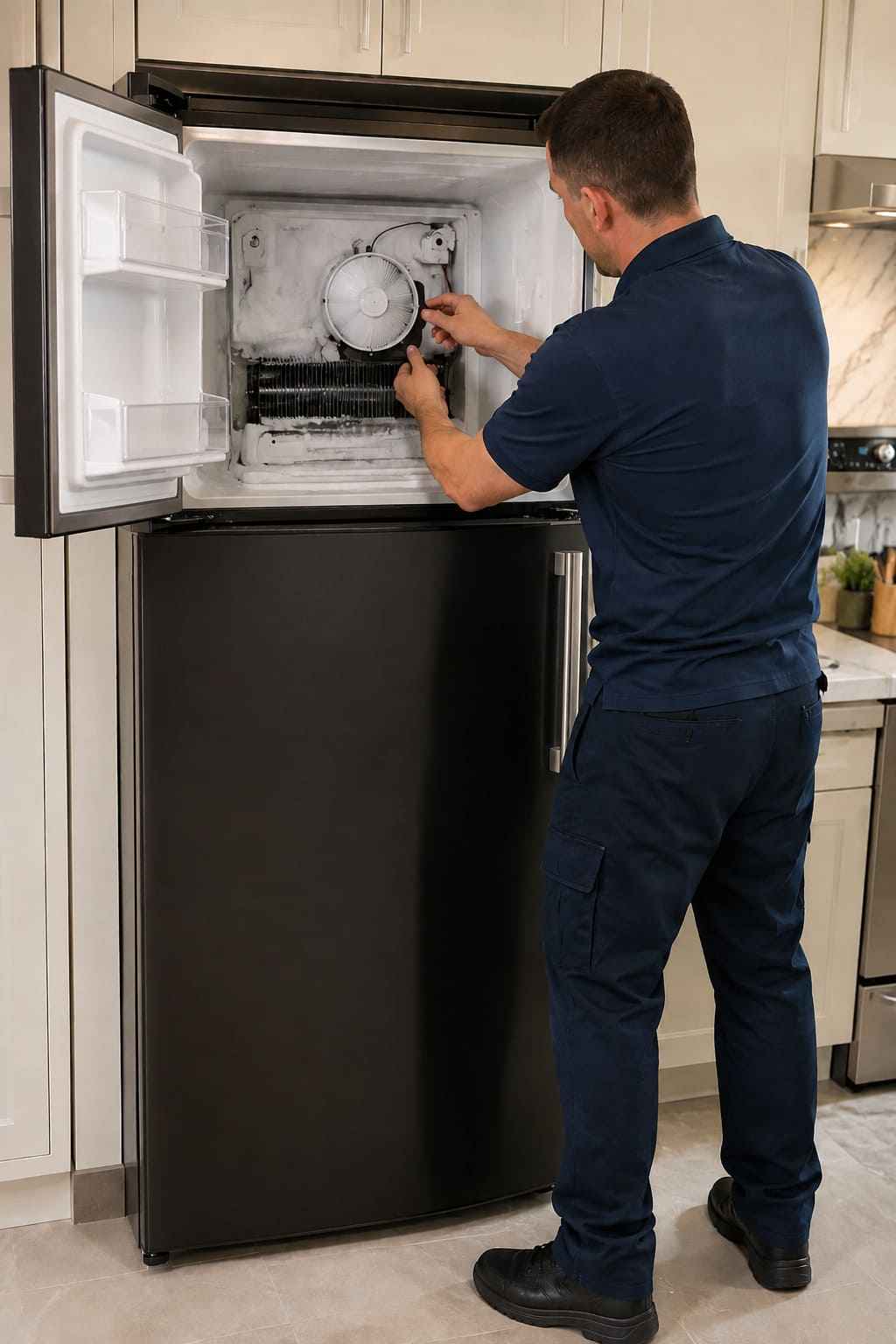
What Appliance Repair Master Checks During Bosch Temperature Service
A strong diagnosis starts with the pattern, not the part.
When Appliance Repair Master arrives for Bosch temperature repair in Atlanta, we look at the appliance as a cooling system. The display is only one piece of the job.
Area checked | Why it matters |
|---|---|
Refrigerator temperature | Confirms whether the fresh-food section is holding range |
Actual freezer temperature | Shows whether the freezer is stable near target |
Display and setting response | Checks actual vs display temperature behavior |
Door closure and gasket contact | Finds warm-air entry points |
Air vents and loading pattern | Rules out blocked circulation |
Evaporator fan | Confirms cold air is moving properly |
Damper operation | Checks whether air is routed into the refrigerator section |
Frost pattern | Helps identify defrost or cooling-system issues |
Defrost behavior | Finds causes of slow recovery and repeated spikes |
Sensors and control response | Helps confirm or rule out temperature module failure |
Recovery time | Shows whether the refrigerator can return to range after normal use |
This way you’ll avoid the expensive mistake: replacing the nearest part instead of the failed part.
A Bosch refrigerator with temperature fluctuating can look like a sensor issue, then turn out to be airflow. A warm refrigerator section can look like a control problem, then turn out to be a fan. A display mismatch can look like a panel issue, then trace back to sensor feedback or compartment circulation.
Appliance Repair Master pinpoints the failure before recommending the repair.
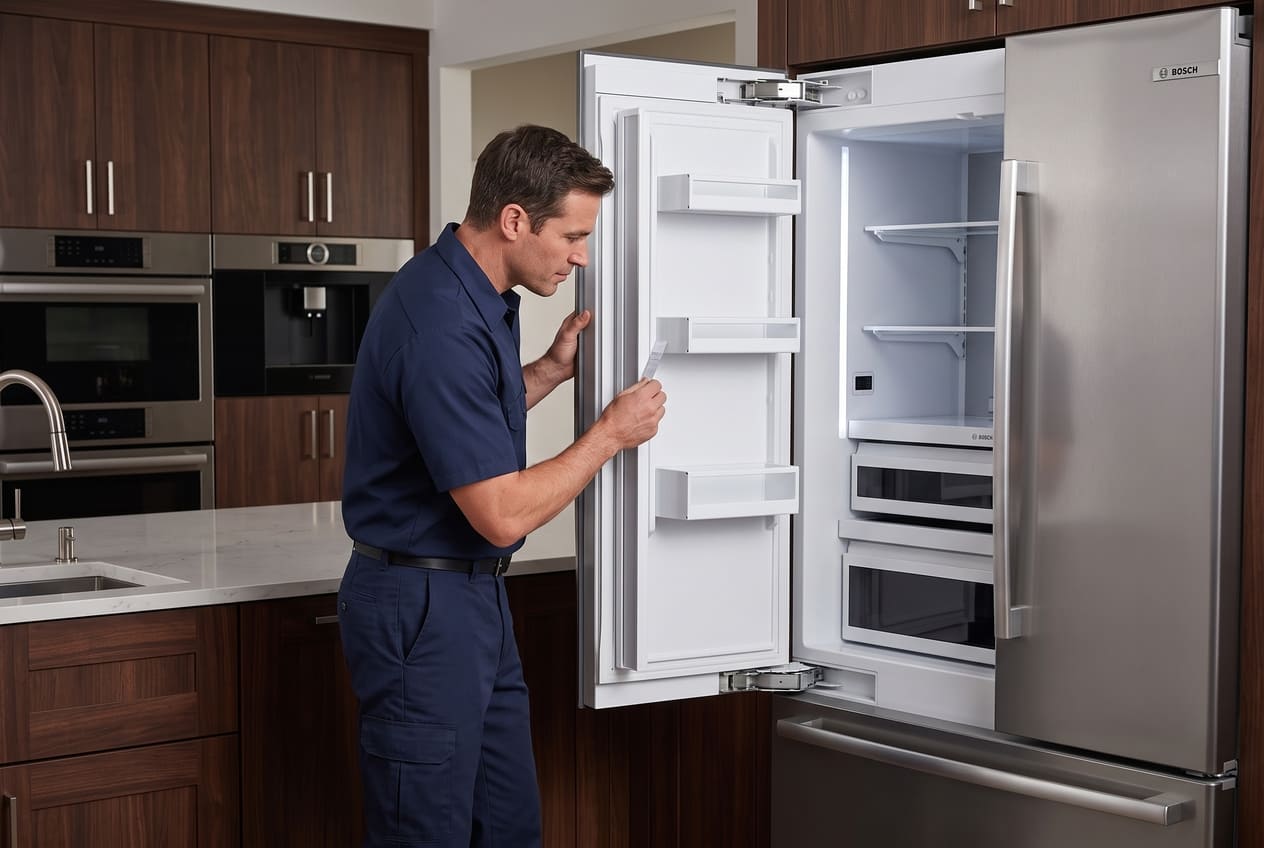
Why our diagnostic approach helps homeowners
Bosch refrigerator isn’t the appliance to fix by guesswork. Parts can be expensive, and similar symptoms can come from very different failures.
A warm refrigerator section can come from blocked airflow, a fan, a damper, a defrost issue, a sensor, or a control problem. A freezer alarm can come from heavy use, a door issue, poor recovery, or deeper cooling trouble. Actual vs display temperature mismatch can point to a sensor, but it can also trace back to airflow or loading.
Why this protects the customer
We test before replacing. When you call Appliance Repair Master, you get a repair path based on what the refrigerator is doing in your kitchen – not a generic part swap.
When to Book Same-Day Bosch Temperature Repair
Book same-day Bosch refrigerator repair if:
- the refrigerator section stays warm for several hours;
- the freezer alarm keeps returning;
- ice cream softens even with the freezer near its normal setting;
- the display and thermometer keep disagreeing;
- temperature swings keep repeating with no clear trigger;
- the refrigerator section runs warm while the freezer stays closer to target;
- frost buildup appears near the rear panel;
- the fan sounds unusual or quiet when it should be running;
- panel changes don’t affect the actual compartment temperature;
- groceries are spoiling faster than usual.
Temperature problems can get expensive quietly. You might lose food before the appliance fully fails. A defrost issue can block airflow. A weak fan can strain the system. A bad sensor can keep the refrigerator chasing the wrong target.
Early diagnosis keeps the repair cleaner.
Same-day repair is especially smart when food safety is involved
Refrigerator temperature problems don’t always wait politely. If the fresh-food section keeps running warm, every hour can affect dairy, meat, leftovers, and prepared food. If the freezer alarm returns, frozen items can soften and refreeze, which makes quality and safety harder to judge.
Call sooner when:
- you store medication or temperature-sensitive items;
- the refrigerator is used heavily by a family;
- the freezer alarm appears more than once;
- the issue started during hot weather;
- you already lost groceries once;
- the refrigerator is built into cabinetry and heat has fewer places to escape.

Bosch 800/500 Series Temperature Problems We Repair
Appliance Repair Master services Bosch 800 and 500 Series refrigerators across Atlanta and nearby Georgia areas. We handle:
✓ Bosch temperature problems | ✓ Bosch refrigerator temperature fluctuating |
|---|---|
✓ actual vs display temperature mismatch | ✓ refrigerator section running warm |
✓ freezer alarms | ✓ defrost cycle spikes |
✓ slow recovery after grocery loading | ✓ weak airflow |
✓ evaporator fan issues | ✓ damper problems |
✓ sensor failures | ✓ temperature module failure symptoms |
✓ control response problems | ✓ uneven cooling |
✓ food freezing in the refrigerator section | ✓ soft freezer items |
✓ cooling trouble after installation or moving | ✓ refrigerator problems during Atlanta heat |
If your Bosch still cools but doesn’t cool consistently, that’s a good time to call. The problem is active enough to diagnose, but it might still be early enough to prevent a larger repair.
Local Bosch temperature repair in Atlanta
We repair Bosch refrigerator temperature problems throughout Atlanta and nearby areas, including Buckhead, Midtown, Decatur, Sandy Springs, Brookhaven, Dunwoody, Smyrna, Marietta, Roswell, Alpharetta, and surrounding Georgia communities.
Bosch temperature issue in a busy home isn’t something to keep testing for weeks. If the thermometer keeps showing warm temperatures, the freezer alarm returns, or the refrigerator section won’t stabilize, Appliance Repair Master can help restore steady cooling.
Before You Call, Have These Details Ready
You don’t need a full diagnosis. A few details help the technician arrive with a stronger plan.
Try to note:
- Bosch model number, if visible;
- refrigerator setting;
- freezer setting;
- independent thermometer result;
- whether the issue affects the refrigerator, freezer, or both;
- whether the problem started after groceries, moving, installation, power loss, or hot weather;
- whether a freezer alarm appeared;
- whether frost buildup is visible;
- whether the doors close cleanly;
- whether vents were blocked;
- whether the temperature improves, then rises again.
What to avoid before the technician arrives
Some DIY moves make temperature problems harder to diagnose.
Avoid:
- changing settings every few hours;
- unplugging the refrigerator repeatedly;
- scraping frost with sharp tools;
- using a hair dryer inside the cabinet;
- removing panels without proper tools;
- packing the refrigerator tighter to hold the cold;
- ignoring a repeated freezer alarm;
- assuming the display tells the whole story.
Keep the appliance as stable as possible. If food safety is a concern, move perishable items to a cooler or another refrigerator while waiting for service.
Conclusion
Sometimes the appliance only needs time to recover after groceries, door openings, or a normal cycle. Or the fix starts with clearing vents, checking the door seal, and confirming the actual temperature with a separate thermometer.
But repeated warm performance is different. So are freezer alarms, actual vs display temperature mismatch, slow recovery, defrost cycle spikes, and a refrigerator section that stays warm while the freezer remains close to range.
That is the point where Appliance Repair Master should step in.
We repair Bosch temperature problems in Atlanta with the kind of diagnosis premium refrigerators deserve: actual temperature testing, airflow checks, fan and damper inspection, sensor review, defrost evaluation, and control-system diagnosis before parts are replaced.
FAQ
1. Why is my Bosch refrigerator set to 37°F but still running warm?
The setting can be correct while the actual compartment temperature runs higher. Check with a separate refrigerator thermometer placed on a middle shelf. If the thermometer keeps showing warm temperatures after the refrigerator has had time to stabilize, the issue can involve airflow, fan operation, sensor feedback, defrost behavior, or controls.
2. What temperature should my Bosch refrigerator and freezer hold?
For most household use, the refrigerator should stay around the upper 30s°F, and the freezer should stay near 0°F. Small swings can happen during normal use. Repeated warm readings or slow recovery deserve service.
3. Why does my Bosch refrigerator temperature fluctuate?
Temperature can fluctuate after groceries, door openings, warm food, setting changes, hot kitchen conditions, or defrost activity. If the refrigerator returns to range, monitor it. If the swing keeps repeating or the refrigerator stays warm, book a diagnosis.
4. Why is my Bosch freezer cold but the refrigerator warm?
That pattern often points toward airflow trouble. The freezer can stay near range while the fresh-food section runs warm if vents are blocked, the evaporator fan is weak, the damper isn’t routing air properly, frost is affecting circulation, or sensors aren’t giving accurate feedback.