
If your LG refrigerator suddenly stops cooling, it usually catches you off guard. One day everything is working fine, and the next morning you open the fridge door and realize something isn’t right. When this happens, most homeowners start asking the same question:
Did the compressor just fail?
In many cases, that’s exactly what happened.
Over the past decade, our appliance repair technicians have seen a growing number of service calls related to LG compressor failure, particularly in refrigerators equipped with the company’s linear compressor technology. Many of these cases are described by technicians as linear compressor failure, where the compressor continues running but can no longer circulate refrigerant properly.
Some refrigerators lose cooling suddenly. Others struggle for weeks before temperatures finally rise enough to become noticeable. But once cooling stops, the problem almost always traces back to something inside the refrigerator’s sealed system: the compressor, refrigerant flow, or a leak somewhere in the cooling circuit.
The good news is that many of these problems can be diagnosed quickly once a technician checks the system. And depending on the condition of the refrigerator, repair may still be a very reasonable option.
Before jumping to conclusions, though, it helps to understand how LG refrigerators are built and why compressor issues have become such a widely discussed topic.
How LG Linear Compressors Work
Most refrigerators use a rotary compressor with spinning components. LG introduced a different concept called the linear compressor, which uses a piston that moves back and forth in a straight line. The idea behind the design was pretty simple:
fewer moving parts → less friction → quieter operation.
Linear Compressor Feature | Expected Benefit |
Fewer moving parts | Reduced mechanical wear |
Linear piston motion | Quieter operation |
Energy-efficient design | Lower electricity consumption |
10 year warranty | Long-term reliability |
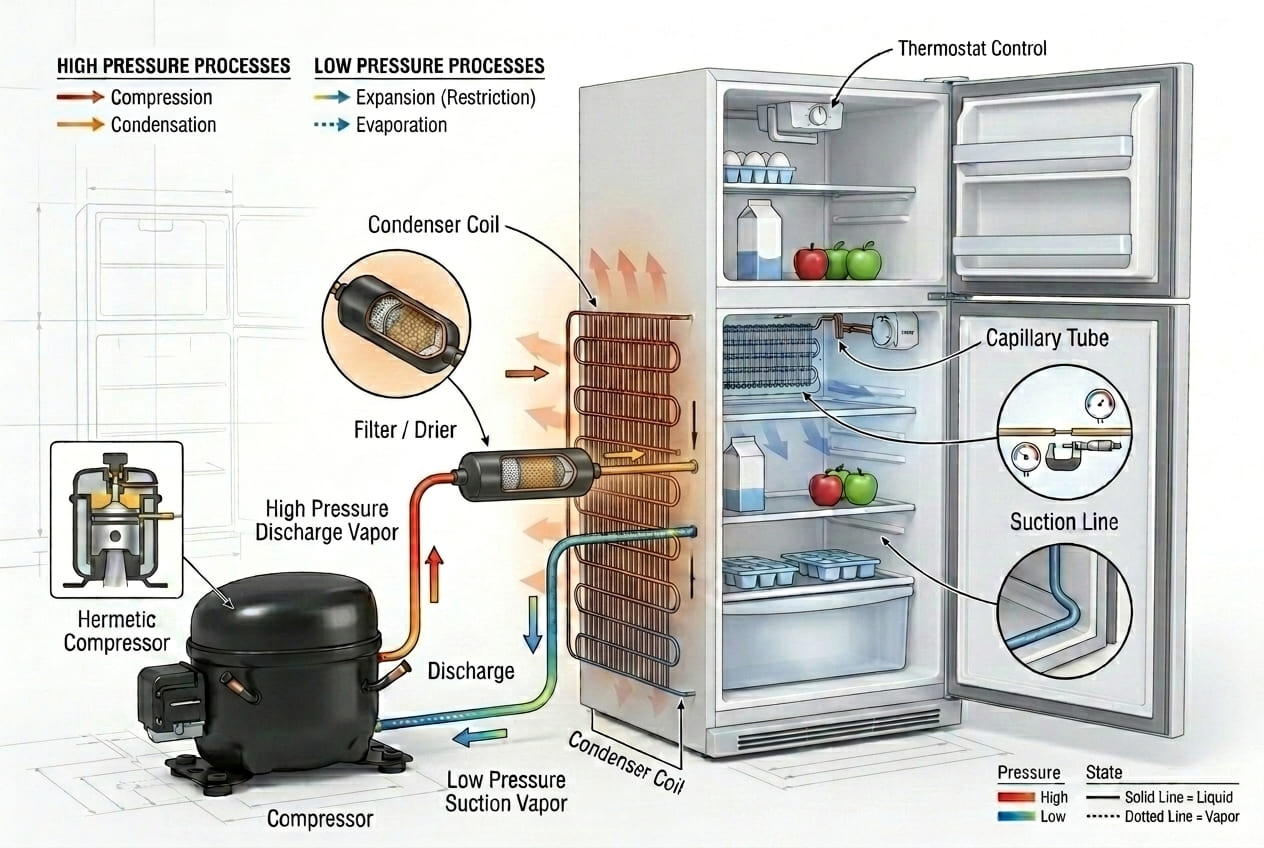
When everything is working the way it should, the compressor pushes refrigerant through the cooling system and keeps the refrigerator at a steady temperature.
But if that pressure drops, the whole cooling cycle starts falling behind.
In theory, the design makes sense. However, technicians working on refrigerators across the country have encountered situations where cooling problems eventually trace back to the compressor or sealed system.
Warning Signs Your LG Compressor May Be Failing
Refrigerator cooling problems can appear gradually or suddenly.
Here are warning signals technicians often encounter.
Refrigerator runs but does not cool
The refrigerator seems to operate normally: lights and fans are working, yet the temperature keeps rising.
Compressor not running
Freezer cold but refrigerator warm
This situation can indicate restricted refrigerant circulation.
Refrigerator running constantly
Possible causes include:
- refrigerant leak
- evaporator corrosion
- internal compressor wear
- sealed-system restriction
⚠️ Quick Check If your LG refrigerator isn’t cooling, look for these signs:
If you notice several of these symptoms together, the compressor or sealed system may need professional inspection. |
What to Check Before Scheduling Service
Before assuming the compressor has failed, there are a few quick things worth checking.
Make sure the refrigerator still has proper power and that the temperature controls haven’t been changed accidentally.
You may also want to check:
- condenser coils for heavy dust buildup
- airflow around the refrigerator
- door seals for gaps
- whether the compressor is attempting to start
If you stand near the back of the refrigerator, you may notice a few different sounds. A steady hum usually means the compressor is running. Clicking every few seconds can mean it’s trying to start and shutting back down. If it’s completely silent while the refrigerator should be cooling, that can point to a compressor or control issue.
If the refrigerator is clearly running but still not cooling after these checks, the sealed system may need professional diagnosis.
Why LG Compressors Fail
Several conditions can affect compressor performance.
Internal compressor wear
Over time, internal components may lose the ability to maintain pressure.
Refrigerant leaks
Leaks can occur in:
- evaporator coils
- condenser tubing
- compressor joints
- aluminum refrigerant lines
Aluminum lining defect
Some technicians believe that aluminum lining defect inside certain compressors may contribute to premature wear. In these cases, tiny metal particles can circulate through the sealed system and interfere with compressor valves or refrigerant flow.
While this condition does not appear in every refrigerator, it has been discussed in technical forums and service reports involving linear compressor failures.
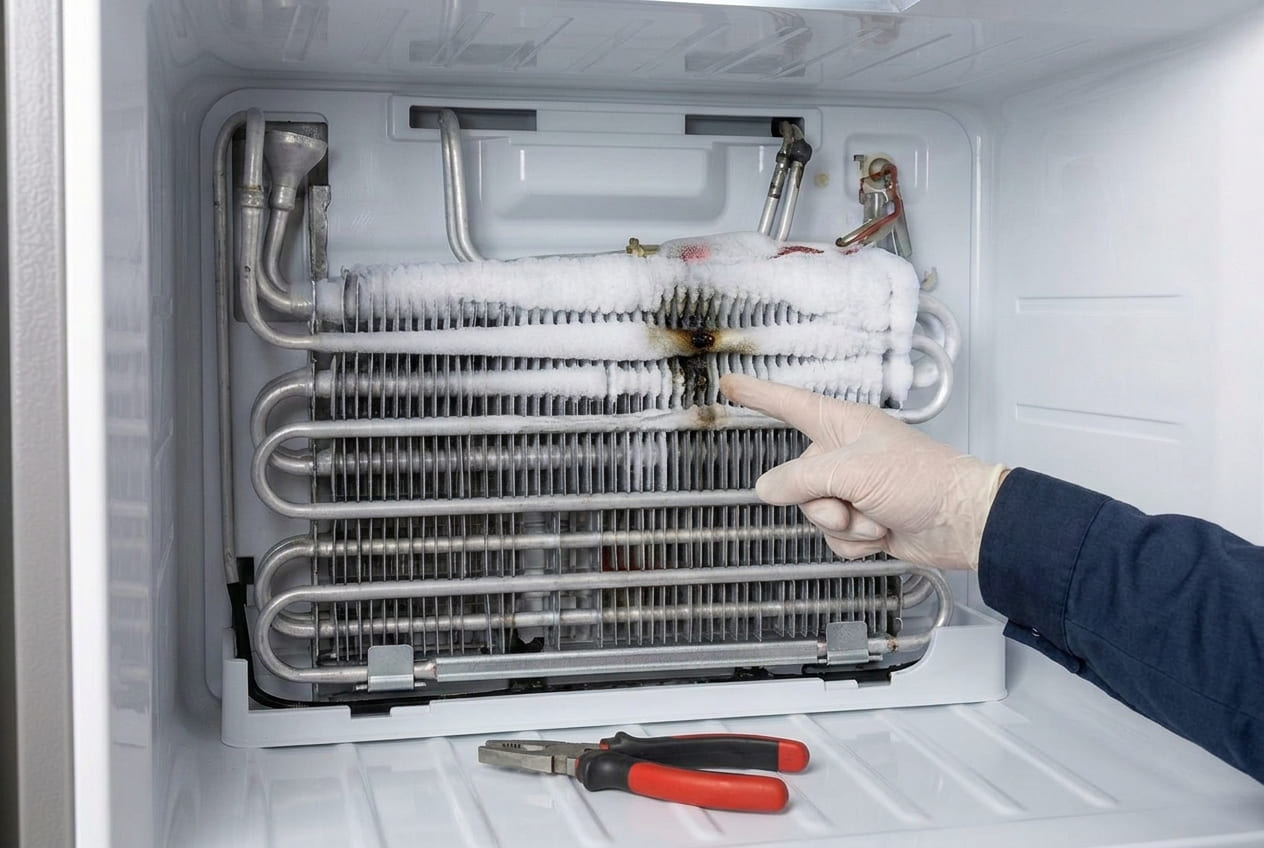
Evaporator corrosion
A small leak in the evaporator coil can gradually reduce refrigerant levels and disrupt cooling.
What Technicians Usually Find
When a technician checks a refrigerator that isn’t cooling, they’re usually looking at a few possible situations.
Sometimes the compressor itself is wearing out.
Other times the sealed system has lost refrigerant somewhere along the line.
Here are the main possibilities.
Compressor losing efficiency
Over time the compressor may still run, but it can’t build enough pressure to keep refrigerant moving through the system.
Refrigerant leak
Cooling systems rely on refrigerant circulating through sealed tubing. If a leak develops, cooling performance drops quickly.
Evaporator coil corrosion
If the evaporator coil develops a leak inside the cabinet, the refrigerant slowly escapes and cooling begins to fade.
LG LFXS Series and Reported Compressor Issues
Technicians frequently see service calls involving the LG LFXS refrigerator series, including:
- LFXS30766
- LFXS29626_
- LFXS28968
- LFXS26596S
These French-door refrigerators became widely installed in kitchens across the United States.
Technical Compressor Diagnostic Guide
Technicians follow a systematic diagnostic process when checking compressors.
Diagnostic Step | Purpose |
Verify power and fans | Confirm refrigerator is operating |
Listen for compressor activity | Identify startup attempts |
Check compressor voltage | Confirm electrical supply |
Inspect evaporator frost pattern | Evaluate refrigerant circulation |
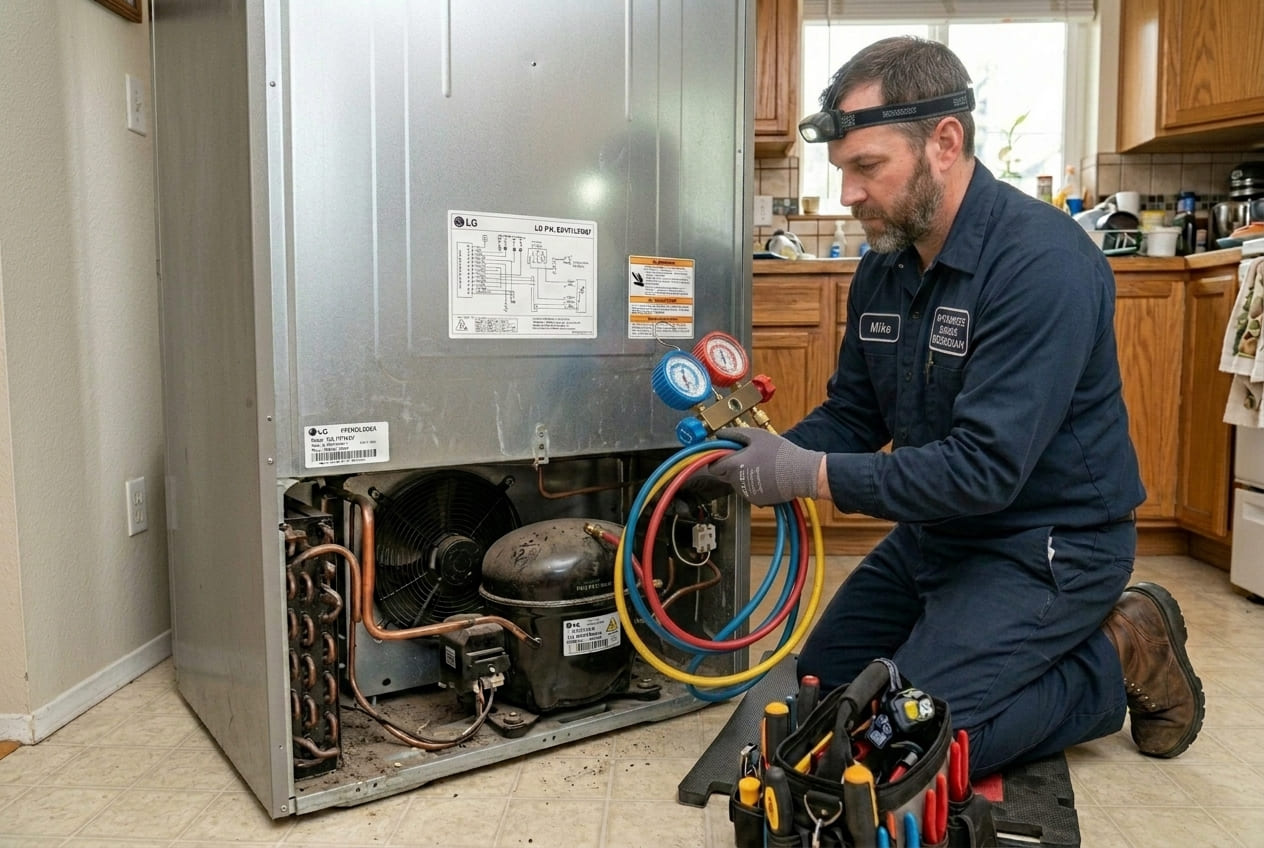
Measure refrigerant pressure | Detect leaks or restrictions |
Evaluate compressor efficiency | Confirm internal failure |
🛠 Technician Tip
A refrigerator may appear to run normally even when the compressor has stopped circulating refrigerant. Lights work, fans spin, and the control panel responds — but cooling slowly disappears.
How Appliance Technicians Diagnose Compressor Failure in 10 Minutes
Experienced technicians can often identify compressor trouble quickly.
Typical rapid diagnostic steps include:
- Confirm refrigerator is calling for cooling
- Check compressor sound and vibration
- Measure voltage to the compressor
- Inspect evaporator frost pattern
Observation | Possible Diagnosis |
Even frost across coil | Cooling system working |
Frost on one corner only | Refrigerant restriction |
No frost | Compressor or refrigerant failure |
This early assessment helps determine whether the issue involves the compressor or another sealed-system component.
LG Linear Compressor Class Action Lawsuit
Over the past several years, some homeowners reported repeated cooling failures in certain LG refrigerator models equipped with linear compressors.
These reports eventually led to several class-action lawsuits involving LG’s compressor technology.
In these cases, consumers alleged that some refrigerators experienced compressor problems earlier than expected.
While not every LG refrigerator develops these issues, the lawsuits brought additional attention to compressor reliability and sealed-system repairs in certain models.
For technicians, the takeaway is simple: when an LG refrigerator stops cooling, the compressor and sealed system deserve a careful inspection.
Understanding the LG 10-Year Compressor Warranty
Warranty Period | Coverage |
Year 1 | Parts and labor |
Years 2-5 | Sealed system components |
Years 6-10 | Compressor part only |
Labor costs are often not included after the first year. For many Atlanta homeowners, the bigger issue is not the part itself but the expensive labor costs involved in compressor replacement and sealed-system work.
When Compressor Replacement Makes Sense
Once a technician confirms a compressor failure, the next step is deciding whether replacement is worth it.
Several factors usually influence that decision.
Factor | Why It Matters |
Refrigerator age | Newer units are usually worth repairing |
Overall appliance condition | Multiple problems may change the recommendation |
Sealed system condition | Additional leaks can increase repair cost |
Warranty coverage | Compressor parts may still be covered |
In many cases, replacing the compressor can extend the life of the refrigerator for several more years.
However, if the refrigerator is older and the sealed system has additional issues, replacement may be the better long-term solution.
Typical LG Compressor Repair Costs
Compressor replacement typically includes:
- refrigerant recovery
- compressor installation
- filter dryer replacement
- system vacuum testing
- refrigerant recharge
Typical Atlanta repair cost:
$600 – $1200
Need refrigerator repair?
Tips to Extend Refrigerator Life
- Clean condenser coils annually
- Maintain proper airflow behind the refrigerator
- Avoid overloading shelves
- Check door seals regularly
- Keep recommended temperature settings
The Bottom Line
If your LG refrigerator is running but not cooling, the compressor or sealed refrigeration system may not be circulating refrigerant the way it should.
The tricky part is that the refrigerator can still look like it’s working. The lights come on. Fans run. The display responds normally. But if the compressor isn’t building enough pressure, the cooling system can’t remove heat from inside the fridge.
That’s usually when homeowners start noticing things like food warming up, the freezer getting soft, or the refrigerator running nonstop.
The good news is that most of these problems can be diagnosed fairly quickly once a technician checks the compressor, refrigerant pressure, and evaporator frost pattern.
If your refrigerator temperature keeps climbing, it’s worth having the system inspected before food starts going bad.
FAQ
1. How do I know if my LG refrigerator compressor has failed?
If the refrigerator is running but the temperature keeps rising, the compressor may not be circulating refrigerant properly. You might notice the fridge feels warm even though the lights and fans are working. Clicking sounds from the back of the appliance or a compressor that runs constantly can also point to a compressor problem.
2. Can an LG refrigerator still run if the compressor is failing?
Yes, and that’s what confuses many homeowners. The refrigerator can still look like it’s working — the lights turn on, fans run, and the display responds. But if the compressor isn’t building enough pressure inside the sealed system, the refrigerator can’t remove heat and the temperature will start climbing.
3. Is LG compressor failure covered under warranty?
Many LG refrigerators include a 10-year warranty on the compressor itself. However, after the first year the warranty usually covers the compressor part only. Labor and additional sealed-system repairs may still involve service costs.
4. Should I repair my LG refrigerator or replace it?
It depends on the refrigerator’s age and the condition of the cooling system. If the appliance is under five years old, repair is often the best option. For refrigerators closer to ten years old, technicians usually look at the full condition of the sealed system before recommending repair or replacement.
*Disclaimer
The pricing listed on our website may not always be up to date and is provided for general informational purposes only.
Pricing is subject to change due to fluctuations in parts costs, supplier pricing, and market conditions.
Our pricing includes business operational costs such as insurance coverage, office expenses, parts delivery, technician labor, transportation, and other associated costs related to sourcing, delivering, and installing replacement parts.
These factors are reflected in the final service price to ensure licensed, insured, and professional repair service.Estimates provided prior to diagnosis are not final.
Warranty coverage applies exclusively to parts installed and labor performed by our technicians and does not cover misuse, pre-existing conditions, or unrelated future failures.