
You’re likely reading this because your $2,500 stainless steel LG French Door refrigerator has turned into a lukewarm closet. Maybe your milk feels a little off, your ice cream has the consistency of soft-serve, or you’ve noticed the internal display stubbornly hovering at 40°F, regardless of how low you set the thermostat. These LG temperature problems usually start subtly, with food warming up before the display shows anything is wrong.
In the world of appliance repair, LG is a polarizing brand. When they’re pulling their weight, they are quiet, energy-efficient marvels. But when the temperature fails, it tends to fail in these complex, cascading ways that leave homeowners frustrated and out of pocket.
If that sounds familiar, you’ve come to the right place. We’ve spent over 15 years in Atlanta kitchens seeing exactly what happens when these high-tech systems conk out. Our guide is created to help you reckon with what’s going on under the hood, from simple DIY sensor checks to the technical reality behind the LG linear compressor lawsuits. We’re going to explain the 40-degree wall step-by-step so you can decide if your fridge needs a simple maintenance tweak or a master technician’s touch.
Here is what we are going to cover:
- The 40°F Phenomenon: Why your display says one thing, but your thermometer says another.
- The DIY Response: How to rule out dusty coils and blocked vents in 10 minutes.
- Advanced Diagnostics: How to test thermistor calibration and fan motor health.
- The Linear Compressor Truth: A look at the LFXS series and the “sealed system” issues that usually point to hardware failure.
- The Next Move: How to weigh the cost of a specialized repair against the price of a new unit.
Let’s take a closer look at getting your kitchen back to normal.
Why Your Display Is Gaslighting You
One of the biggest hurdles for LG owners is the digital readout on the door. You set it to 37°F for the fridge and 0°F for the freezer. The display says it’s exactly at those numbers. But inside, your leftovers are sweating.
How LG Software Handles Temperature
In the industry, we call the number on the door the Target Set Point. It is not a real-time thermometer. LG’s software is programmed to display the target number as long as the fridge is within a reasonable range (usually within 5-8 degrees). The engineers did this to prevent homeowners from panicking during a normal defrost cycle when temps naturally rise for a few minutes.
The catch: When your cooling system starts to fail—say, due to the compressor overheating the temperature drifts slowly. It hits 39… then 41… then 43. This is what homeowners mean when they notice the temperature fluctuating inside the fresh-food section. Because the computer is still trying to cool, it keeps showing you 37 on the door. It only updates the display or throws an error code like Er IF or Off once the situation is critical.
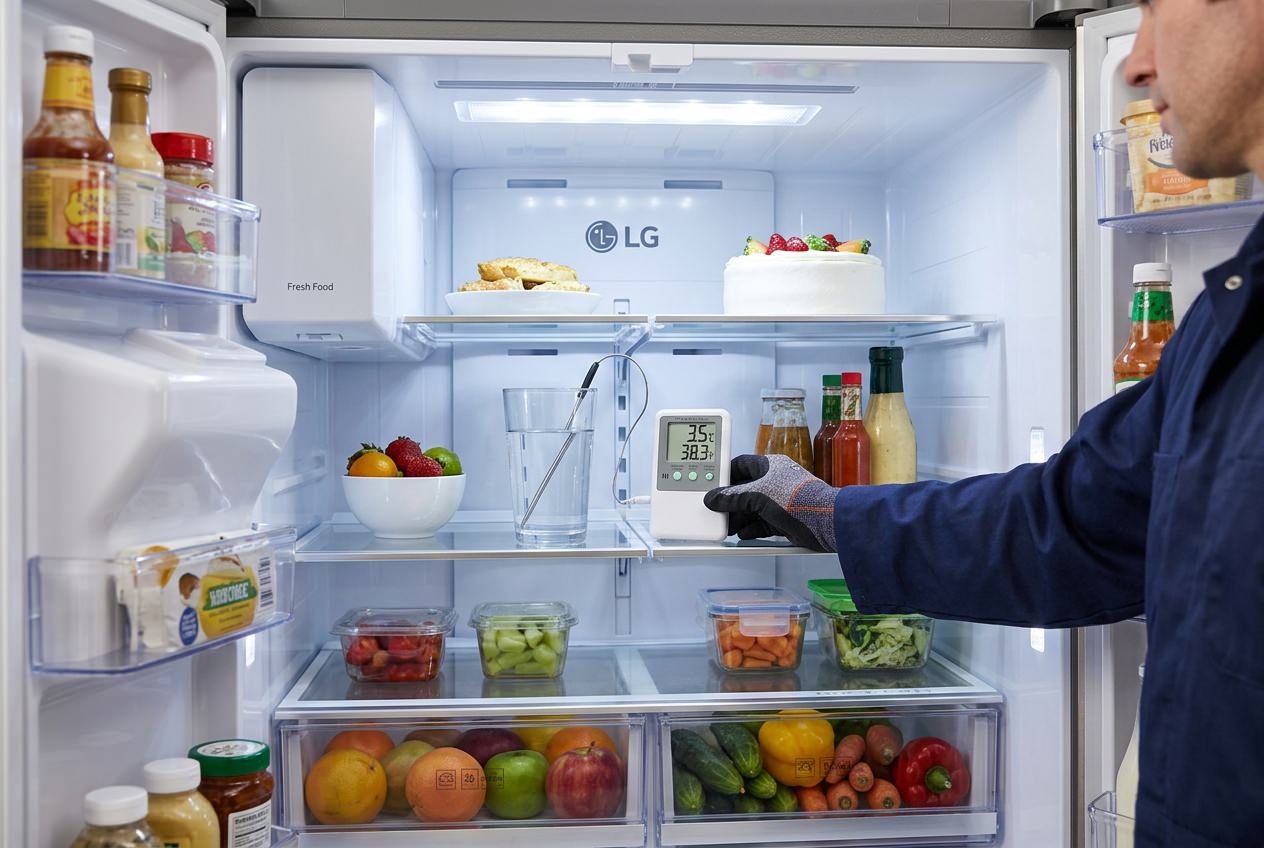
The Glass of Water Test
If you suspect your fridge is lying to you, don’t trust the air temperature. Air escapes every time you open the door.
- Place a glass of water on the middle shelf.
- Leave a meat thermometer in it for at least 4 hours (overnight is better).
- If that water is 41°F or higher, you’ve officially hit the 40-degree wall.
Quick Triage – The Symptoms and Likely Culprits
Before we get into the heavy technical stuff, use this table to narrow down your problem. We’ve built this based on thousands of service calls in the Atlanta metro area.
LG Symptom vs. Diagnostic Path
What you see/hear | What it usually means | DIY or Call a Pro? |
Fridge is 42°F; Freezer is 10°F | Airflow blockage or failing Fan | DIY (Easy) |
Fridge is 50°F; Freezer is -5°F | Defrost failure or stuck Damper | DIY (Intermediate) |
Constant clicking from the back | Compressor “Stall” (Start Relay) | Pro Check |
Hissing sound after the fridge stops | Leaking Discharge Valve | Pro Only |
Water pooling under the deli drawer | Clogged Drain / “Pink Slime” | DIY (Intermediate) |
“Off” or “IFE” on the display | Fan Error or Demo Mode | DIY Reset |
Level 1 DIY – The Environmental Fixes
Sometimes, the 40-degree wall isn’t a mechanical failure at all as tt’s an environmental one. Let’s look at the simple stuff first.
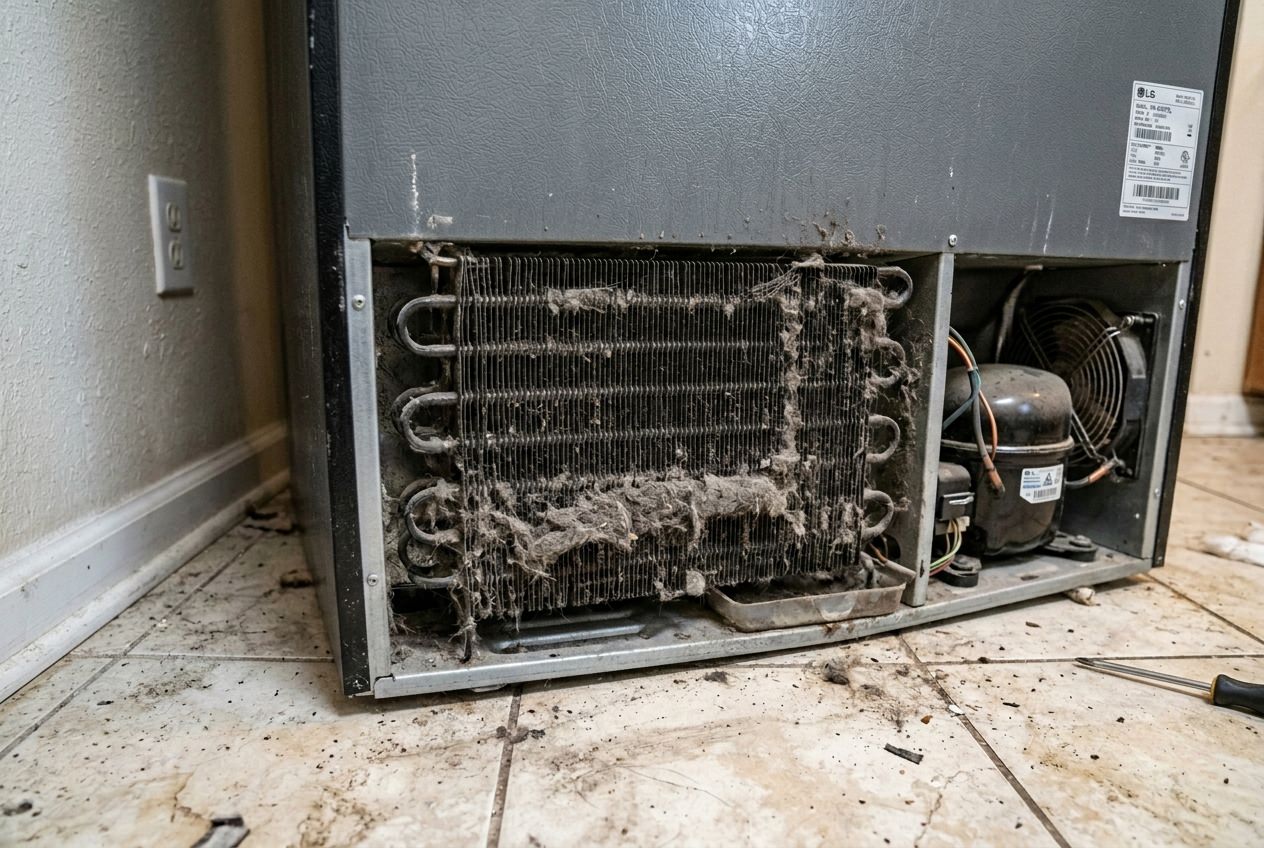
1. The Condenser Coil Heat Exchange
Think of your fridge like an air conditioner. It isn’t creating cold, but removing heat instead. It does this through the condenser coils at the bottom.
The move: Pull the fridge out and look at the back bottom panel. If you have a dog or cat, those coils are likely matted with fur. When the coils are clogged, the heat stays trapped. This leads directly to compressor overheating.
- Fix: Use a coil brush or a shop vac with a crevice tool.
Pro Tip: Don’t use a wet cloth; it just turns the dust into mud that gets stuck deeper in the fins.
2. The Gasket Dollar Bill Test
If your door seals (gaskets) are torn or just dirty, warm air is rushing in.
- Fix: Close a dollar bill in the door. If it pulls out with no resistance, the seal is shot. Clean the gaskets with warm soapy water. If they are brittle, you can sometimes “revive” them by heating them gently with a hair dryer to make them supple again.
3. Airflow Vents
LG French Door units are very sensitive to how you load them. If you have a giant Costco-sized pizza box pushed against the back wall, you are blocking the return air vents.
- Fix: Ensure there is at least 2 inches of clearance at the back of every shelf.
The Geo Variable – Humidity, Slime, and Icing
We see a specific type of failure in Atlanta that techs in dry climates like Arizona rarely encounter. We call it the Ice Choke.
The Pink Slime Drain Clog
Airborne bacteria (Serratia marcescens) loves the moist, dark environment of your fridge’s drain tube. In our humidity, this bacteria can grow into a thick, pinkish sludge.
The Result: When your fridge goes through a defrost cycle, the melted water has nowhere to go. It backs up into the freezer floor, freezes into a sheet of ice, and eventually blocks the air ducts.
- How to tell: Look for ice on the floor of the freezer or water dripping into the crisper drawers.
- The Fix: You’ll need to remove the back panel of the freezer and clear the drain hole with hot water and a drop of bleach to kill the bacteria.
Iced-Over Evaporator Coils
If your freezer is working but the fridge is warm, your evaporator coils might be a solid block of ice. This usually happens because of a defrost failure.
- The Check: Look at the back wall of the freezer. Do you see frost poking through the vents? If so, the air can’t pass through the coils to reach the fridge.
Testing the Sensors and Fans
Now we’re moving into DIY fixing territory. If your coils are clean and the fridge is empty, but it’s still warm, we need to test the electronics.
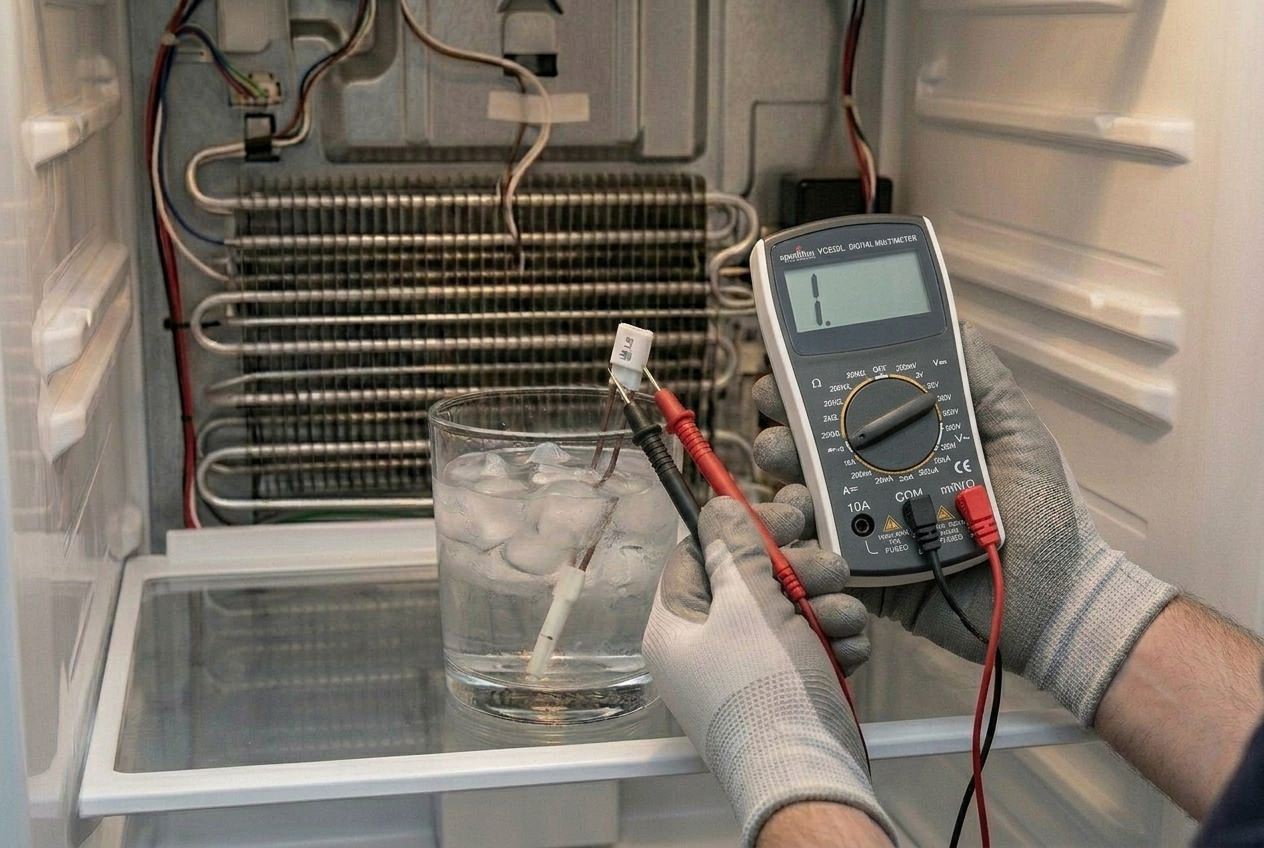
1. Thermistor Calibration
A thermistor is a small resistor that changes its signal based on temperature. LG uses NTC (Negative Temperature Coefficient) sensors.
Here’s the rub: They don’t always break but drift. A sensor might tell the control board issues that it’s 32°F when it’s 40°F.
- How to test: You’ll need a multimeter set to Ohms (Ω).
- The Chart: At 32°F (in a glass of ice water), the sensor should read roughly 30,000 Ohms (30kΩ). If it reads 20k or 40k, your fridge is being lied to. Replacing a thermistor is a $40 fix that solves a “broken” fridge.
2. The Evaporator Fan & Hall Sensor
LG fans are smart. They have a third wire called a Hall Sensor that tells the board exactly how fast the fan is spinning.
The Ghost Failure: Sometimes the fan spins, but it’s too slow. The Hall Sensor detects this and tells the board to throttle down the cooling to protect the system.
- The Check: Press the door switches manually. You should hear the fan ramp up. If it sounds like it’s struggling, or if it makes a “chirping” noise, it’s done.
3. Forced Test Mode
Most LG main boards (located on the back or top) have a small button.
- Press 1 time: All components (Compressor, Fans) run at 100%. If the fridge gets cold in this mode, your problem is a sensor or the control board.
- Press 2 times: Forces a defrost cycle. This is the fastest way to see if your defrost heater is working.
The Linear Compressor Crisis – Understanding the Lawsuit
We have to reckon with the elephant in the kitchen. If you own an LG LFXS Series refrigerator made between 2014 and 2020, you are likely dealing with a known mechanical defect.
Why do they fail?
Traditional compressors use a crankshaft to move a piston. LG’s Linear compressor uses a single piston on a spring. It’s energy-efficient but has a critical weak point: the internal discharge valve.
This valve is a thin piece of metal that can fatigue over time. When it fails, the compressor hums, but it can’t build up enough pressure.
Symptoms of a Failing Linear Compressor:
- The 40-Degree Wall: The refrigerator is not cooling below 40F even though the display is set lower.
- Constant Running: The fridge never shuts off.
- The Click of Death: A loud click every few minutes as the start relay trips.
- The Hissing Sound: After the compressor stops, you hear gas leaking back through the failed valve.
The Lawsuit Reality: Many of these units are covered under an extended 10-year parts warranty. However, the labor for sealed system problems is highly technical. It involves welding (brazing) copper lines and handling refrigerant, which requires EPA certification.
Where DIY Ends and We Come In
A refrigerator is a closed loop. If there is a leak in that loop, or if the compressor has failed internally, you have sealed system problems.
Why this isn’t DIY domestic experiments:
- Refrigerant Handling: Modern LG fridges use R600a (isobutane). It is highly flammable. One spark from a standard torch can cause an explosion in your kitchen.
- Precision Charging: You can’t just add a can like you do with a car. Refrigerant is measured in grams. Most LG units only hold about 60 to 90 grams. Even being 5 grams off will cause the fridge to freeze up or fail to cool.
- The Vacuum Pull: After we replace a compressor, we have to use a specialized pump to pull a vacuum on the lines to remove every trace of Georgia humidity. If even a drop of moisture remains, it will turn into ice and clog the capillary tube, killing the new compressor.
Control Board Issues – The Brain of the Operation
Sometimes the heart is fine, but the brain is scrambled. Atlanta is famous for summer storms that cause power flickers. These flickers are the #1 killer of control board issues in LG appliances.
What our technicians usually find:
A power surge can partially fry a triac on the board. The board might still be able to run the lights and the display, but it forgets how to tell the compressor to speed up.
- Worth checking: Look at the main board for any charred spots or bulging capacitors. If you find one, the board needs to be replaced.
Repair vs. Replace
At Appliance Repair Master, we believe in honesty. We aren’t going to suggest a $700 repair on a fridge that belongs in a scrapyard.
Use the 50% Rule
If the repair cost is more than 50% of the cost of a new fridge, and the unit is more than 8 years old, it might be time to go shopping.
However, consider this: A new French Door LG will cost you $2,500+. If your compressor is covered under warranty and the labor is $600, you are getting a second life out of your fridge for a fraction of the cost.
Life Expectancy & Repair Logic
Age of Fridge | Common Issues | Recommendation |
0–3 Years | Sensors, Fans, Clogs | Always Repair |
4–7 Years | Compressor, Board | Repair (if Warranty applies) |
8–11 Years | Sealed System Leak | Consider Replacement |
12+ Years | Multiple Failures | Time to go Shopping |
Why Atlanta Residents Trust Appliance Repair Master
Living in Georgia presents unique challenges. We know the neighborhoods with hard water that clogs LG ice makers, and we know how to handle the pink slime clogs caused by our humidity.
When you call us, you are getting:
- Diagnostic Integrity: We use digital manifolds to see exactly what’s happening inside your sealed system.
- The One-Trip Goal: Our vans are stocked with the most common LG thermistors, fans, and boards.
- Warranty Protection: We back our labor with a rock-solid warranty. If we fix it, it stays fixed.
Conclusion
If your LG is stuck at the 40-degree wall, don’t wait for it to stop cooling entirely. Temperature fluctuations are your fridge’s way of screaming for help.
Let us remind you the triage one last time:
- Hard Reset: Unplug for 10 minutes.
- Clean the Coils: Stop the compressor overheating.
- Check the Vents: Give the air room to move.
- Listen for the Click: If it’s clicking, the heart is failing.
That’s where we come in. At Appliance Repair Master, we’ve got you covered. We serve the entire Atlanta metro area with same-day service and master-level diagnostics. Don’t let your expensive groceries end up in the trash.
FAQ
1. My display says "Off" — is my fridge broken?
Not necessarily! It’s likely in “Demo Mode.” This happens if you accidentally press a combination of buttons while cleaning the display. To fix it, open one door and press and hold the “Refrigeration” and “Ice Plus” buttons at the same time for 5 seconds. The fridge will beep and start cooling.
2. Why is my fridge making a bird-like chirping sound?
That’s almost always the evaporator fan motor. The bearings are failing. It’s an annoying sound, but it’s a red flag that your cooling is about to stop.
3. How often should I clean my coils?
In a standard Atlanta home, once every 6 months. If you have a golden retriever or a cat, make it once every 3 months.
4. Can I just "top off" the Freon?
No. A refrigerator is a closed system. If it’s low on refrigerant, there is a leak. “Adding gas” is like trying to fill a bucket with a hole in the bottom. We have to find the leak and weld it shut.
5. Is the LG LFXS lawsuit still active?
The main settlement has passed, but LG has extended the parts warranty on the compressor for many models to 10 years. We can check your serial number to see if you are covered.
6. My fridge is cool at the bottom but warm at the top. Why?
This is usually a fan issue or a vent blockage. Cold air enters from the top. If it’s warm at the top, the air isn’t being pushed out properly.
*Disclaimer:
The pricing listed on our website may not always be up to date and is provided for general informational purposes only.
Pricing is subject to change due to fluctuations in parts costs, supplier pricing, and market conditions.
Our pricing includes business operational costs such as insurance coverage, office expenses, parts delivery, technician labor, transportation, and other associated costs related to sourcing, delivering, and installing replacement parts.
These factors are reflected in the final service price to ensure reliable, insured, and professional repair service.Estimates provided prior to diagnosis are not final.
Warranty coverage applies exclusively to parts installed and labor performed by our technicians and does not cover misuse, pre-existing conditions, or unrelated future failures.