
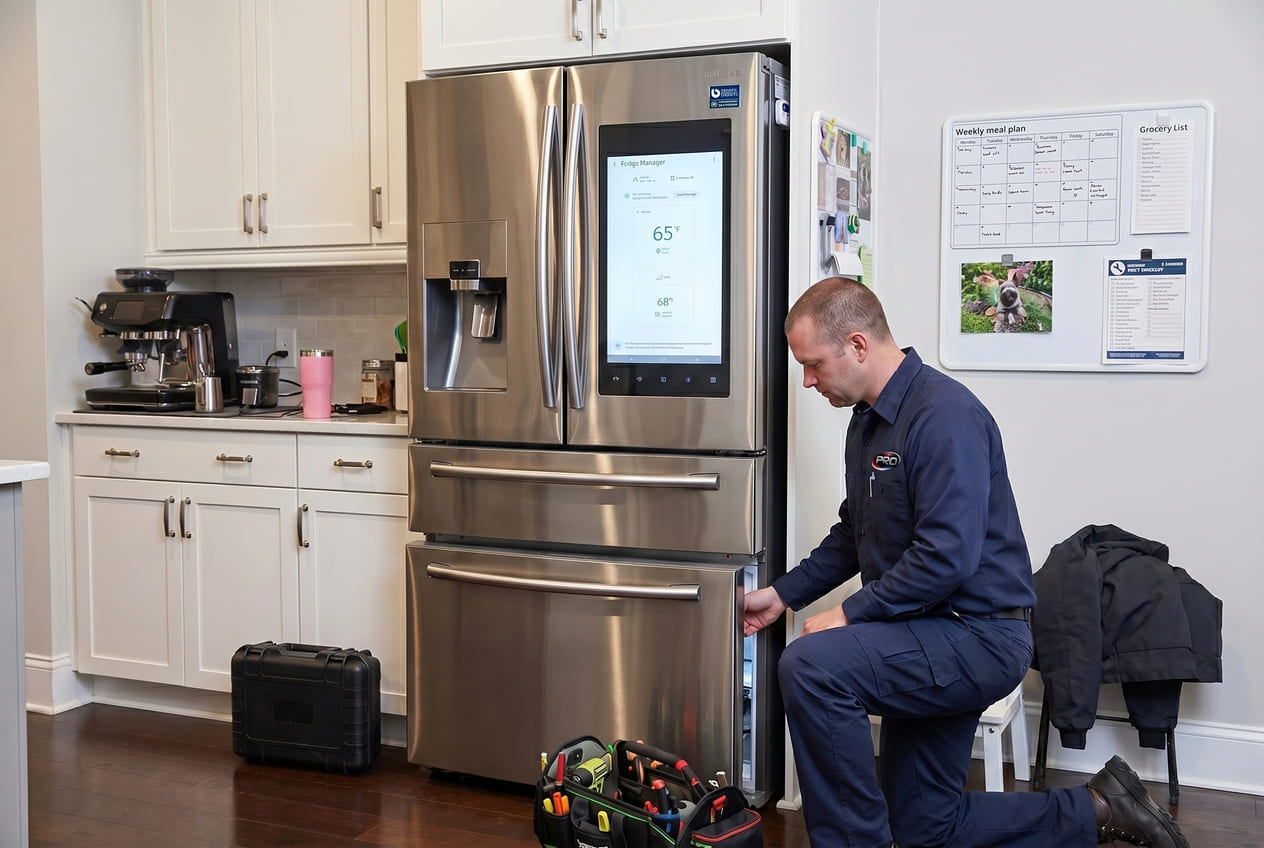
The Samsung RF263 Series tends to run into the same trouble spots: ice production drops, water from the dispenser slows down, frost gathers around the ice compartment, and the fresh-food section starts running warmer than it should. A storm or sudden power loss can make things messier by throwing up error codes 21E 22E 88 88 or pushing the unit into cooling off mode OF OF. That mix is why so many homeowners end up chasing the wrong fix first.
This guide is written to keep that from happening. It covers the RF263 issues owners run into most often, including ice maker repeated failures, frozen ice maker defrost, the dispenser-door problem many people search as side-by-side flapper broken, restart trouble after an outage, and the code patterns that usually mean the refrigerator needs more than a reset.
At Appliance Repair Master, we have spent more than 15 years handling these Samsung problems in homes across Atlanta. Our aim is to show you what is safe to check on your own, what tends to waste time, and when samsung rf263 series repair is the better move.
Start with the display
On the RF263, the display can save you a lot of time. If the panel is showing cooling off mode OF OF, O FF, OFF OFF, or scrolling bars, the refrigerator is sitting in Cooling Off Mode. The lights can still work and even the fan can still sound normal. But the compressor does not run, and so the refrigerator and freezer do not cool.
The same display is useful after a storm or power dip. Error codes 21E 22E 88 88 usually point to the fan side or a restart problem after power returns. The code matters more than playing the riddles. Write it down or take a photo before you unplug anything.
What you see | What it usually means | First move |
OF OF / O FF / OFF OFF | Cooling Off Mode | Turn the mode off and recheck cooling |
21E | Freezer fan-side trouble | Look for frost, airflow trouble, repeat fan noise |
22E / 22C | Fridge fan-side trouble | Check warm-fridge symptoms, frost, vent clearance |
88 88 after outage | Power outage restart failure pattern | Document the code before resetting power |
Checklist before touching the plug
- Take a picture of the display.
- Check whether the problem started after a storm or outage.
- Rule out cooling off mode OF OF first.
- Do not keep unplugging the refrigerator just to make the panel look normal.
A quick tip
A reset can clear the code. It does not tell you why the code showed up.
Low ice production usually starts on the water side
If the dispenser slows down and the ice bucket starts turning out smaller cubes, cloudy cubes, or clumped ice, start with the water path. On Samsung refrigerators, low water pressure and restricted filtration are two of the most common reasons for poor ice output.
Signs the water side deserves the first look
- Dispenser flow has slowed down.
- Ice output dropped at the same time.
- Cubes are smaller than usual.
- Ice in the bucket looks cloudy or starts clumping.
- The problem showed up after a filter change or after the filter should have been changed.
Symptom | Most likely direction | First move |
Slow water and low ice production | Filter or supply restriction | Replace/check filter and flush the line |
Small or cloudy ice | Low pressure or restricted water path | Check dispenser flow and household supply |
Clumped ice in the bucket | Weak fill, warm-air entry, or melt/refreeze | Check water first, then inspect the ice area |
Problem started after filter change | Filter fit or trapped air | Reseat filter and flush thoroughly |
The pressure question behind water inlet valve 20 psi comes up for a reason. Some flow does not always mean enough flow. On this platform, the water line can still move water and still be too weak to keep the dispenser and ice maker working well.
What not to do
- Do not lower the freezer setting to solve a water-delivery problem.
- Do not assume the ice maker itself failed just because output dropped.
- Do not ignore the filter and supply side if water and ice got worse together.

Frozen ice maker defrost helps once but it doesn’t explain why the ice maker froze
This is the pattern that turns a quick fix into a repeat call. The ice maker freezes up. Then the bucket gets wet or slushy. The homeowner notices ice jams at the dispenser and clears it out, the refrigerator behaves well for a few days, and then the same thing happens again.
That is the practical meaning of frozen ice maker defrost on the RF263. Useful once. Expensive when it becomes a routine.
Signs the thaw is only buying time
- The bucket turns wet or slushy again.
- Frost comes back around the ice area.
- The dispenser jams again.
- The same problem returns after a few days or a week.
- Low ice production and frost show up together.
The flap issue owners search as side-by-side flapper broken
The RF263 is not a side-by-side, but owners still use the phrase side-by-side flapper broken because the symptom is familiar: the ice chute door is not sealing, not closing flush, or letting warm air into the chute. If that flap does not close well, warm air gets into the ice compartment and the freeze-up cycle starts again.
What to inspect
- The ice bucket for clumped or fused ice.
- The dispenser chutes for stuck pieces of ice.
- Whether the bucket is fully seated.
- Whether frost keeps building in the same spot.
A quick tip
One thaw shows you the refrigerator could make ice again. A second freeze-up confirms you the first thaw was never the fix.

A warm refrigerator section on the RF263 usually points to airflow first
If the fresh-food section has gone warm while the freezer still seems mostly okay, the first checks are simpler than many owners expect. Food blocking the rear vents, frost near the back wall, a drawer not closing fully, or a dirty gasket can change cooling enough to show up in the refrigerator section before the freezer fully gives in.
Start here
- Look for food blocking the rear vents.
- Check the back wall and vent area for frost.
- Make sure doors and drawers close fully.
- Inspect the gasket for gaps, dirt, or twists.
- Compare the fresh-food side to the freezer side, not just the display reading.
What you notice | What it usually points to | First move |
Fridge section warm, freezer mostly okay | Airflow or fan-side issue | Check vents, frost, closure |
Frost near vents or on the back wall | Airflow restriction or repeat warm-air entry | Inspect seals and frost pattern |
Panel looks normal, food does not | Sensor or fan behavior may be involved | Trust actual compartment performance first |
Problem started after a door was left ajar | Seal or moisture issue | Check closure and frost before anything else |
This is where homeowners start using phrases like temperature sensor calibration. In this series, the useful next move is checking airflow, frost, seals, and code history before assuming the sensor side is the whole story.
What is safe to try at home, and where DIY should stop
Worth doing
- Checking the display for cooling off mode OF OF and codes.
- Taking a photo of the panel before resetting anything.
- Replacing and flushing the water filter.
- Checking dispenser flow.
- Emptying clumped ice from the bucket.
- Clearing obvious ice jams at the dispenser.
- Making sure doors and drawers close fully.
- Checking for blocked vents and visible frost.
Usually a waste of time
- Unplugging the refrigerator every time the panel throws a code.
- Treating repeat freeze-ups as a one-time thaw issue.
- Ordering an ice maker before checking water flow.
- Changing temperature settings over and over without fixing the air path.
- Forcing the dispenser when the bucket is already clumped.
A few home checks are worth the effort on the RF263 but if the wrong check is repeating you better stop DIY attempts. Once the same symptom returns, or once several symptoms begin arriving together, the repair usually goes faster and costs less when it is handled cleanly.
Appliance Repair Master
We keep pricing clear and stable, and we don’t turn an RF263 visit into a fishing expedition. Once the easy checks are done, the goal is a direct diagnosis and a repair path that makes sense.
Conclusion
The RF263 tends to repeat the same trouble patterns: panel codes after outages, low ice production tied to the water side, freeze-ups around the ice bucket, and warm-refrigerator complaints that start with airflow before they become something larger. If you sort the symptom in the right order, the next move gets easier. If you chase the wrong symptom first, the refrigerator will keep sending you in circles.
That is the line we care about at Appliance Repair Master. Homeowners should be able to handle the safe checks without losing a weekend to bad guesses. Once the same problem comes back, or once several symptoms start showing up together, the repair usually goes faster and costs less when it is handled cleanly.
FAQ
1. What does cooling off mode OF OF mean on a Samsung RF263?
It means the refrigerator is in Cooling Off Mode. The lights and controls may still look normal, but the refrigerator and freezer do not cool.
2. What do error codes 21E 22E 88 88 usually mean?
21E points to the freezer fan side. 22E or 22C point to the fridge fan side. 88 88 often shows up after a power outage or restart problem.
3. Why does my RF263 keep making less ice?
Most often, the first place to look is water flow: filter condition, supply pressure, or the dispenser side. Low flow and low ice production usually belong to the same problem.
4. Does frozen ice maker defrost count as a repair?
Not by itself. A thaw can clear the ice and get the refrigerator working again for a while. If the same freeze-up returns, the thaw only removes the symptom.
5. What does side-by-side flapper broken mean on an RF263?
Owners use that phrase for a dispenser flap or chute-door problem. On the RF263, the issue is usually warm air getting into the ice chute or bucket area because the flap is not sealing properly or ice is blocking it.
6. When should I stop DIY and call for samsung rf263 series repair?
Call when the same symptom keeps returning, when the refrigerator is showing repeat codes, or when water, ice, and temperature problems are showing up together.