
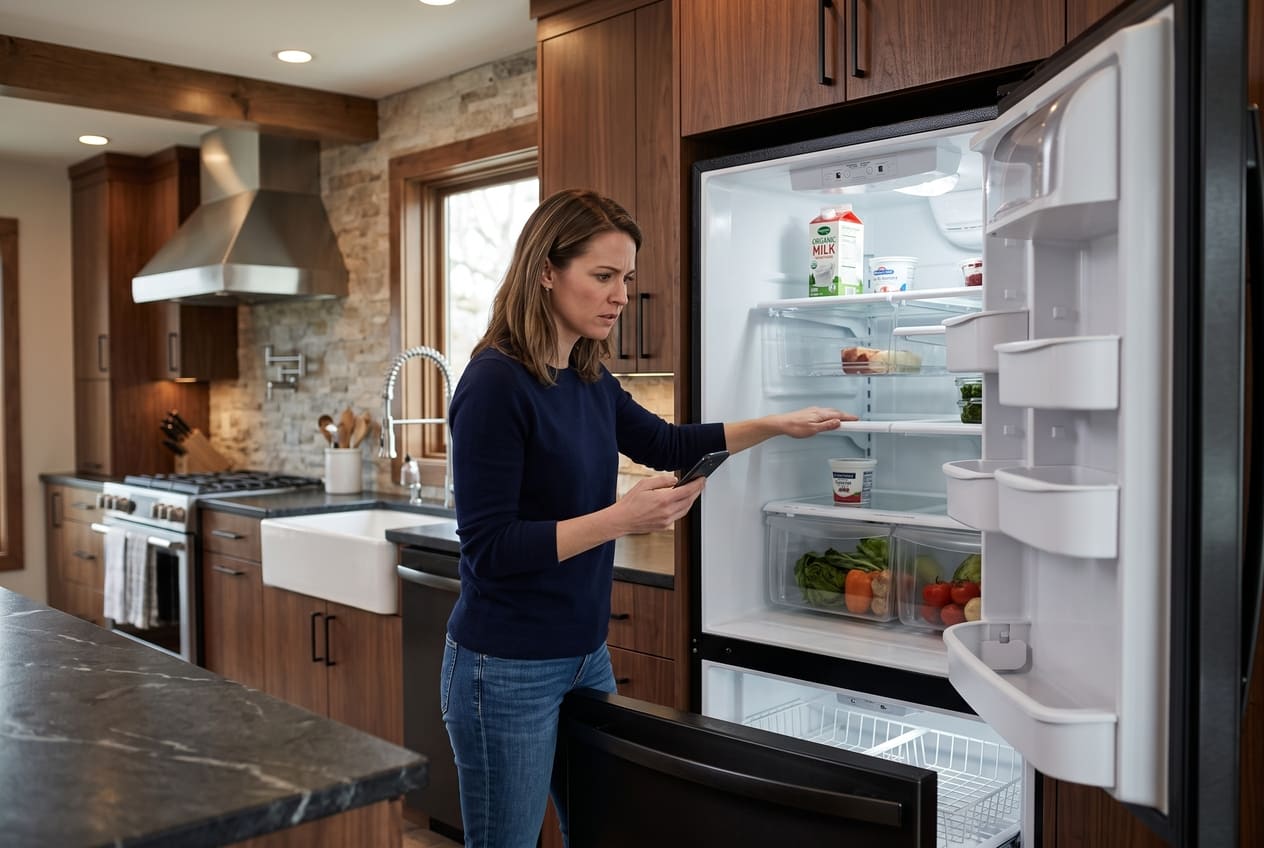
The freezer works but the fridge doesn’t. That pattern matters.
When Amana refrigerator isnэt cooling but the freezer still freezes, people won’t think about the compressor first. On many Amana refrigerators, cold air is produced around the freezer-side evaporator, then moved into the fresh-food section through vents and controlled by a damper. If airflow gets blocked, the freezer can stay cold while the refrigerator section warms up.
That’s why a warm fridge with a cold freezer points us toward the airflow path: defrost system ice buildup, blocked air vents, evaporator fan malfunction, or a damper stuck closed. If both sections are warm, or you hear repeated clicking, the diagnostic branch changes and a start relay failure or compressor-start problem may be involved.
Before you spend money
Run the safe checks below. If food is warming, move perishables to another refrigerator or cooler first. You better keep the refrigerator at 40°F or below and the freezer at 0°F.
Start with the symptom, then choose the right repair path
Freezer cold, fridge warm Most likely airflow: frost choking the evaporator area, blocked vents, a failed evaporator fan, or a damper that will not open. | Both sections warm Check power, cooling mode, controls, doors, condenser airflow, start relay, compressor, and sealed-system issues. |
Clicking or compressor not starting Do not keep forcing restarts. This can point to a start relay failure, overload, control problem, or compressor fault. | Weak air from fridge vents Look for blocked air vents, overpacked shelves, frost behind the freezer panel, or an evaporator fan that is slowing down. |
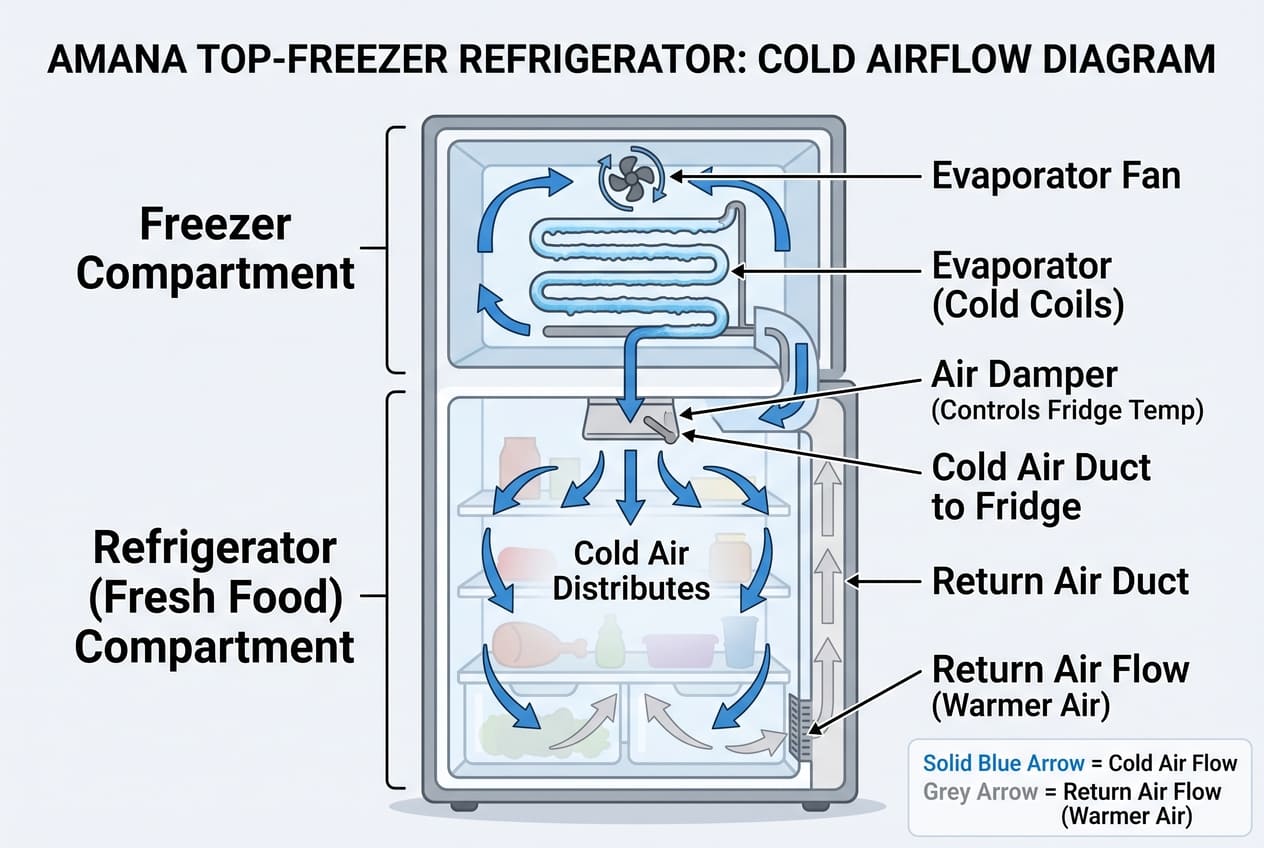
How one Amana cooling system feeds both zones
- Compressor runs – Circulates refrigerant through the sealed system.
- Evaporator coil cools – The coil in the freezer area absorbs heat and becomes the cold source.
- Evaporator fan pulls air – The fan moves cold air across the coil and through the freezer airflow path.
- Damper opens – A mechanical or motorized flap allows cold air into the fresh-food compartment.
- Cold air circulates – Air enters and returns through vents; blocked vents reduce cooling.
- Defrost cycle clears frost – The heater and thermostat/control logic keep frost from choking airflow.
Technician note
Steps 3, 4, and 6 are the failure zones we treat carefully: evaporator fan, damper, and defrost system. We qualify the diagnosis instead of promising that one thaw test proves the exact failed part.
The 8-hour thaw test for a cold-freezer, warm-fridge pattern
Use this only when the freezer is still cold and the refrigerator compartment is warm. It is a screening test, not a permanent fix and not a final parts diagnosis.
- Move perishables to a cooler or another refrigerator before testing.
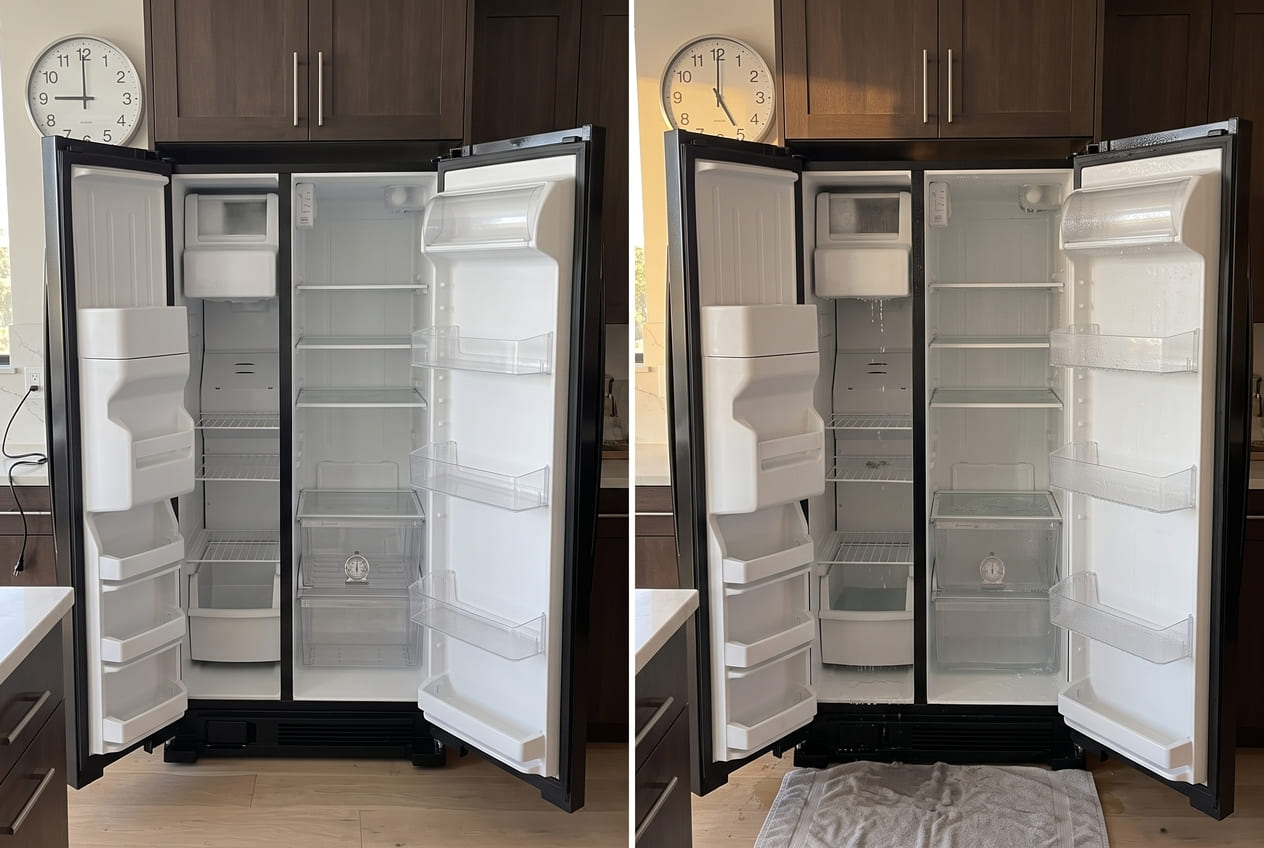
- Unplug the refrigerator. Open both the refrigerator and freezer doors completely.
- Place towels near the base in case melting frost drains or drips.
- Leave the unit unplugged for 8 to 12 hours so hidden frost can melt.
- Plug it back in, let it run, and check actual temperature after 24 hours with an appliance thermometer.
If the fridge cools again Ice blockage or a defrost-system problem becomes likely. The heater, thermostat/terminator, timer, board, door seal, or airflow path still needs confirmation. | If the fridge stays warm Look at the evaporator fan, damper, controls, blocked vents, start components, or a deeper system fault. Call before replacing parts blindly. |
Don’t do this Don’t use a knife, screwdriver, heat gun, or hair dryer to remove ice. Don’t touch fan blades or internal electrical parts while the unit is plugged in. |
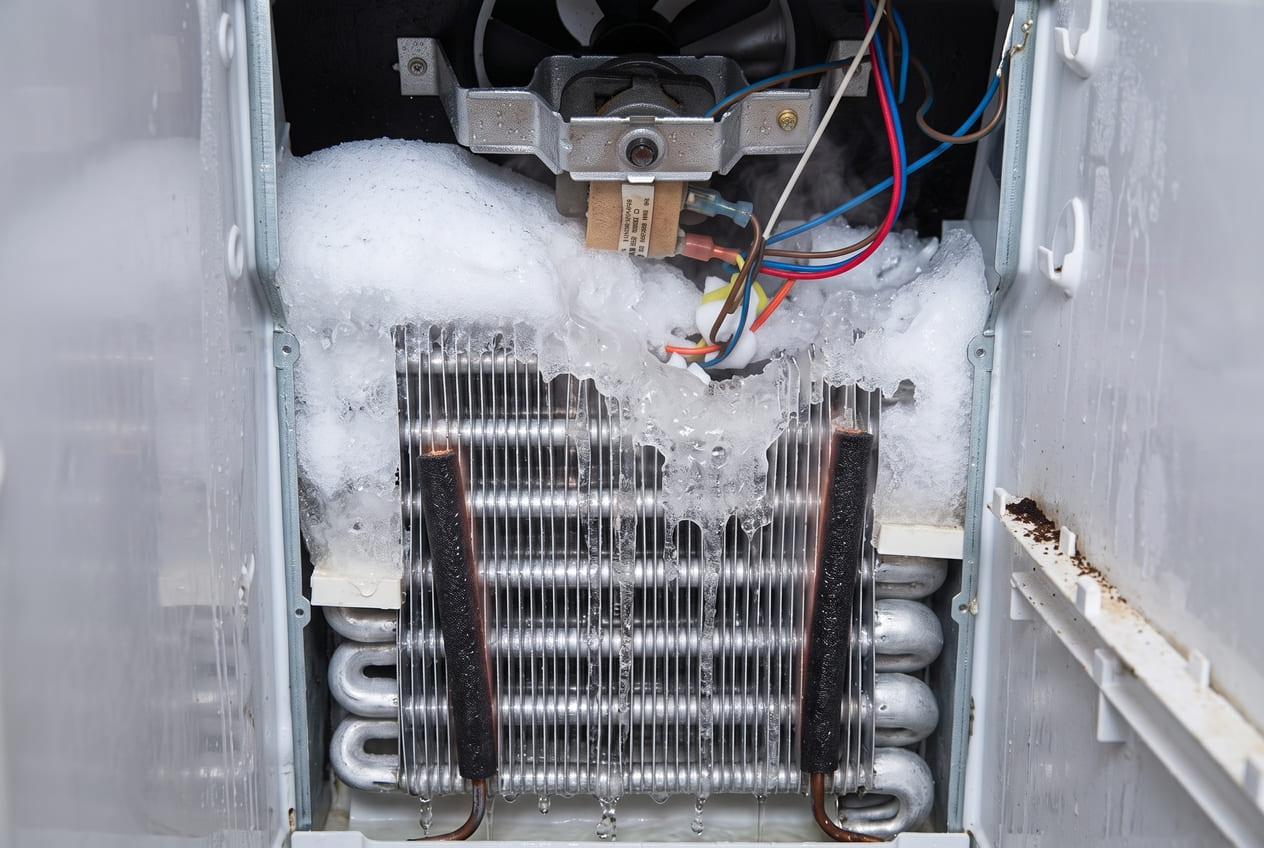
Five failure points we check on Amana cooling calls
- Defrost system ice buildup
What you notice: refrigerator gradually warms over days or weeks; freezer stays cold; fridge vents feel weak.
Technician check: inspect frost pattern, test defrost heater, thermostat/terminator, timer or board, and verify the airflow path after clearing ice.
2. Blocked air vents
What you notice: uneven cooling, frozen items near the vent, warm shelves away from vent, or overpacked food against the rear wall.
Technician check: confirm supply and return vents are open and airflow is balanced.
- Evaporator fan malfunction
What you notice: fridge warm, freezer cold, little or no airflow, fan noise absent or rough. Technician check: inspect blade, verify power to motor, and test motor operation safely.
- Damper stuck closed
What you notice: vents are visible in the fresh-food section but cold air does not enter. Technician check: inspect ice obstruction, actuator, control arm, and motorized damper function when the fridge calls for cooling.
- Start relay failure
What you notice: this usually belongs to the both-warm or clicking branch, not the classic freezer-cold branch.
Technician check: evaluate start relay, overload, capacitor if equipped, compressor behavior, and control voltage.
Six questions to answer before you call
1. Is the freezer cold? | Yes: freezer fine, fridge warm. No: both zones warm. Freezer also warms: compressor, relay, condenser, control, or sealed-system branch. |
2. Did the thaw test help? | Cooled again: defrost or ice blockage likely. Still warm: fan, damper, controls, blocked vent, start system, or deeper issue. |
3. Are the fridge vents blowing? | No airflow: fan or complete ice blockage. Weak airflow: partial ice blockage, blocked vents, or damper issue. Normal airflow: controls or temperature sensing may be involved. |
4. When did it start? | Gradual: defrost system ice buildup is common. Sudden overnight: fan, damper, power, controls, or start components move up the list. |
5. How old is the refrigerator? | Under 5 years: check warranty and repair options. 5 to 8 years: compare repair with replacement. Older units: we will be direct about repair value. |
6. Coils cleaned recently? | Dust, lint, and pet hair can make both zones run warm and keep the compressor hot. Coil location varies by model; check the manual before cleaning. |
Repair math for Amana refrigerator owners
Amana refrigerators often sit in a practical, value-focused price range, so the repair decision should be plain. A fan, damper, thermostat, or defrost repair usually makes sense when the cabinet is solid and the appliance is not near the end of its service life. Expensive sealed-system work deserves a sharper conversation.
Situation | Recommendation | Why |
Defrost heater, thermostat, timer, or board issue | Repair | Common airflow repair when the rest of the unit is sound. |
Evaporator fan motor failed | Repair | Single-part repair can restore airflow without replacing the appliance. |
Damper stuck or broken | Repair | Usually a focused airflow repair, sometimes caused by ice around the mechanism. |
Dirty condenser coils or condenser fan obstruction | Repair | Often a cleaning and airflow service, then verify temperatures. |
Compressor-start issue on newer unit | Check first | Could be relay/overload/capacitor/control rather than a full compressor replacement. |
Sealed-system restriction, refrigerant loss, or aging compressor | Call first | Requires EPA-certified refrigerant handling and a repair-vs-replace conversation. |
Atlanta Amana cooling scenarios we are built to diagnose
East Atlanta: gradual warm fridge Fridge at 58°F. Freezer holding 5°F. Cooling declined over two weeks. The thaw test restored cooling temporarily, which made defrost system ice buildup the leading suspect. Technician path: test heater, thermostat/terminator, timer or board, then clear the coil. | Smyrna: sudden warm refrigerator The fridge went warm overnight while the freezer stayed cold. A thaw did not restore cooling, so defrost was not the only issue. Technician path: verify evaporator fan operation and airflow to the fresh-food section. |
If both zones slightly warm
Compressor running continuously and hot. The pattern doesn’t match the cold-freezer/warm-fridge branch.
Technician path: inspect condenser airflow, coil load, condenser fan, start components, and actual temperatures.
BOTTOM LINE
The strongest clue is the pattern. Freezer cold and fridge warm usually means cold air isn’t reaching the fresh-food section. Both zones warm or a clicking compressor sends the diagnosis toward power, condenser airflow, start components, controls, compressor, or sealed-system work.
Call with the model number, symptom pattern, and thaw-test result if you ran it. We will tell you the smartest next move before you spend money on parts that may not fix the refrigerator.
FAQ
1. My fridge is warm but the freezer is cold. Is the compressor failing?
Usually, no. A cold freezer means the compressor and sealed system may still be doing their job. The problem often sits in the airflow path: defrost system ice buildup, blocked air vents, evaporator fan malfunction, or a damper stuck closed.
2. What is the 8-hour thaw test?
It is a no-tool screening test for hidden ice blockage. Unplug the refrigerator, open both doors, let frost melt for 8 to 12 hours, then restart and check the actual temperature after 24 hours. If cooling returns, defrost or ice blockage becomes likely, but the failed part still needs confirmation.
3. Can blocked air vents make the refrigerator warm?
Yes. Amana explains that cold air moves from the freezer into the refrigerator through vents, and blocked vents decrease airflow. Keep packages away from supply and return vents.
4. Where does relay failure fit?
Start relay failure usually shows up when both sections are warm, the compressor does not start, or the refrigerator clicks and cycles. It is not the first branch for a freezer-cold, fridge-warm complaint.
5. How often should condenser coils be cleaned?
It depends on the home and model. Dusty homes, kitchens with grease, and homes with pets may need more frequent cleaning. Coil location varies, so check the model manual before pulling panels or covers.